← The Vatican Museums🏛️ 1509–1511🌐 中文
The School of Athens
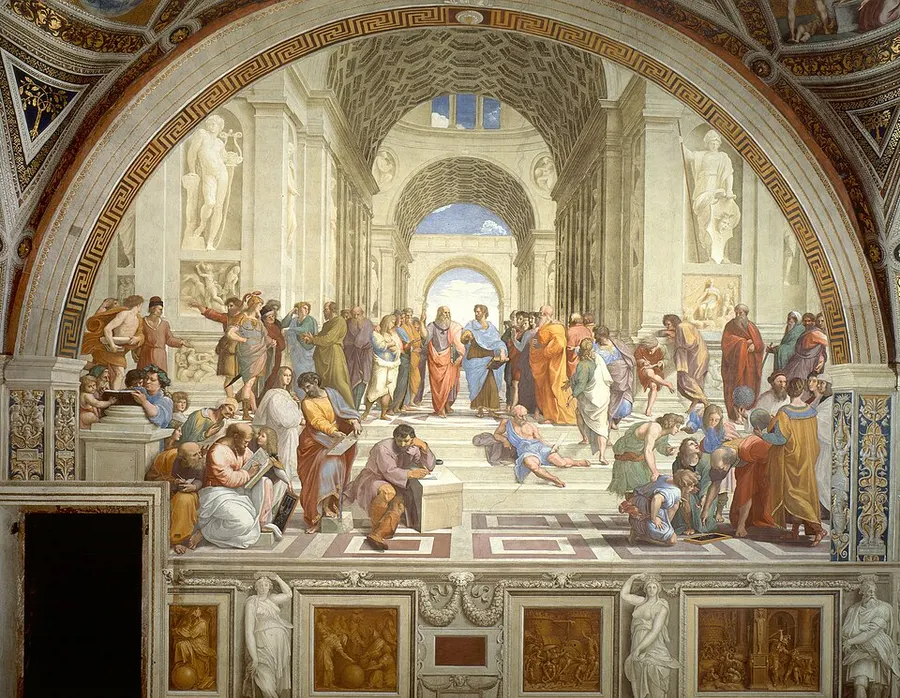
Fifty-odd Greek philosophers in one frame; at the center one points up, one presses down — two millennia of Plato versus Aristotle compressed into two hand gestures.
Where it livesThe Raphael Rooms · Stanza della Segnatura · On the route before the Sistine — follow signage
- ✨ Origin
Origin · A Pagan Temple in the Pope’s Study
Each wall of Julius II’s private study took a theme; "Philosophy" fell to the 26-year-old Raphael — who delivered a pantheon of reason.
In 1508 the warrior-pope Julius II decided to redecorate his new quarters — refusing to live under frescoes commissioned by his Borgia predecessor Alexander VI, unwilling, he said, to face the images of usurpers daily. The program for the new study (later the Stanza della Segnatura, where the highest papal tribunal signed its acts) was ambitious: four walls for the four provinces of the human spirit — Theology, Philosophy, Poetry, Law. The Disputa took the theology wall; facing it, on the wall of Philosophy, rose the School of Athens. To fill an entire wall of the pope’s study with pagan philosophers, face to face with Theology, was itself the humanist manifesto: reason and faith as two walls of a single sanctuary.
The painted setting is a colossal vaulted basilica — its architecture, by the standard reading, borrowed from Bramante’s contemporaneous design for new St Peter’s (Bramante was Raphael’s compatriot and sponsor); Apollo (art) and Athena (wisdom) stand in the niches. Fifty-odd thinkers each get their proper station: Socrates at left counting off arguments on his fingers; Diogenes sprawled alone on the steps — the Cynic antisocial even in paint; Pythagoras calculating at lower left; Euclid bending with his compasses at lower right (his features, by common identification, Bramante’s); at the right edge, beside Zoroaster and Ptolemy with their globes, Raphael painted himself — the young face looking straight out at you, his signature to posterity.
All the composition’s energy converges on the central pair: Plato (white-bearded, holding the Timaeus), index finger to the sky — truth dwells among the Forms; Aristotle (holding the Ethics), palm pressed downward — truth lives in experience. Two gestures, and the route map of twenty-five centuries of Western philosophy. Plato’s face is traditionally held to be Leonardo’s (recorded as tradition) — Raphael’s homage to the elder master, and the humanist creed written on the wall: our contemporaries are the ancients returned.
Connects to👼RaphaelArt HistoryThe 26-year-old painter — who set himself among the philosophers💡PlatoPhilosophyThe one pointing up — truth among the Forms📚AristotlePhilosophyThe one pressing down — truth in experience🕯️DiogenesPhilosophySprawled alone on the steps — antisocial even in paintSources: Vasari, Lives of the Artists · Studies of the decorative program of the Stanza della Segnatura · Traditional identifications of the figures (Plato as Leonardo da Vinci, etc., given by tradition)
- 🧭 Journey
Journey · The Ceiling Next Door Rewrote This Wall
From the last layerOnly because two geniuses were painting in the same palace at once could this through-the-wall dialogue happen — Heraclitus is the receipt of that stolen look.
Midway through, Raphael saw Michelangelo’s unfinished ceiling — and came back to add one figure to a wall he had already finished.
This wall’s most famous journey was not a relocation but a live revision. In 1510–11, a few dozen meters away, Michelangelo’s ceiling was rising in secret behind screens. By Vasari’s account, Bramante used one of Michelangelo’s absences from Rome to smuggle Raphael in for a look at the half-done vault — and the young painter was shaken by that new race of mighty, twisting bodies. Back in the Segnatura he added to the finished School of Athens, on the deliberately empty steps at front center, a figure absent from the full-scale preparatory cartoon that survives in Milan: a brooding solitary thinker, chin on hand — Heraclitus — whose sullen face and booted legs are by common consent Michelangelo’s own (the boots the very type he wore on the scaffold). Art history holds no more dignified concession of defeat: paint the rival who shook you into the dead center of your masterpiece.
For five centuries since, the wall has never left the room — yet it circulates worldwide as the visual byword for philosophy itself: opening image of countless textbooks, template for university murals, substrate of covers and memes; the up-finger/down-palm pair is the most widely transmitted shorthand image in the history of thought. A neat Vatican symmetry: the Creation of Adam came to stand for the instant of faith, the School of Athens for the temple of reason — each monopolizing one domain of the imagination.
It survived dangers too: the Napoleonic years stripped the Vatican of its movable treasures (the full story on our Laocoön and Apollo Belvedere pages), but frescoes cannot be carted off — immovability, for once, served as armor. The systematic restoration of the 1990s cleared the soot and mapped which passages are Raphael’s own hand and which his workshop’s — and the plaster patch beneath Heraclitus is physically distinct, material proof of the late insertion.
Connects to🗿MichelangeloArt HistoryThe rival next door, painted in as Heraclitus⛪Pope Julius IIArt HistoryThe pope employing both geniuses at once — patron of the duelSources: Vasari's account of Raphael peeking at the Sistine ceiling (noted as such) · The full-scale cartoon held at the Biblioteca Ambrosiana, Milan · Analysis of the plaster layers during the 1990s restoration
- 📍 Today
Today · Bring the Roster and Take Attendance
From the last layerIt has become philosophy’s global visual symbol — the textbook memories you bring are the ticket its five-century circulation issued you.
This wall is the family photo of our Philosophy universe — skim the roster first, and every face you recognize becomes an old friend.
Practical note: the Raphael Rooms sit on the forced march toward the Sistine, and the crowd flows — the column will push you forward. To look properly, step to the side and let the current pass behind you; this wall deserves five minutes against the stream. And one aside for conversation: this room was the pope’s private study and the signing chamber of his highest tribunal — where you now stand, you could not have entered for five centuries.
Take attendance in three difficulty tiers. Beginner: central Plato (finger up) and Aristotle (palm down) — confirm the two gestures first; then Diogenes, the only figure lying down. Intermediate: Pythagoras at lower left (a boy holds the slate of harmonic ratios for him); Euclid stooping with compasses at lower right (Bramante’s face); brooding Heraclitus at front center (Michelangelo’s face — check the boots). Advanced: the young face at the right edge meeting your eyes — Raphael himself, the only figure who looks at you; and beside him the turned figure and the globe-bearer, Ptolemy and Zoroaster, astronomy and astrology holding court together. Each figure you name, open his page in our Philosophy universe — this wall is that universe’s visual index.
The closing thread: in one palace the School of Athens (1509–11) and the Sistine ceiling (1508–12) rose almost month for month — the temple of reason and the epic of creation are two faces of a single moment, and the Last Judgment of twenty-five years later is that moment’s elegy. Read the three pages in the order Athens → Ceiling → Judgment and you have walked not three walls but the full arc of the Renaissance from noon to dusk. One last echo: the up-finger and the down-palm find an Eastern counterpart in our "Confucius vs Socrates" comparison page — philosophy in every civilization begins with a disagreement about where to look.
Sources: Vatican Museums display notes · Comparative studies identifying the figures