Ancient Greek Philosopher, Founder of Logic and of the Lyceum
The First to Ask the Right Question · Founders
LogicMetaphysicsEthics
Who they are
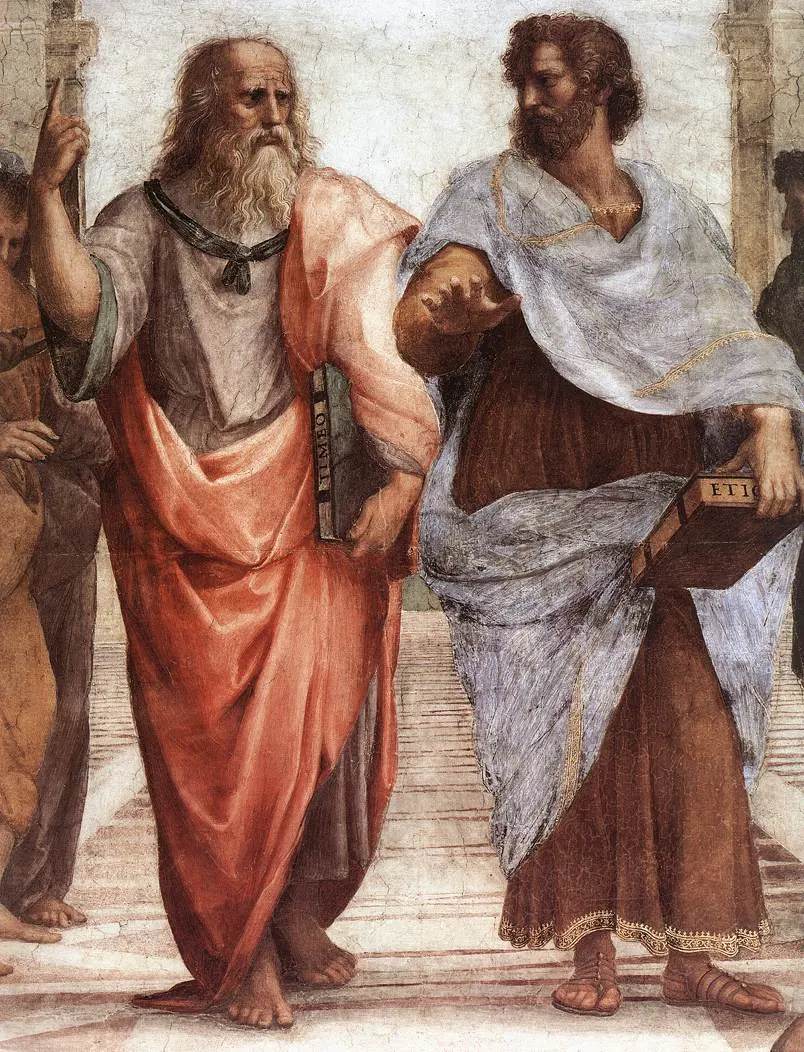
Aristotle (384–322 BC) was Plato’s most famous student, once the private tutor of Alexander the Great, and later founded the "Lyceum" in Athens. He differed from his teacher Plato on one fundamental point: Plato held that concrete things are copies of abstract Forms, and that the Forms alone are the primary reality; Aristotle held instead that form is inherent in concrete things themselves and cannot exist independently apart from individual things — a difference later summed up as "Plato points up, Aristotle points down" (from the composition of Raphael’s famous painting The School of Athens). He systematically founded formal logic (the syllogism), and his works cover nearly every field of knowledge then known — physics, biology, ethics, politics, poetics — earning him the name "the encyclopedic philosopher"; his system thereafter dominated the scholarly traditions of the Western and Islamic worlds for nearly two thousand years.
The School of Athens (detail) · Raphael, 1509–1511, the Vatican
Aristotle differed from his teacher Plato’s theory of Forms on many philosophical questions, and is said to have uttered the line "I love my teacher, but I love truth more" (though its exact wording is a later summary rather than a direct quotation from his works), vividly capturing his scholarly attitude of both respecting his teacher and holding to independent judgment.
The Origin of the Peripatetic School
Aristotle habitually paced among the colonnades of the Lyceum while lecturing his students on philosophy, and the school he founded thereby came to be called the "Peripatetic" school (from the Greek for "walking about"). This walk-and-discuss manner of teaching also reflects, from the side, his scholarly style of stressing observation and the accumulation of experience, distinct from the more abstract, speculative tradition of Plato’s Academy.
Below are how modern works borrow or reinterpret this name or story — not the original material. The two differ, so keep them apart.
Raphael’s School of AthensThe composition of Plato (pointing up) and Aristotle (palm down) standing side by side at the center of this public-domain painting is the most classic visual summary in Western art history of the two’s philosophical divergence.