🎨ArtArt History
🏠 Home🌐 中文
Art HistoryMASTERS
👼

Raphael

Original nameRaphael

One of the Renaissance "trinity," the embodiment of harmony and grace

Putting the Human Back at the Center · Renaissance & Baroque
PaintingMadonnasClassical Harmony

Who they are

Named with Leonardo and Michelangelo as the Renaissance "trinity," though far younger than the other two. He drew from all — Leonardo’s softness, Michelangelo’s force — fusing them into his own faultless harmony and grace. His Madonnas are gentle and serene, and his fresco The School of Athens gathers the philosophers of ancient Greece into a grand hall, the finest symbol of classical reason. He died young, at only thirty-seven.

Primary sourcesThe School of Athens (Vatican)The Sistine Madonna (Dresden)

Key stories

The School of Athens: Philosophers in One Room
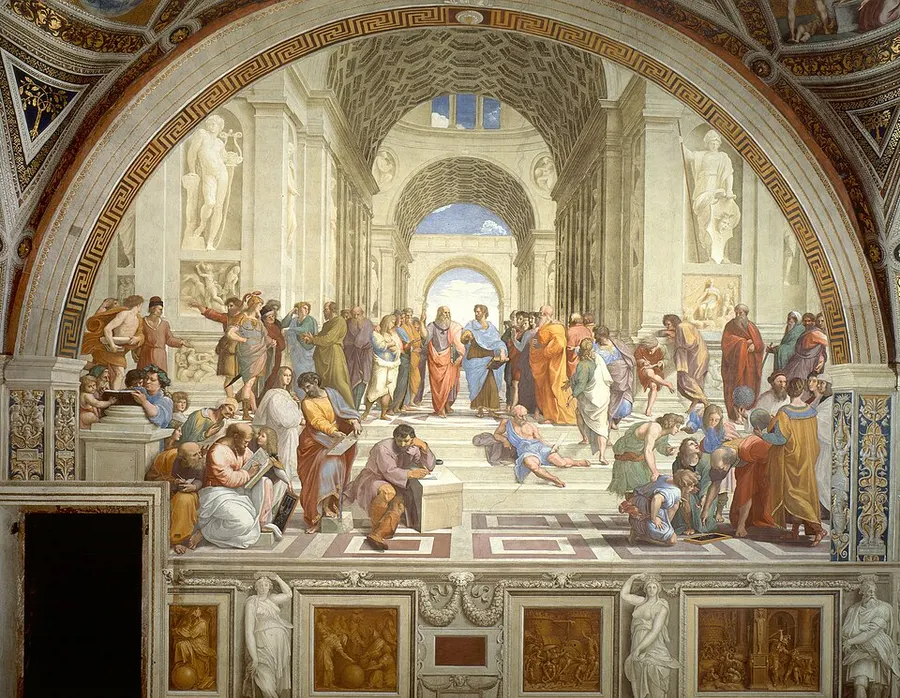
The School of Athens
The School of Athens · Raphael, 1509–1511, the Vatican

In the Vatican fresco The School of Athens, Raphael painted Plato, Aristotle, Socrates, Pythagoras, and other philosophers who spanned centuries and never shared a room, into a single grand vaulted hall — Plato pointing to the heavens, Aristotle gesturing to the earth, one asking of the ideal, the other of experience. With one painting, he took a "group photo" of the entire age of classical reason.

Relationships

Echoes today

Below are how modern works borrow or reinterpret this name or story — not the original material. The two differ, so keep them apart.

The cherubs at the foot of the Sistine MadonnaThe two chin-in-hand cherubs at the bottom of the painting, once cropped out, became one of the most popular decorative images in the world, seen on cards, packaging, and merchandise.

Appears in