🦉Thought & FaithPhilosophy
🏠 Home🌐 中文
PhilosophyAGORA

Socrates

Ancient Greek Philosopher, Founder of the "Socratic Method"

The First to Ask the Right Question · Founders
EthicsThe Socratic MethodAthenian Philosophy

Who they are

Socrates (c. 470–399 BC) was an ancient Greek philosopher who left no writings of his own; his thought comes down to us mainly through the dialogues of his student Plato. He professed to "know that he knew nothing," and habitually used a chain of questions (the "Socratic method") to expose the gaps behind an interlocutor’s seemingly certain beliefs, turning the focus of philosophy away from the questions of cosmic origin that had occupied the earlier natural philosophers and toward ethical questions such as "how one ought to live." He was condemned to death by an Athenian court on charges of "corrupting the youth and impiety toward the gods of the city," and though he could have fled into exile through an escape his friends had arranged, he chose to obey the verdict and drink the hemlock — a choice that was itself the most thoroughgoing practice of his philosophical stance.

Primary sourcesThe Platonic dialogues (Apology, Phaedo, etc.)Xenophon, Memorabilia

Key stories

"I Know That I Know Nothing"
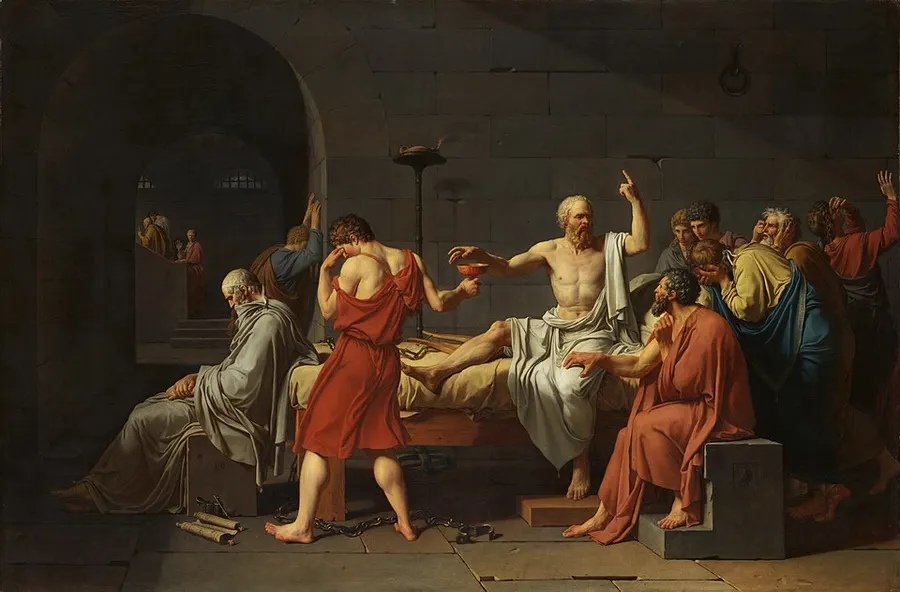
The Death of Socrates
The Death of Socrates · Jacques-Louis David, 1787, the Met

The Oracle at Delphi once declared Socrates the wisest man in Athens, and, baffled, he went about the city questioning the politicians, poets, and craftsmen who prided themselves on their learning, one by one, only to find that they in fact half-understood the very fields they claimed to master, without knowing it. Socrates thereby grasped that his own wisdom lay precisely in knowing clearly his own ignorance, while the others did not even know that much.

A Composed Death

After Socrates was condemned to death, his student Crito bribed the jailers to arrange his escape, but he refused to flee, holding that a citizen who enjoys the protection of the city’s laws should respect the law’s verdict, even one he thought unjust. In the deathbed scene recorded in the Phaedo he calmly discussed the immortality of the soul with his students and composedly drank the hemlock and died.

Version differences

Socrates left no writings of his own, and what we know as "Socratic thought" comes wholly through the relays of Plato, Xenophon, and others; moreover, the character "Socrates" in Plato’s dialogues gradually takes on more of Plato’s own theory of Forms as the dates of composition advance, and distinguishing "the historical Socrates" from "Plato’s Socrates" is the long-standing "Socratic problem" in scholarship.

Relationships

Disciple

Echoes today

Below are how modern works borrow or reinterpret this name or story — not the original material. The two differ, so keep them apart.

The "Socratic method" (a teaching method)The teaching method of guiding students to discover answers on their own through a chain of questions is still widely used in law-school education and courses in critical thinking.

Appears in

Curiosity mailCurious about world civilization? Leave your email — we’ll tell you when there’s something worth a look.

Free · unsubscribe anytime · Privacy