← The Vatican Museums🏹 c. AD 120–140 (Roman marble, conventionally after a Greek bronze)🌐 中文
The Apollo Belvedere
For three centuries it was "the most perfect statue in the world," and Winckelmann wrote aesthetics’ most famous eulogy to it — then taste turned, and it became a "cold copy." Taste, too, has a rise and fall.
Where it livesMuseo Pio-Clementino · The Octagonal Court · A niche near the Laocoön — follow signage
- ✨ Origin
Origin · The God Just After the Arrow
Apollo has just loosed the string — the statue seizes the second after majesty discharges: victory certain, wrath still cooling.
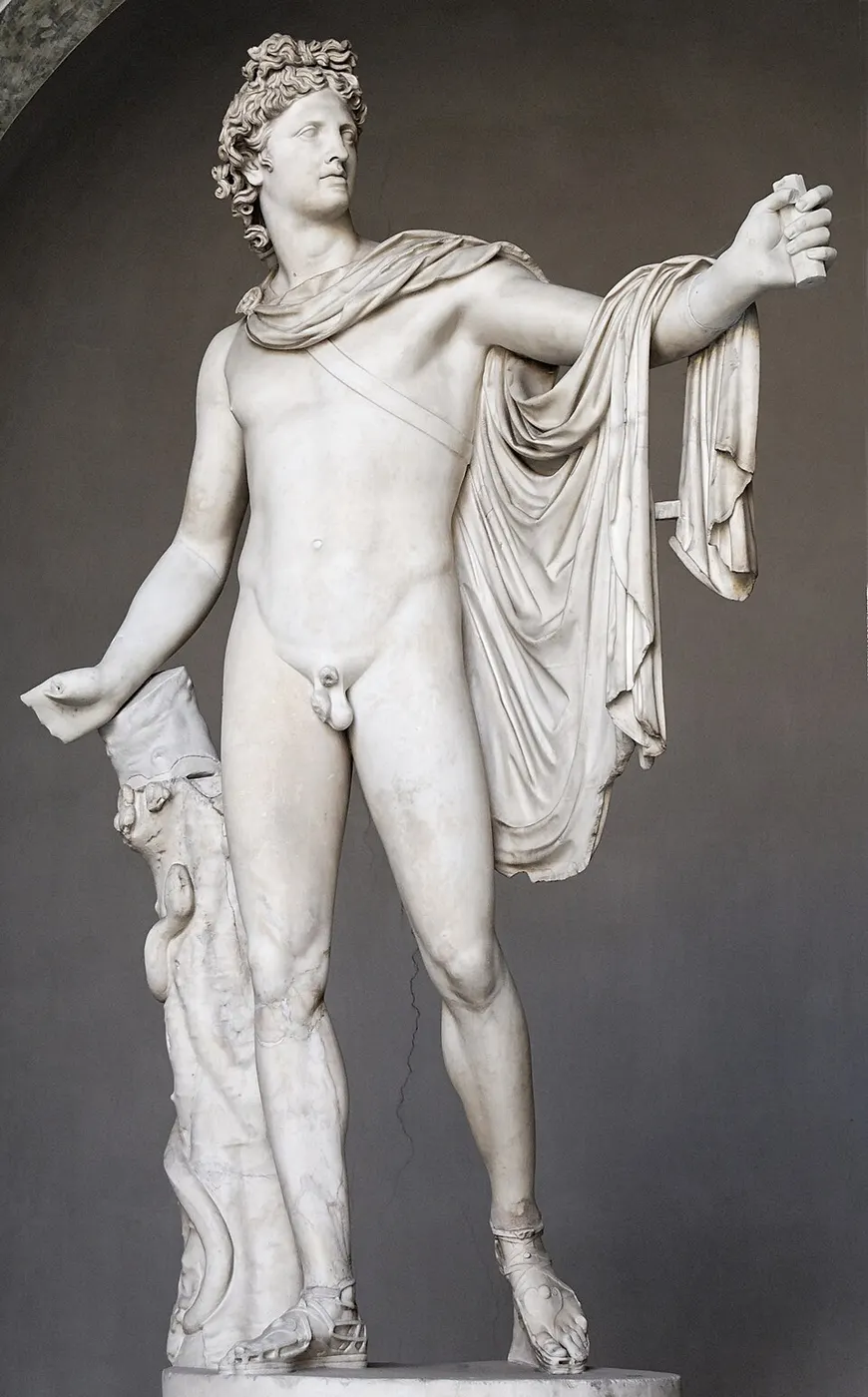
The Apollo has just released a fatal arrow — left arm extended (a bow once in hand), head turned proudly after the shot, cloak over the arm, the stance between striding and halting. At whom? Two readings coexist: the slaying of the serpent Python (the founding myth of Delphi), or a general chastisement of the profane. Either way the sculptor’s chosen instant is masterly: not the tension of the draw nor the violence of the hit, but the second after release — the force already gone from the string, nothing left on the god’s face but certainty. This beauty-of-the-aftermath answers the Laocoön’s agony-in-progress so exactly that no wonder one pope set them in a single courtyard.
The standard account makes it a marble of Hadrian’s era (c. AD 120–140) after — or adapting — a fourth-century BC Greek bronze in the manner of Leochares. But the attribution rests on style alone, no bronze original is attested, and some recent scholarship argues it may be a Roman creation outright: dating and authorship stand here as open, honestly flagged. Unearthed in Italy in the later fifteenth century (accounts of the site differ), it soon entered the collection of Cardinal Giuliano della Rovere — elected pope in 1503 as Julius II. He brought his private statue into the Vatican’s Belvedere courtyard, which gave it its name; with the Laocoön unearthed three years later, it formed the founding pair of the Vatican collections.
The missing left hand and right forearm were restored in the 1530s by Montorsoli, a collaborator of Michelangelo — one more Renaissance case of the restorer stepping into the frame: that age was not content to collect antiquity; it insisted on completing it by hand.
Connects to☀️ApolloGreek & RomanThe god himself, bowstring still humming — lord of light, archery and plague⛪Pope Julius IIArt HistoryThe pope who brought his private statue into the Vatican — founder of the Belvedere collectionSources: Pio-Clementino catalogue notes (dating and attribution disputed, noted as such) · Records of Montorsoli's restorations
- 🧭 Journey
Journey · The Throne and Abdication of Taste
From the last layerEnthroned as the very standard of ideal beauty, it was first to be toppled when taste revolted — the higher the throne, the louder the abdication.
A paragraph by Winckelmann enthroned it atop aesthetics; Napoleon claimed it with a parade — then the nineteenth century changed the wind.
Its second life was cast in prose. In 1764 Winckelmann, founder of art history as a discipline, crowned it in his History of Ancient Art as "the highest ideal of art among all the works of antiquity that escaped destruction" — a description that itself became the model of art-historical writing, and his program of Greek "noble simplicity and quiet grandeur" took this statue as supreme exhibit. For the next century Europe’s taste orbited it: Goethe made his Roman pilgrimage to see it; every academy owned a plaster cast, and young artists copied it as scripture; its profile stamped prints, reliefs and medals — it was, for that age, the very glyph of Beauty.
In 1797 Napoleon’s Treaty of Tolentino carted it with the Laocoön to Paris (the fuller story on our Laocoön page), where it reigned as the crown of the trophy system of the Musée Napoléon until its return in 1815. The abduction only confirmed the rank: when the conqueror inventoried what in Europe was most worth taking, it stood at the head of the list.
And then the throne fell — not to scandal, but to the turning of taste itself. From the mid-nineteenth century two currents pulled it down: the Parthenon marbles’ arrival in London confronted Europe for the first time with fifth-century Greek originals in all their carnal weight, and the halo of the "Roman copy" paled overnight; meanwhile Romanticism and then modernism converted "perfect, polished, ideal" from praise into accusation. Critics began to find it "cold," "sweet," "merely elegant." The same stone, not one atom altered, traveled in three centuries from highest ideal of art to textbook has-been — its journey a mirror that reflects not the statue but what each age wanted. Which is this site’s recurring lesson: looking is never neutral.
Sources: Winckelmann, History of the Art of Antiquity (1764) · Archives of the transfer under the Treaty of Tolentino and the 1815 restitution · Critical literature on the shift in taste during the nineteenth century
- 📍 Today
Today · Retry an Aesthetic Case With Your Own Eyes
From the last layerBoth reversals of taste happen off the wall label — the gallery gives you only the stone; the verdict is yours to draft.
Two beauties share one courtyard: the Laocoön’s struggle, then Apollo’s poise — and then ask yourself which side you take.
The Octagonal Court hands you a perfect experiment: Laocoön and Apollo stand steps apart. Feel first the grip of the Laocoön’s agony, then cross to the Apollo — the temperature drops, everything is the calm after release. The two statues are beauty’s two poles: one says beauty is intensity, the other that beauty is restraint. Three centuries ago Europe voted Apollo; a century and a half ago it switched its vote to the Laocoön line — now it is your turn. There is no correct ballot, but once cast, you will never walk a museum the same way.
Three close looks. ① The turn of the head: the face’s perfect symmetry deliberately broken by the turn — follow his gaze toward "where the arrow went" and you find yourself supplying the unseen target; a classic device by which sculpture conscripts the viewer’s imagination. ② The restorations: the left hand and right forearm differ faintly in tone and grain — Montorsoli’s work of the 1530s. Set against the Laocoön’s recovered original arm nearby, one courtyard displays restoration’s two endings: a wrong guess corrected by the original centuries later, and a guess that never met its original at all. ③ The cloak: draped over the extended arm, it balances the composition — and structurally props the marble cantilever. Behind ideal beauty, always engineering.
Onward on this site: the Apollo page in the Greek universe holds the god’s full dossier (Delphi, Python, light and plague as one); the Apollo Fountain page in our Versailles lens shows the same god drafted in the seventeenth century as the spokesman of kingship — from the Vatican’s ideal of beauty to Versailles’ embodiment of power, one god hired twice, the cleanest specimen of how each age requisitions its myths. Read all three and the name "Apollo" will carry a new weight in your ear.
Sources: Vatican Museums display notes