← The Vatican Museums🖐️ 1508–1512🌐 中文
The Sistine Chapel Ceiling
A sculptor who insisted he was no painter, pinned to a scaffold by a pope for four years — when he came down, the ceiling of Western painting had been nailed twenty meters up.
Where it livesThe Sistine Chapel · The chapel vault, some 20 meters up · The finale of the museum route — follow signage
- ✨ Origin
Origin · A Masterpiece Under Duress
He signed the contract "Michelangelo, sculptor" — convinced the commission was a rival’s trap. He painted his way out of the trap and into a throne.
In 1508 Michelangelo, thirty-three, was consumed by the tomb sculptures of Pope Julius II when the warrior-pope reassigned him: paint the vault of the chapel built by his uncle Sixtus IV. Michelangelo was appalled — he considered himself a sculptor, with almost no practical fresco experience; by the accounts of his biographers Condivi and Vasari, he took the commission for a trap laid by the architect Bramante to shame a sculptor in an art not his own (a partisan narrative, and flagged as such). His protest went into the contract signature itself: "Michelangelo, sculptor." A sonnet to a friend complains more vividly — paint dripping on his face, beard to heaven, belly pressed to chin: "I am not in the right place — I am not a painter."
Then the not-painter did three things. He dismissed the team of Florentine assistants early and executed the main scheme essentially alone — four years, over five hundred square meters, three hundred-odd figures. He discarded the pope’s pedestrian program of twelve apostles and invented his own: a sweep of Genesis from the separation of light and darkness to the drunkenness of Noah, nine central scenes ringed by prophets, sibyls and the ancestors of Christ — a sculptor treating the vault as one colossal frieze for the display of bodies. And he forged a language of his own: those twisting, straining, muscle-loaded figures (the ignudi above all) gave fresco the mass of marble. He was sculpting after all — in paint.
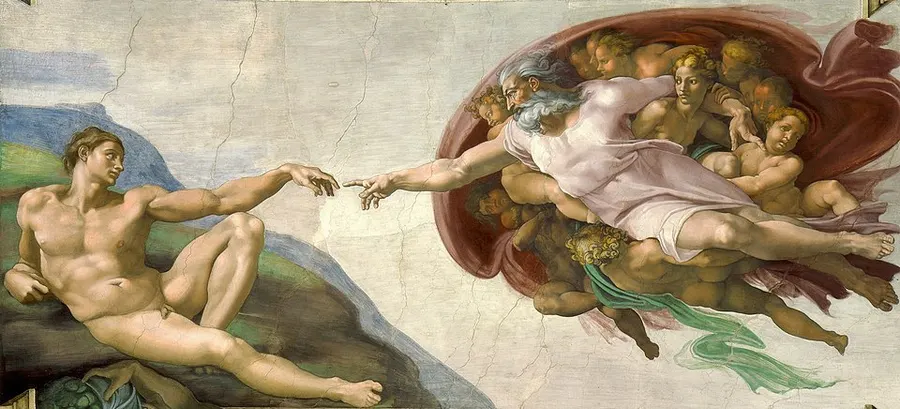
The most famous panel, the Creation of Adam, compresses the whole revolution: God no longer enthroned but storming through the void wrapped in angels; Adam languidly lifting a hand — and between two fingertips, a gap that never closes. The relation of God and man reduced to a touch about to happen: that gap is the Renaissance’s whole wager on the human — divinity extended to your fingertip; whether you take it is up to you.
Connects to🗿MichelangeloArt HistoryThe "not a painter" — sculpture executed in paint⛪Pope Julius IIArt HistoryThe warrior-pope who pinned him to the scaffold🌈NoahWorld FaithsThe vault’s closing scenes are his flood and his drunkennessSources: Condivi, Life of Michelangelo (a partisan account from Michelangelo's own camp, noted as such) · Vasari, Lives of the Artists · Michelangelo's sonnet to Giovanni da Pistoia
- 🧭 Journey
Journey · Five Centuries of Cleaning, and the War Over It
From the last layerBecause it is fresco painted in place and cannot move, its entire history happens on the surface — soot, cleaning and controversy are its provenance.
The ceiling never moved — what traveled was its color: four centuries of candle soot, then a 1980s cleaning whose brightness startled the world.
For an immovable masterpiece, fate is written on the surface. Through more than four centuries of daily use — candle and lamp smoke, incense, damp, and successive crude "maintenance" campaigns (bread, wine, even glue-soaked sponges) — the vault acquired glaze upon glaze of brown. By the twentieth century the world’s Michelangelo was a somber master of drawing and mass, and a large literature of art history rested on that layer of soot.
Between 1980 and 1994 the Vatican undertook the most watched and most contested restoration in the history of art, removing centuries of grime and old retouching centimeter by centimeter. What emerged scandalized the field — pomegranate reds, apple greens, bright yellows, violets: Michelangelo turned out to be a blazing colorist. The controversy detonated at once: supporters held this was the true face of 1512; critics — prominent artists and scholars among them — charged that the cleaning had stripped the painter’s final dry-brush shadowing (the a secco finish) along with the dirt: "we gained the color and lost the shadows." The debate has never fully closed, and in this site’s custom both cases stand here side by side: the brilliance you see reflects the restorers’ rigorously tested conclusions, while "did they go too far" remains an open question of art history. In passing: the restoration was financed by Japan’s NTV in exchange for exclusive film rights — an immovable object still travels, in the modern currencies of sponsorship and copyright.
The other invisible journey is the right to look: in five centuries the chapel passed from an elite liturgical preserve to a public sanctum where millions queue and crane each year — while remaining a working religious space. Papal conclaves are held beneath this very vault; when black or white smoke rises from the chimney, Genesis hangs above the cardinals’ heads. Art, faith and the transfer of power under one roof: there is no second example on earth.
Sources: Archives of the 1980–1994 restoration (sponsored by NTV) · Literature on the restoration controversy (both sides presented)
- 📍 Today
Today · Reading It Amid the Crush and the Hush
From the last layerThe restoration decides the colors you see; its rights deal decides that you cannot photograph them — five centuries of provenance reaching right down to your raised phone.
In a hall of no-photos and enforced hush, set yourself three targets: one gap, one prophet, one ring of nudes.
Manage expectations first: the Sistine is the finale of the museum route; you will share the hall with hundreds while guards loop "Silenzio! No photo!" (photography is banned — officially tied to the restoration sponsor’s exclusive rights, and to conservation and order). Your neck-craning window in the crush is often only ten-odd minutes, so a plan beats extra time. Don’t hunt the Creation of Adam first: read the narrative direction. Michelangelo began at the Drunkenness of Noah end and grew bolder as he went — compare the two ends and you can see, with the naked eye, four years of evolution: figures larger, compositions simpler, the hand fiercer. Hidden on the vault is a time-lapse of a painter teaching himself.
Then the three targets. ① The gap: between the two fingers of the Creation of Adam — smaller in person than any reproduction, and more staggering; note too the angel-packed mantle around God (modern viewers see a brain section or a womb — later readings, filed here as such). ② One prophet: Jonah, painted on the brutal curve directly above the altar, his backward-tilting body defying the concave surface yet fooling every eye — Vasari called it the vault’s technical summit. ③ The ring of ignudi: twenty nude youths framing the scenes, unrelated to the story, bodies for the sake of bodies — the sculptor’s contraband, and a manifesto seating the human beside scripture.
Keep one last minute for the whole: imagine 31 October 1512, Romans looking up at these five hundred square meters for the first time. To continue on this site: the altar wall beneath the same roof holds the Last Judgment, painted twenty-five years later (own page) — same man, same room, from creation to doomsday; a few rooms away hangs Raphael’s School of Athens of the very same years (own page) — two geniuses dueling through a wall. Read the three pages together and you have read the High Renaissance at its peak.
Sources: Vatican Museums visitor rules · Vasari's comments on the figure of Jonah