🦉Thought & FaithPhilosophy
🏠 Home🌐 中文
PhilosophyAGORA
💡

Plato

Ancient Greek Philosopher, Proposer of the Theory of Forms, Founder of the Academy

The First to Ask the Right Question · Founders
The Theory of FormsThe AcademyThe Republic

Who they are

Plato (c. 427–347 BC) was Socrates’s most important student and founded the "Academy" in Athens, the first organized institution of higher learning in Western history, which endured for nearly nine hundred years until it was ordered closed by the Byzantine emperor Justinian in AD 529. Nearly all his works are written as dialogues, with Socrates often as the main speaker — which also makes distinguishing "Socrates’s own thought" from "the thought Plato expressed through Socrates’s mouth" a long-standing scholarly difficulty in Plato studies. His "theory of Forms" holds that the concrete things our senses reach are only imperfect copies of higher, eternal, unchanging "Forms" — a conception that profoundly shaped the Western metaphysical tradition of the next two thousand years, of which Whitehead once remarked that "the whole history of Western philosophy is but a series of footnotes to Plato."

Primary sourcesThe Platonic dialogues (Republic, Symposium, Phaedo, etc.)

Key stories

The Allegory of the Cave
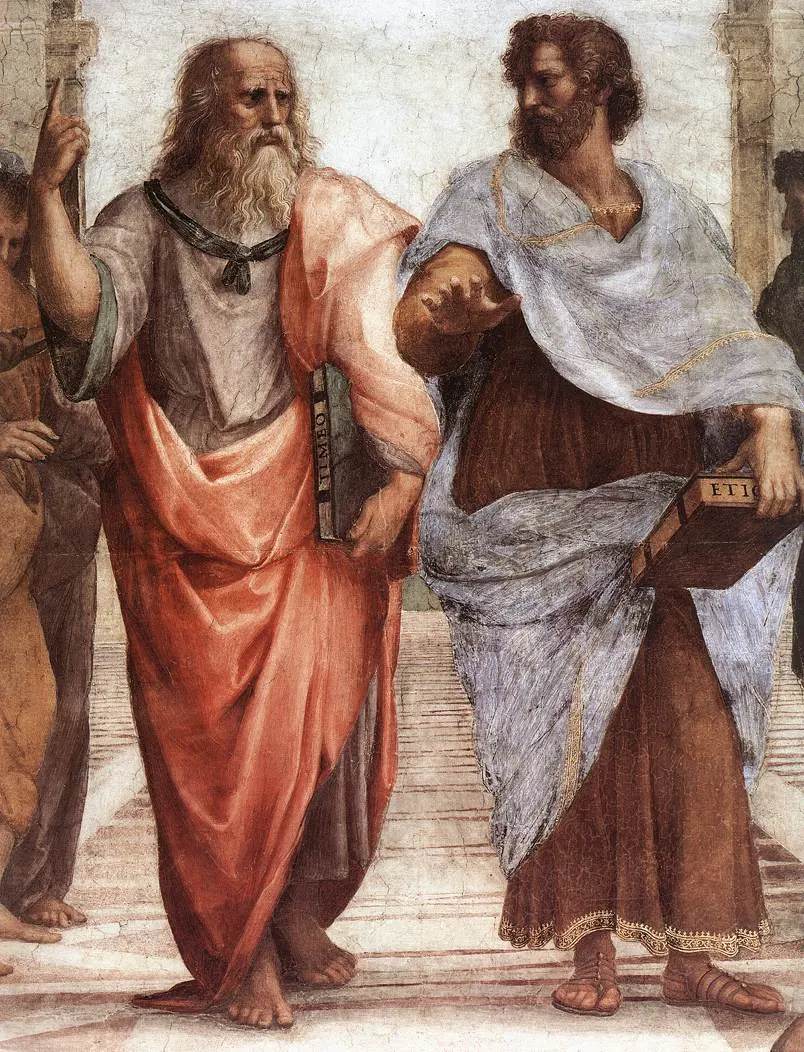
The School of Athens (detail)
The School of Athens (detail) · Raphael, 1509–1511, the Vatican

In the Republic Plato tells a parable: a group of people are chained in a cave from childhood, able to see only the shadows flickering on the wall, mistaking the shadows for the real world. Should one break free and leave the cave to see the real things in the sunlight, then return to tell the others the truth, he would instead be taken for mad by his companions. This parable vividly conveys his core stance that "the world of the senses is only a copy of the world of Forms, yet most people mistake the copy for the real."

The Conception of the Philosopher-King

In the Republic Plato held that only a philosopher who has truly grasped "the Form of the Good" is fit to rule the city — "unless philosophers become kings, or kings truly take up philosophy… the ills of the city will not cease" — and this conception of the "philosopher-king" long stirred debate over the relationship between philosophy and political power.

Relationships

Echoes today

Below are how modern works borrow or reinterpret this name or story — not the original material. The two differ, so keep them apart.

"Platonic love" (an idiom)In the modern context it often means a purely spiritual love without a physical relationship; the intellectual source of the phrase is precisely the "ladder of love" theory told by Diotima in the Symposium, but its sense has been greatly simplified by later ages.
The contemporary citation of the Allegory of the CaveThe "Allegory of the Cave" is still a classic metaphor for discussing how media and ideology shape mass cognition, common in media-literacy and critical-thinking education.

Appears in

Curiosity mailCurious about world civilization? Leave your email — we’ll tell you when there’s something worth a look.

Free · unsubscribe anytime · Privacy