← The Vatican Museums🌄 1516–1520🌐 中文
The Transfiguration
Raphael’s last painting: he died on his thirty-seventh birthday, and the unfinished canvas was set at the head of his bier — for the next three centuries Europe called it the greatest painting in the world.
Where it livesThe Pinacoteca · The Raphael room of the Pinacoteca · Room VIII — follow signage
- ✨ Origin
Origin · An Entry in a Duel of Geniuses
A cardinal commissioned rival altarpieces from Raphael and Michelangelo’s camp — Raphael staked everything, stacking two Gospel scenes onto one panel.
In 1516 Cardinal Giulio de’ Medici — the future Pope Clement VII — commissioned altarpieces for Narbonne cathedral, and played a patron’s masterstroke: the same commission twice, one to Raphael, one to Sebastiano del Piombo. Behind Sebastiano stood Michelangelo, supplying drawings — Raphael’s great Vatican rival (see the stolen look at the ceiling on our School of Athens page). This was no ordinary order; it was a public duel between the two camps of Roman art.
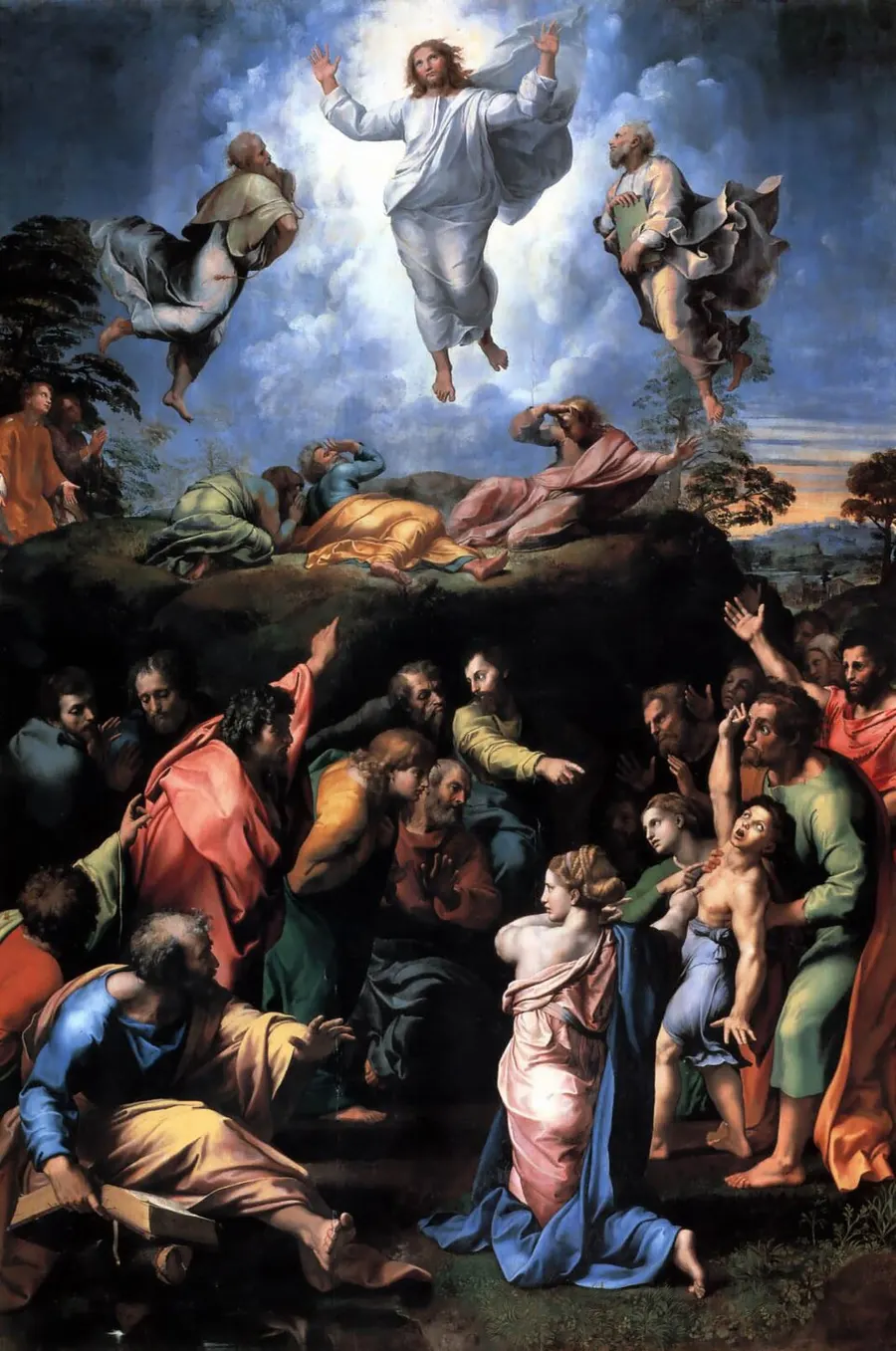
Raphael’s answer broke the rules of the icon. The traditional Transfiguration shows only the radiant moment: Christ transfigured on Mount Tabor, garments white as light, Moses and Elijah at his sides (Moses has his own page in our Religions universe). Raphael forced the Gospel’s very next scene into the lower half of the same panel: at the mountain’s foot, the disciples stand helpless before a boy convulsed by a "demon" — the twisted body, the rolled eyes, a chaos of pointing hands. Above, vertical light and stillness; below, horizontal darkness and tumult; and joining the two worlds, the hands at the center pointing up the mountain — human helplessness aimed at its single answer. Theology and drama compressed into one architecture: the least graceful, most ambitious gamble at the close of a career defined by grace.
On 6 April 1520 Raphael died suddenly — on his thirty-seventh birthday, by Vasari’s account (the born-and-died-same-day tradition rests on Vasari). The painting was nearly finished; passages below were completed by his chief pupil Giulio Romano and the workshop (the exact division remains debated). At the funeral the canvas stood at the head of the bier for all Rome to see. Vasari wrote that the sight of the living Christ in the picture above the dead Raphael on the bier "made every heart break." The painting’s premiere was its painter’s funeral.
Connects to👼RaphaelArt HistoryDead at thirty-seven — this canvas stood at the head of his bier🗿MichelangeloArt HistoryThe unseen hand of the rival entry in the duel✝️JesusWorld FaithsTransfigured and rising in the upper halfSources: Vasari, Lives of the Artists (the account that Raphael was born and died on the same date, and of the funeral, noted as such) · Archives of the twin Narbonne commission · Studies of the division of labour in the workshop (disputed)
- 🧭 Journey
Journey · Three Centuries as "the Greatest Painting in the World"
From the last layerThe funeral made it legend — and every power since, church, empire and museum, has wanted it for a crown.
From bier to altar, from Napoleon’s trophy convoy to the Vatican Pinacoteca — every station measured what Europe meant by "greatest."
After the funeral the cardinal could not bear to ship it to France: the painting stayed in Rome, and from 1523 stood over the high altar of San Pietro in Montorio. For nearly three centuries it then held the top seat of Europe’s artistic league table — from cinquecento treatises to eighteenth-century travel journals, the title "greatest painting in the world" was conferred on it almost by formula, and copying it was the core rite of every northern painter’s Roman pilgrimage. Today’s visitor assumes greatest = Mona Lisa; but before the 1911 theft re-ranked the canon (see our Louvre lens), Europe’s answer for three hundred years was this Transfiguration. The office of "greatest painting" is itself a history of taste.
In 1797 it duly joined Napoleon’s requisition list: after the Treaty of Tolentino it traveled in the same convoy as the Laocoön and the Apollo Belvedere (both told on this site) and reigned eighteen years as the crown of paintings at the Musée Napoléon — the parade that welcomed it marched under the slogan that what Rome no longer had, Paris now possessed. Returned after Waterloo through Canova’s restitution mission, it was kept by Pius VII for the newly organized Vatican Pinacoteca rather than its old church — trading altar candles for the spotlights of art history: from icon to masterpiece.
A systematic restoration in the 1970s lifted centuries of varnish and overpaint, confirming the great majority of the surface as Raphael’s own hand and restoring the original sharpness of the upper-lower contrast. Today it holds a room of its own, facing the door — the Pinacoteca writing "crown jewel" directly into its floor plan.
Sources: Records of its enshrinement at San Pietro in Montorio · Display archives of the Musée Napoléon and records of the 1815 restitution · 1970s restoration report
- 📍 Today
Today · The Duel’s Curtain Call at the End of the Gallery
From the last layerThe turn from altar to gallery recast it from something prayed to into something looked at — your gaze, right now, is the whole of its current office.
Most visitors bolt for the Sistine and skip the Pinacoteca — make the detour: you will have the three-century champion’s farewell almost to yourself.
Practical note: the Pinacoteca lies off the museums’ main conveyor — you must choose the turn. That is exactly why, while the Sistine seethes, this room is often quiet enough to hear footsteps. The detour pays beyond the one painting: Room VIII also holds Raphael’s early Coronation of the Virgin and his tapestry cartoons — one room, one lifetime.
Read the canvas in three passes. ① The two worlds: stand back until the upper light and lower darkness enter your eye together — and notice how your gaze drops first into the tumult below, then is pushed uphill by the pointing hands: Raphael directing your eyes along the theological route from predicament to answer. ② The boy: the convulsed child at lower right is the painting’s boldest passage — a pose so close to clinical record that modern medical writers have used it to discuss the historical depiction of epilepsy, set in stinging contrast against the idealized faces around it. The most graceful painter of the Renaissance spent his last strength on the least graceful truth. ③ The unfinished margins: passages below run slightly stiff — the workshop’s finishing hand; hunting the faces that are "not quite Raphael" is a live connoisseurship lesson (scholars still disagree on the division, so your verdict competes honestly with theirs).
The site’s threads close the drama: the School of Athens page is Raphael’s opening at full noon, this page his abrupt curtain; his rival’s two Sistine pages — Ceiling and Judgment — form the mirrored life: twelve years of dueling in one city, one dead at his height and buried in the Pantheon, the other living to eighty-nine to paint the end of the world. For the religious thread, return to the Religions universe: Moses, who appears beside Christ on the mountain, and the wider grammar of miracle and healing. Leave the museums with this room in your memory and "Renaissance" will mean more than the crowded ceiling — it will include a quiet gallery where a three-century championship opened with a funeral.
Sources: Vatican Pinacoteca display notes · Medical-history discussion of the depiction of epilepsy (given as the view of modern commentators)