Emperor of the First French Empire, a Turning-Point Figure of Modern European History
Those Who Drew the Lines on the Map · Founders & Monarchs
The French RevolutionThe Napoleonic WarsThe First French Empire
Who they are
Napoleon Bonaparte (1769–1821) was born on Corsica and, by military talent, rose swiftly amid the turmoil of the French Revolution, seizing power by coup in 1799 and crowning himself Emperor of the French in 1804. The wars he then led swept across Europe, redrawing the political map of the continent and exporting the French Revolution’s ideals of "liberty and equality" — along with his own absolute rule — to occupied lands. His disastrous 1812 campaign against Russia was the turning point of his fortunes, and in 1815 he was utterly defeated at Waterloo by an Anglo-Prussian coalition and finally died in exile on St. Helena. Many civil-law principles established in his Napoleonic Code still influence the legal systems of several European nations.
Primary sourcesNapoleon, Memoirs of St. HelenaThe text of the Napoleonic CodeContemporary military archives
Key stories
The Coup of Brumaire
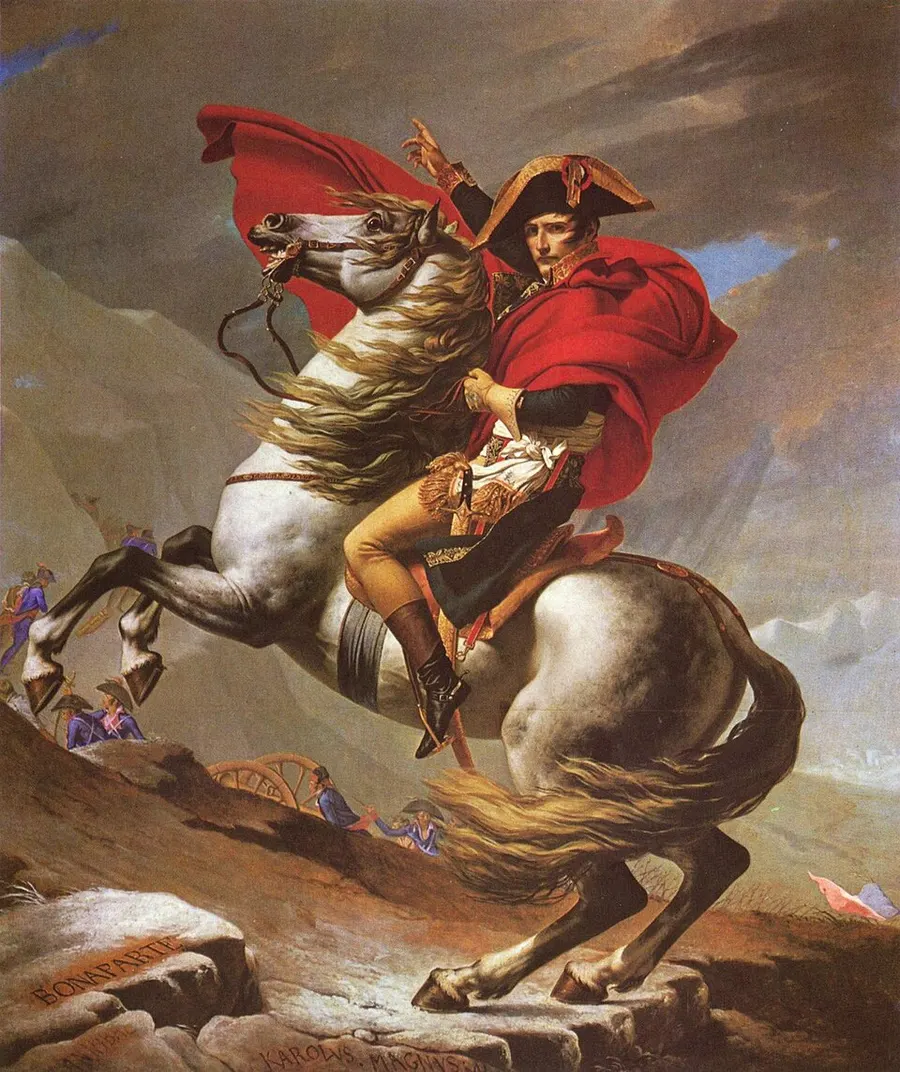
Napoleon Crossing the Alps · Jacques-Louis David, 1801
In November 1799 (the month of "Brumaire" in the French Revolutionary calendar), Napoleon seized the moment when the Directory’s rule was tottering to launch a coup, overthrowing it and setting up a new government with himself as First Consul, in effect ending the Revolution’s republican experiment and paving the way for his coronation as emperor five years later.
The Rout at Moscow
In 1812 Napoleon led a "Grande Armée" said to number 600,000 against Russia, driving deep to take Moscow, but the Russians pursued scorched earth, burning the city and refusing a decisive battle. When deep winter came, the French army lost heavily to hunger, cold, disease, and Cossack raids on the long retreat, with only some thirty thousand surviving — a defeat widely seen as the turning of his empire from ascent to decline.
Below are how modern works borrow or reinterpret this name or story — not the original material. The two differ, so keep them apart.
"Waterloo" (an idiom)In modern English and many languages "meet one’s Waterloo" has become a fixed idiom for "suffering a decisive defeat," derived directly from this battle.
The modern influence of the Napoleonic CodeThe principles of civil law it established are still an important source of the modern civil-law systems of France and of regions earlier shaped by it (such as Belgium, Luxembourg, and Louisiana).