NameJesus of NazarethHonorificChrist (meaning "the anointed")
The Central Figure of the Christian Faith
Where the Faith Begins · Founding Prophets & Central Figures
ChristianityRedemptionThe Sermon on the Mount
Who they are
The Christian New Testament records that Jesus was born in Bethlehem and grew up in Nazareth, began to preach around the age of thirty proclaiming that "the kingdom of heaven is near," became known for the Sermon on the Mount, parables, and healing miracles, and was crucified by the Roman authorities in Jerusalem. Christian tradition holds that he is the "Son of God" and rose on the third day — this core belief is the key point that sets Christianity apart from the other Abrahamic religions. This card presents Christianity’s own understanding as recorded in the New Testament, and makes no inter-religious adjudication of truth.
Primary sourcesThe New Testament, the four Gospels (Matthew, Mark, Luke, John)The Letters of Paul
Key stories
The Sermon on the Mount
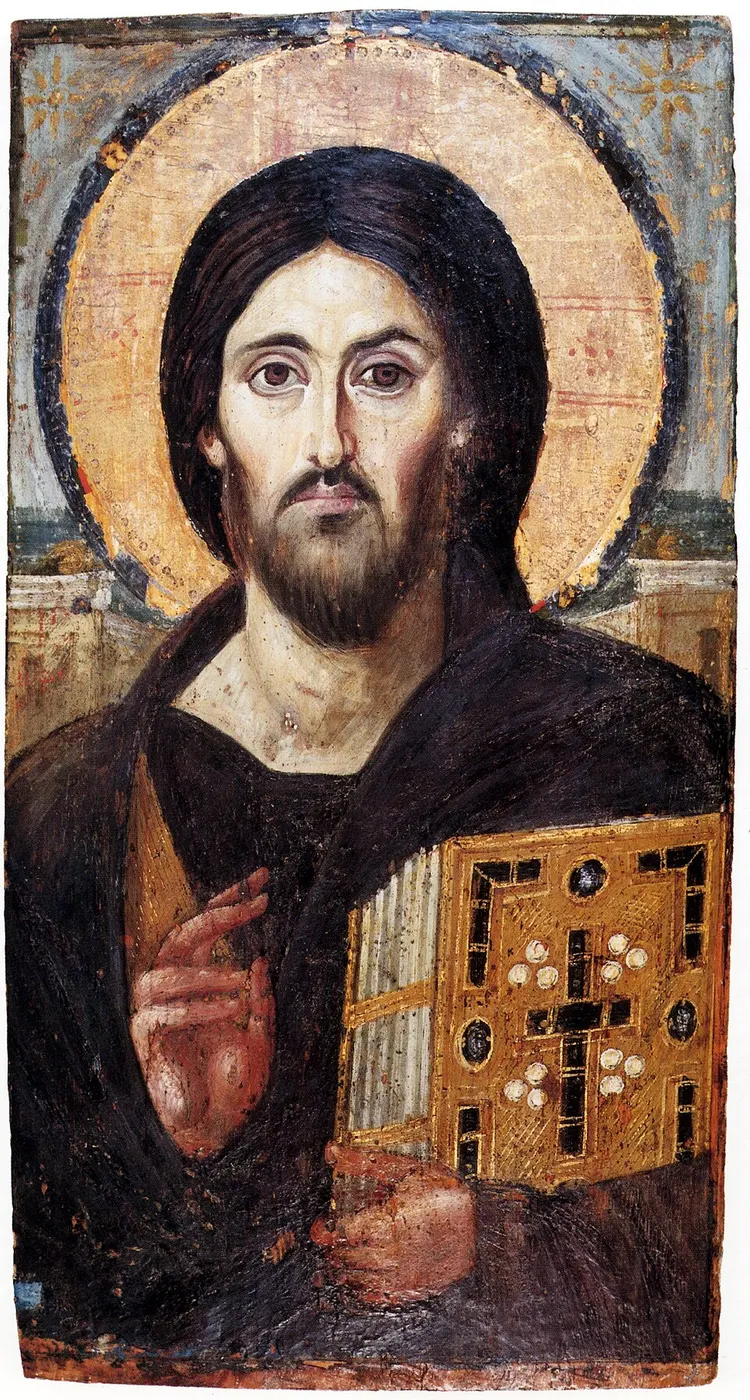
Christ Pantocrator of Sinai · 6th century, Saint Catherine’s Monastery
According to the Gospel of Matthew, Jesus preached to the crowds on a mountain, leaving teachings such as "blessed are the poor in spirit," "love your enemies," and "seek first his kingdom and his righteousness," collectively called the "Sermon on the Mount" — among the most cited passages in Christian ethical teaching.
The Last Supper and the Arrest
On the eve of Passover, Jesus shared a supper with his twelve disciples, foretold that one of them would betray him, and gave them bread and a cup, saying these were "my body" and "my blood" — the scene that became the origin of the Christian rite of the Eucharist. After supper he prayed in the Garden of Gethsemane, and his disciple Judas brought men to identify and arrest him.
The Cross and the Resurrection
Jesus was sentenced to crucifixion by Pontius Pilate, the Roman governor of Judea; the New Testament records that he rose on the third day after his death, appeared to his disciples, and then "ascended." This event is the core of the Christian faith — as Paul wrote in his letters, "if Christ has not been raised, our preaching is in vain."
Version differences
Within Christianity, the formulation of the relation of Jesus’ "divinity and humanity" has occasioned repeated debates at ecumenical councils (such as the Council of Nicaea in 325), and Catholicism, Protestantism, and Eastern Orthodoxy differ subtly in their specific formulations of the Trinity, though all hold Jesus to be the core of the Christian faith. Islam honors Jesus (Isa) as an important prophet but does not hold him to be the Son of God, nor accept the crucifixion — a key point of doctrinal difference between the two faiths, which this site does not adjudicate, stating only each side’s position.
Below are how modern works borrow or reinterpret this name or story — not the original material. The two differ, so keep them apart.
"To bear one’s cross" (idiom)From Jesus bearing the cross to the place of execution before his death, now used in both English and Chinese for shouldering great suffering or responsibility, at a distance from the original religious context.
Leonardo da Vinci’s The Last SupperA public-domain masterpiece depicting Jesus and the twelve disciples at the Passover supper as he announces his coming betrayal, one of the most reproduced compositions in Western art history.