← The Vatican Museums⚡ 1536–1541🌐 中文
The Last Judgment
Twenty-five years after painting Creation, Michelangelo returned to the same room to paint the end of the world — with the Sack of Rome and the Reformation in between, the optimism was gone; what remained was a storm of flesh.
Where it livesThe Sistine Chapel · The entire altar wall · Directly beneath the ceiling — follow signage
- ✨ Origin
Origin · A Second Scaffold in a Changed World
The ceiling asked what man might become; this wall answers what man must face — with a catastrophe in between.
The key to this wall is the dates. The ceiling was finished in 1512, high noon of the Renaissance; in the twenty-five years that followed, Luther posted his theses (1517) and Christendom split, and in 1527 the emperor’s mercenaries put Rome to the sword — the Sack of Rome — while the pope watched from Castel Sant’Angelo. Renaissance optimism effectively died in that massacre. In 1534 the new pope Paul III recalled Michelangelo, now around sixty, to the Sistine — and this time the subject was not the beginning but the end. For this wall two windows were bricked up, Perugino’s frescoes chiseled away, and two lunettes of the ceiling itself sacrificed: Michelangelo painted over his own younger self.
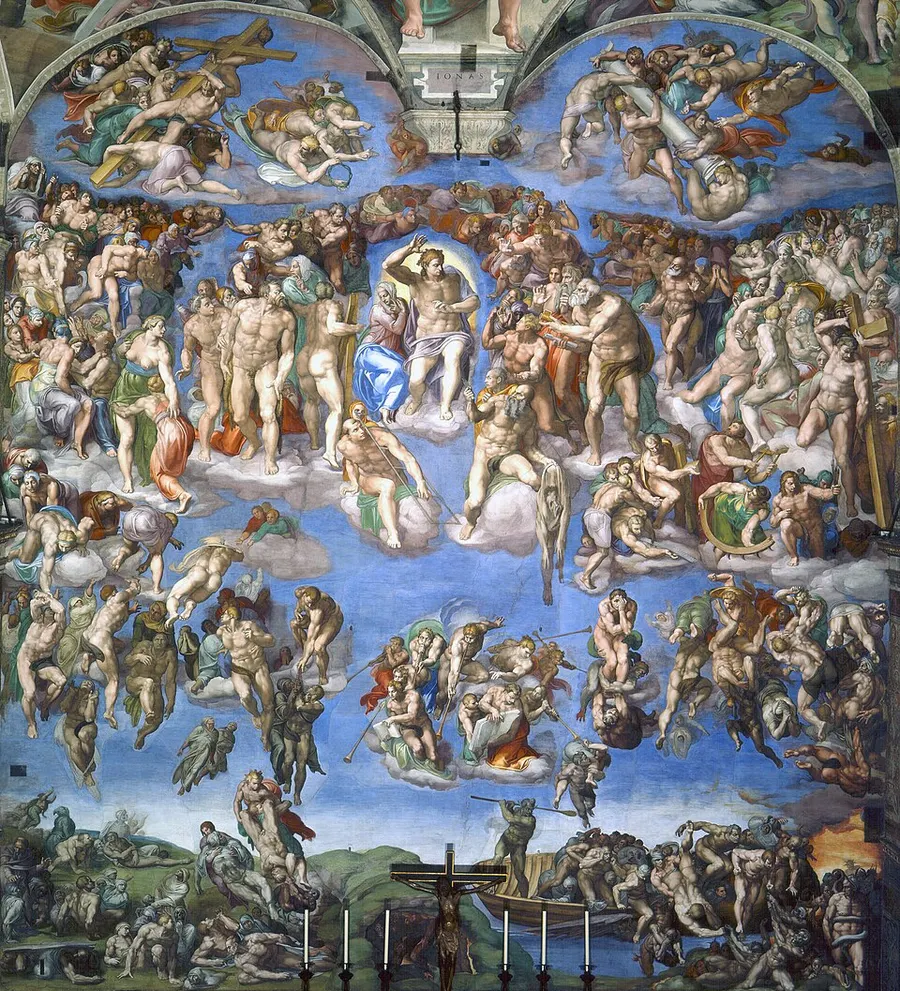
The unveiling of 1541 stunned everyone: some four hundred figures churning in a frameless, horizonless cobalt void. The central Christ is no bearded elder on a tribunal but a beardless, massive young athlete, arm rising toward the blow — and at that instant the saved ascend along his right arm as the damned pour down along his left, the whole wall turning like a vast wheel set in motion. The Virgin shrinks beneath his arm, face averted. The most piercing smuggled detail hangs at Christ’s lower right: the martyr St Bartholomew holding his own flayed skin — and the face on that skin is, by the standard scholarly reading, Michelangelo’s self-portrait. At the dead center of doomsday, the painter hung himself as an empty husk, suspended between salvation and the fall.
The scandal was immediate. The papal master of ceremonies, Biagio da Cesena, declared the wall of nudes fit "for bathhouses and taverns, not the pope’s chapel" — and Michelangelo answered by painting him into hell: the donkey-eared, serpent-wrapped judge Minos in the lower right wears Cesena’s face. Vasari records the pope’s reply to Cesena’s complaint: had you been put in purgatory I might have freed you; from hell, even a pope has no power. (Anecdote per Vasari, flagged as such.)
Connects to🗿MichelangeloArt HistoryBack in the same room twenty-five years on — painting over his younger self✝️JesusWorld FaithsThe beardless judge at the center of the stormSources: Vasari, Lives of the Artists (the source of the Biagio da Cesena anecdote, noted as such) · The standard scholarly reading of the self-portrait on the flayed skin of St. Bartholomew · Historical sources on the Sack of Rome (1527)
- 🧭 Journey
Journey · The Breeches-Painter and the Campaign of Modesty
From the last layerBecause it painted doomsday as a storm of nudes, it was first in line for correction when the age turned — its audacity pre-ordered its draperies.
Michelangelo was barely in his grave when the Council of Trent ordered the nudes clothed — earning the executor a nickname: il Braghettone, the breeches-painter.
The wall never left its place, but it was rewritten. Reformation pressure bred a Catholic internal tightening: the Council of Trent decreed religious art be purged of lasciviousness. In 1564 — the year Michelangelo died — the authorities ordered the Last Judgment covered, and the task fell to his own pupil Daniele da Volterra: loincloths and draperies over dozens of nudes, and a few figures (the pairing of St Catherine and St Blaise) chiseled out and repainted to "correct" a suspect pose. Rome’s nickname for Daniele has outlived him: il Braghettone, the breeches-painter. Later popes added drapery piecemeal for centuries — the wall became a running stratigraphy of shame, each cloth recording what its age deemed unlookable.
The great restoration of 1980–94 faced an ethical puzzle at the altar wall: in cleaning off the grime, should the added breeches come off too? The committee’s ruling had real historiographic character: Daniele’s first campaign of 1564 would stay — itself now a document, the Counter-Reformation’s timestamp on a masterpiece — while sundry later additions could go. What you see today is therefore a layered text: Michelangelo’s hand, the official shame of 1564, and the modern restorers’ adjudication, superimposed on one wall.
One more journey, invisible: the backup. Before the covering campaign, Michelangelo’s friend Marcello Venusti copied the entire wall (the copy now in Naples) — and it is through that copy that we know what the clothed and chiseled passages originally showed. An immovable work kept its complete memory alive through a movable copy: that too is provenance.
Sources: The art decrees of the Council of Trent · Records of the overpainting by Daniele da Volterra · The copy by Marcello Venusti (Naples) · Resolutions of the 1980–94 restoration committee
- 📍 Today
Today · Lower Your Eyes From the Ceiling and Watch Confidence Change
From the last layerKeeping the 1564 draperies and cleaning the rest — every layer on the wall today teaches you how to read a masterpiece edited by its ages.
One movement in one room: look up at Creation, 1512; then level your gaze at Doomsday, 1541 — twenty-five years in the drop of a chin.
The Sistine’s greatest gift is same-room comparison: nowhere else on earth can you stand on one spot and see a single master’s two worldviews, twenty-five years apart. The sequence: first, up — the almost-touch of the Creation of Adam, divinity extended toward man; then drop your gaze plumb to the altar wall — the same God, arm now rising to strike. From the about-to-be-touched to the about-to-be-judged, from anatomical confidence to the terror of flesh, with Luther, the Sack of Rome and the painter’s own old age in between. A hundred chapters on "how the Renaissance ended" teach less than this one lowering of the chin.
Then three details. ① The skin self-portrait: below Christ’s right, the hide hanging from Bartholomew’s hand — the face on it slack, hollow, crumpled; set it against any of the ceiling’s exultant nudes and you feel the weight of this "selfie." ② Minos’ donkey ears: hell’s gate, lower right, the serpent-wound judge — wearing the face of Cesena, the official who sneered at the painting; artistic revenge, shelf life five centuries and counting. ③ The two lower currents: on the left the dead break soil and re-clothe in flesh; on the right Charon swings his oar, driving souls from the boat — a ferryman lifted straight from Dante’s Inferno, for Michelangelo was a fervent reader of the poet. A Catholic altar wall citing a poet’s hell: literature and theology merging in paint.
To continue on this site: the ceiling’s page covers this room’s first act; the School of Athens waits a few rooms away — around 1510 Raphael painted human reason as a temple next door, while here Michelangelo painted human destiny as a storm: two faces of one Renaissance. And for how other civilizations imagined the judgment of the dead, read Yama in the Religions universe and our "Three Underworlds" comparison page — judging the dead, it turns out, is an imagining the whole species shares.
Connects to🔥DanteClassical LiteratureSource of Charon the ferryman — the Inferno Michelangelo knew by heartSources: Vatican Museums display notes · Dante, Inferno, Canto III (Charon)