Where the Faith Begins · Founding Prophets & Central Figures
The Hebrew BibleExodusThe Ten Commandments
Who they are
The Hebrew Bible records that Moses was born to an enslaved Israelite family in Egypt; when Pharaoh ordered the killing of Israelite boys, he was set adrift on the Nile in a reed basket and raised by an Egyptian princess. Grown, he killed a man and fled to Midian, received God’s call in the burning bush at Horeb, returned to lead Israel out of Egypt, received the Ten Commandments at Mount Sinai, and led his people wandering forty years in the wilderness. Moses is Judaism’s most important prophet, and also one of the shared prophets revered in Christianity and Islam.
Primary sourcesThe Hebrew Bible, the Five Books of Moses (Exodus, Leviticus, Numbers, Deuteronomy)
Key stories
The Burning Bush
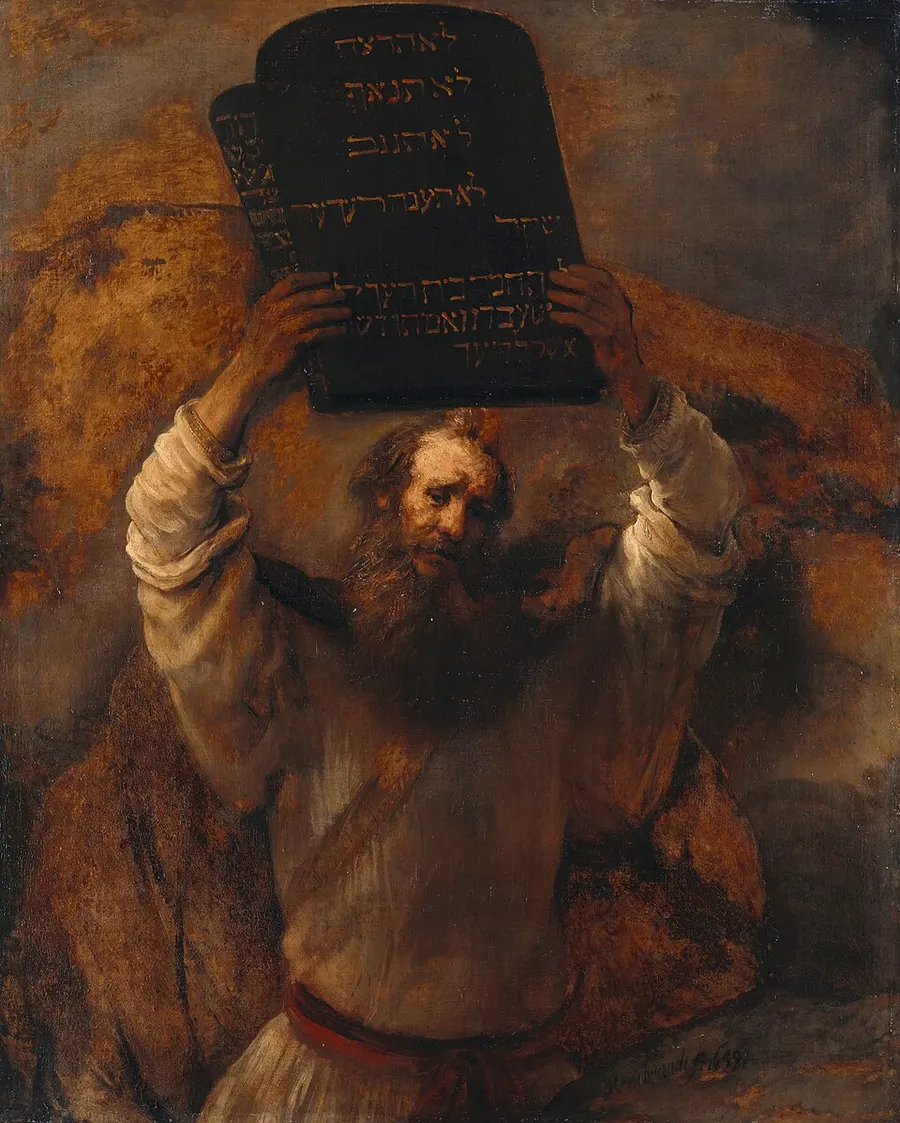
Moses with the Ten Commandments · Rembrandt, 1659, Gemäldegalerie Berlin
While shepherding in the wilderness of Midian, Moses saw a bush aflame yet not consumed, and drew near; God called his name from the bush, declaring "I am that I am," and commanded him to return to Egypt to lead Israel out of the land of bondage. When Moses demurred as poor of speech, God promised that his brother Aaron would be his spokesman.
The Ten Plagues and the Exodus
Moses conveyed God’s command "let my people go," and when Pharaoh refused again and again, Egypt was struck by ten plagues — of blood, frogs, and more — the last taking the life of every firstborn in Egypt, save the Israelite homes marked with lamb’s blood on the doorframes, who were "passed over." Pharaoh at last let Israel go, and this event became the origin of the Jewish Passover.
Mount Sinai and the Ten Commandments
After the Exodus, Israel camped at the foot of Mount Sinai, and Moses climbed the mountain for forty days and nights, receiving the Ten Commandments inscribed on two stone tablets — the core law of Israel’s covenant with God. Coming down to find his people worshipping a golden calf, he smashed the tablets in anger and later inscribed them anew.
Version differences
Moses is honored as an important prophet in all three of the Jewish, Christian, and Islamic traditions (called "Musa" in Islam), one of the representative figures of narrative shared across the three faiths; the specific doctrinal placement differs slightly among them, but the core narrative of "the Exodus and receiving the Ten Commandments" is acknowledged by all three.
Below are how modern works borrow or reinterpret this name or story — not the original material. The two differ, so keep them apart.
"Parting the Red Sea" (idiom)In English, "parting the Red Sea" is used for a seemingly impossible predicament resolved as if by miracle, straight from the Exodus account.
Michelangelo’s MosesA public-domain sculpture in the church of San Pietro in Vincoli in Rome, one of the representative works of Renaissance sculpture.