← Versailles👑 Formed in the 1670s; restored to its 1789 state🌐 中文
The Queen’s Bedchamber
Three queens and two dauphines gave birth in public in this bed — nineteen royal children were born here. And to the left of the bed hides a small door that saved Marie-Antoinette’s life in October 1789.
Where it standsThe Palace · Main floor, mirroring the King’s Apartment · End of the Queen’s Apartment — follow the visit route
- ✨ Origin
Origin · Even Childbirth Was an Affair of State
Public royal birth was not spectacle but constitutional procedure: an heir to the throne had to be born before witnesses, foreclosing any possibility of substitution.
On the plan this room mirrors the king’s bedchamber; in function it could not differ more. The king’s bed staged rising; the queen’s bed carried the dynasty’s core production — heirs. Bourbon court law required royal births to be public, witnessed by courtiers and officials: not perversity, but the physical guarantee of the succession. A throne’s legitimacy rested on the fact that this child truly issued from the queen, and the only anti-forgery device available was enough well-born eyes watching. Nineteen children of France were born in this room — every delivery a state proceeding with an official record.
In December 1778 Marie-Antoinette bore her first child here. So many spectators pressed in that the air gave out and the queen fainted after delivery — the royal physician, the court record says, shouted for the windows to be thrown open before the crowd was cleared. Louis XVI thereafter restricted attendance, and the institution of public birth contracted: a medieval mechanism exposing its own absurdity in its final grand performance.
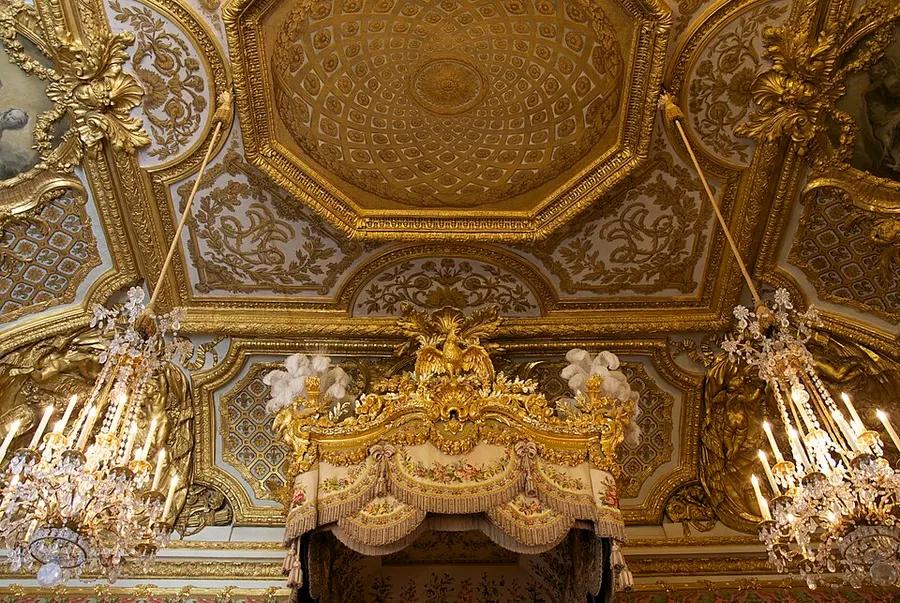
The furnishings deserve close reading too: what you see is the room as it stood in the summer of 1789 — the queen’s last arrangement before flight. The flowered silks were rewoven from the original Lyon workshop patterns; peacock feathers and lilac sprays, almost too light for Versailles — Marie-Antoinette’s private taste seeping into official space. And to the left of the bed, flush with the wallpaper, hides a nearly invisible door to the inner rooms and the king’s side — designed to give the queen one private route through a ceremonial world. No one imagined its most important use would be escape.
Connects to💐Marie AntoinetteEuropean HistoryThe queen who gave birth in public here — and fled through the hidden door👑Maria TheresaEuropean HistoryThe Austrian empress who married her fourteen-year-old daughter into this roomSources: Archives of Bourbon court etiquette · Court records of the 1778 royal birth · The Versailles restoration project (to its 1789 state)
- 🧭 Journey
Journey · Two Minutes at the Hidden Door
From the last layerA door built as one private route through a ceremonial world became, on the dawn that world collapsed, the only way out.
At dawn on 6 October 1789, as the mob axed through the antechamber, the queen fled barefoot through this door toward the king’s side — a two-minute margin that changed the date of her appointment with the guillotine.
At dawn on 6 October 1789 a spearhead of the crowd that had marched on Versailles broke into the palace and made straight for the queen’s apartment — in the Paris street-press, Marie-Antoinette had long been built into the effigy of every misery: l’Autrichienne, Madame Déficit. Two of the Garde du Corps held the antechamber door and paid nearly with their lives (accounts differ on whether one or both died of their wounds — both versions recorded here). A lady-in-waiting shook the queen awake; with no time to dress she snatched a wrap and ran barefoot to the hidden door left of the bed, through the inner corridor to the king’s apartment. Minutes later the mob burst in and drove pikes into the just-abandoned bedding. The little door designed for a private route fulfilled its purpose in the most literal way possible.
After that morning’s balcony scene (see the King’s Bedchamber page on this site) the royal family was conducted to Paris. The room stood empty; the Revolution auctioned everything movable, its silks and furniture and candlesticks scattering across Europe. France then spent generations buying back or re-making the contents piece by piece — the bed hangings you see were rewoven in Lyon in the twentieth century from the original pattern sheets, a labor of decades; the latest restoration, completed around 2019, froze the room precisely at the summer of 1789. The curatorial choice is itself a sentence: not Bourbon glory, not guillotine red, but the last moment before leaving — history paused at the click of a closing door.
Marie-Antoinette never saw the room again. She was executed on 16 October 1793; as the cart passed through Paris, the painter David — the same who would paint the Coronation, then a fervent revolutionary — sketched her final profile from the roadside: a gaunt woman sitting bolt upright. The same pen crowned Napoleon eleven years later. Art’s ways of serving power outlive the powers themselves.
Sources: Eyewitness accounts of 6 October 1789 (records of the guards' casualties disagree, presented as such) · Revolutionary auction inventories · Records of the restoration project around 2019
- 📍 Today
Today · Find the Door
From the last layerThe restoration is frozen at summer 1789 — every detail you hunt today, you hunt in the room as she left it.
Don’t look at the bed first — look at the wallpaper seam left of it: the hidden door is still there, and most visitors walk past without seeing it.
This room is an observation test. Question one is the door: from the rail, study the flowered wall left of the bedhead — the seam runs along the pattern’s edges, near-perfectly hidden; once you find it, replay the two seconds it opened and shut at dawn on 6 October 1789. Question two is the ceiling corners: look closely at the gilded birds — Habsburg double eagles nested among Bourbon lilies and peacocks, heraldic diplomacy custom-made for an Austrian queen. Question three is the jewel cabinet right of the bed (a reconstruction): the original, among the costliest furniture in Europe, vanished in the revolutionary auctions — the story behind this one copy teaches you what "buying back a room" actually costs.
Read it against its twin: arriving from the king’s bedchamber (the route connects them), you have just seen the bed of power; this is the bed of blood. One performs rule, the other produces succession — together they are absolutism’s complete machine: one managing the present, one the future. And both machines were switched off within the same forty-eight hours, 5–6 October 1789, by the same women of Paris.
To continue on this site: for the queen’s other face, go to the Trianon and the Hamlet (they have their own page) — the private world she built to escape this public bedroom, an anti-Versailles made of model farmhouses; set the two against each other and you watch a person flattened by an institution build herself an exit, and the exit become the last straw that crushed her name. Her full story is in the Europe universe.
Sources: Palace of Versailles display notes · Studies of the Habsburg heraldic decoration