← Versailles🛏️ Fixed in its present form in 1701🌐 中文
The King’s Bedchamber
The geometric center of all Versailles is a bed: the king rose and retired in public, even dressing was ceremony — absolutism simply abolished the concept of private life.
Where it standsThe Palace · Main floor, directly above the Marble Courtyard · Heart of the King’s Apartment — follow the visit route
- ✨ Origin
Origin · Turning Waking Up into a Mass
In 1701 Louis XIV moved his bedchamber onto the palace’s exact central axis — the Sun King now rose on the line of the sunrise, and the nobility of Europe queued to watch him dress.
Look at the floor plan and the skin prickles: this room sits precisely on Versailles’ great east-west axis — facing east, toward sunrise, with the Hall of Mirrors and the sunset garden at its back. The largest palace in Europe unfolds symmetrically around one bed. Not romance — architecture as political statement: the sun rises from the king’s bed.
Each morning the lever played here: some hundred courtiers admitted in ranked waves to watch the king woken, prayed over, dressed. Handing the royal shirt was the most coveted honor in France, assigned on the spot by precedence — a prince of the blood if present, otherwise down the ladder; each night the coucher ran the film backward. It sounds absurd; it was precision power engineering. Louis XIV had lived through noble revolt as a boy — the Fronde — and his answer was not the axe but the aquarium: draw the mightiest families to Versailles and let them spend themselves on the question of who stands closer to the royal dressing gown today. A duke competing to hand a shirt has no time to raise his province in rebellion. The duc de Saint-Simon’s memoirs record every venomous detail of the system: a ceremony that never closed, nobles recast as actors, and the sole spectator-director lying in bed.
On 1 September 1715 Louis XIV died in this bed at seventy-six, after seventy-two years on the throne — the longest personal reign in European history, ending on the very spot where its days began. Louis XV and Louis XVI kept the room and the ritual running — until the October when everything stopped.
Sources: Official furnishing archives of the Palace of Versailles · Memoirs of the Duke of Saint-Simon · Records of the king's death in 1715
- 🧭 Journey
Journey · 6 October 1789: The Ritual Stops
From the last layerA room that made private life a public rite ended in the most public way possible: the curtsy on the balcony is the lever’s logic carried to its end.
The women of Paris marched on Versailles; from the balcony outside this room the monarchy bowed to the crowd — by that afternoon the bed was empty, and no king ever slept in it again.
On 5 October 1789 thousands of Parisian women, driven by bread prices, marched twenty kilometers through rain to Versailles, Lafayette’s National Guard trailing behind. Before dawn a crowd broke into the palace; guards died; Queen Marie-Antoinette fled through a hidden passage into the king’s apartment. By morning the mob filled the Marble Courtyard demanding the king. Louis XVI stepped onto the central balcony outside this bedchamber and promised to return to Paris with his people; the crowd then called for the queen. Marie-Antoinette came out with her two children — the crowd shouted for the queen alone; she sent the children back and stood by herself, facing ten thousand stares and not a few muskets, and sank into a deep curtsy. Witnesses record the square erupting in "Vive la Reine!" — the old regime’s last applause, earned with a bow that was really a curtain call.
That afternoon the royal family traveled to Paris escorted — in truth, conducted — by the crowd, never to return. In a single day Versailles fell from imperial nerve-center to empty shell; the Revolution then auctioned its furnishings year after year. The textiles and fittings you see in the bedchamber today were rewoven and remade piece by piece against the 1789 inventories — twentieth-century hands restoring an eighteenth-century ledger.
The room’s later fate compresses the palace’s own: Napoleon would not sleep here (too hot a symbol), the restored Bourbons could not (too costly, too painful), until Louis-Philippe of the July Monarchy turned the whole palace in 1837 into a museum "to all the glories of France." The king’s bed became an exhibit — completing its destiny, since it had been built to be looked at all along.
Connects to💐Marie AntoinetteEuropean HistoryThe queen who curtsied alone on the balcony outside this roomSources: Eyewitness accounts of the October 1789 events · Revolutionary auction inventories · Archives of the Versailles restoration project
- 📍 Today
Today · Stand at the Rail Where the Courtiers Stood
From the last layerThe restoration froze the last morning of 1789 — today’s furnishings are a photograph of the instant the ritual stopped.
The gilded balustrade before the bed is a fossil of the old order: inside it, sacred space; outside it, you — in exactly the dukes’ old spot.
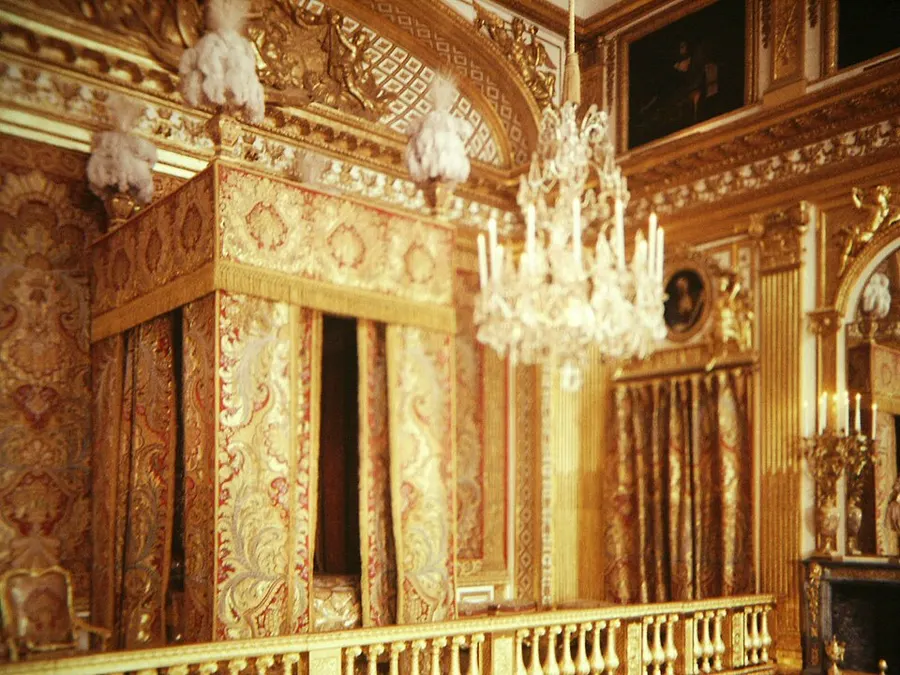
Notice, as you enter, where your feet stop: naturally, outside a low gilded balustrade. That rail was the lever’s boundary — the bed’s side of it a ceremonial sanctuary, its form borrowed from altar rails. Absolutism spoke religion’s spatial grammar: the king’s bed as altar. The line where visitors halt today is precisely where courtiers halted then — this room needs no re-enactment; you are cast the moment you walk in.
Three details. First, the canopy and angel-crowned textiles above the bed: gold-thread weaving restored against the 1789 inventory — the fabrics that watched the ritual’s final autumn. Second, turn to the windows: the Marble Courtyard and the east, the sunrise that staged the lever’s cosmology; on 6 October 1789 the crowd packed that courtyard, and the balcony lies just beyond these windows. Third, stand at the room’s center and look up: after 1 September 1715 the king lay in state here — "the Sun King died on the axis of the sunrise" is not rhetoric but this room’s literal fact.
Route-wise, see it back-to-back with the Hall of Mirrors (they adjoin): the hall is power’s public stage, the bedchamber its backstage — but at Versailles the backstage was the true stage. With these two rooms read, you hold the key to the whole palace: Versailles is not a residence but a machine that institutionalized seeing-and-being-seen; and its final scene (a curtsy on a balcony) spoke the same grammar as its opening act (a king rising in public).
Sources: Palace of Versailles display notes · The 1789 furnishing inventory (the basis for the restoration)