← Versailles🌅 1668–1671🌐 中文
The Apollo Fountain and the Grand Axis
The sun god’s chariot bursts from the water, charging toward the palace — each morning the sun rises behind the king’s bed and "drives" down this axis across his garden.
Where it standsThe Gardens · Open air · At the foot of the Royal Way (the Green Carpet) — follow the garden map
- ✨ Origin
Origin · Geometry to Conquer Nature, Myth to Caption Himself
Le Nôtre pressed a marsh into perspective lines, and Tuby cast the sun god to Le Brun’s design — the whole garden is a treatise on kingship written in earth.
See the whole before the fountain. The gardens of Versailles were not planted but computed: over twenty years the gardener André Le Nôtre pressed a marshy hunting ground into pure geometry — the central axis fired straight from palace to horizon, hedges clipped into walls, basins laid as mirrors, even the optical illusions calculated (the Grand Canal is 1.6 km long yet foreshortened by design; only walking it reveals the true size). Contemporaries read the message correctly: a monarch who can trim nature itself into straight lines will have no trouble with men. The garden is absolutism’s open-air treatise, built by workforces the size of armies; its waterworks were so vast they begot the Machine de Marly, one of the era’s wonder-machines.
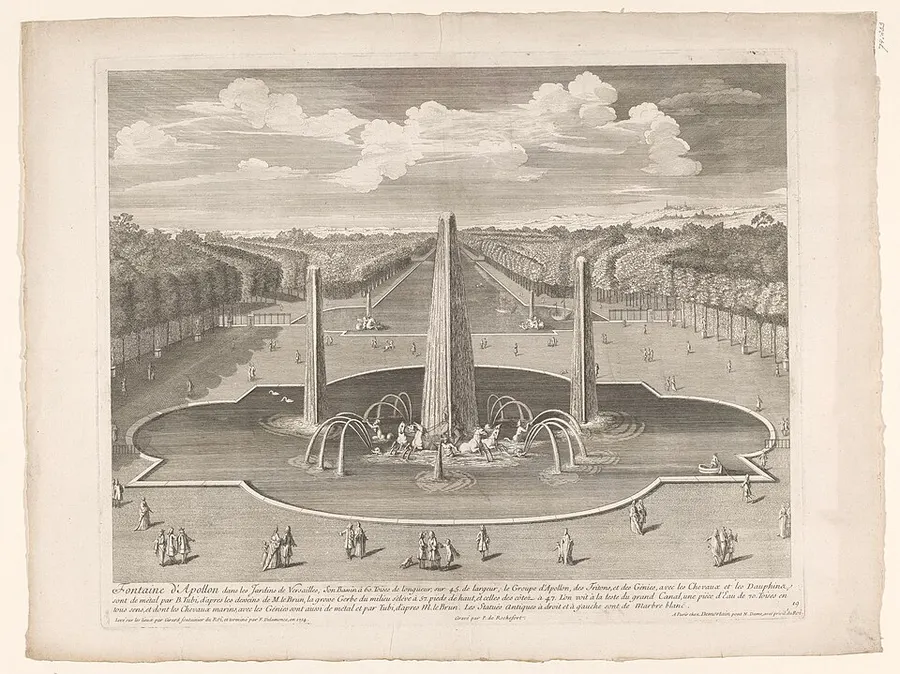
The Apollo Fountain (1668–71) is the treatise’s thesis sentence. To designs by the first painter Le Brun, the sculptor Tuby cast in gilded lead the sun god’s chariot: four horses surging, tritons sounding conch-shell fanfares, Apollo taking the reins as he bursts from the water — the moment of rising. Its orientation carries the entire meaning: the chariot charges east, toward the palace, toward the king’s bedchamber — "rising" at the exact angle of the morning sun. Paired with the Latona Fountain (Apollo’s mother) up the axis, the garden tells one complete solar myth, and the myth has a single referent. Louis XIV had styled himself Apollo since youth — he danced the rising sun in court ballets (hence "Sun King") — and here the role is cast in metal and installed in a theater that never closes.
Even the details carry politics: the Latona Fountain shows Apollo’s mother insulted by Lycian peasants whom Zeus turns into frogs (Ovid) — read by scholars, in the standard interpretation, as an allegory of the Fronde, the revolt of Louis’ boyhood: insult the king’s mother, become vermin. Even the fountains hold grudges. At Versailles myth is not ornament but encrypted proclamation — and the decryption key is the set of names in this site’s Greek universe.
Connects to☀️ApolloGreek & RomanThe sun god cast into the fountain — the king’s mythological double☀️Louis XIVEuropean HistoryThe king who styled himself Apollo and danced the sun in court balletSources: Archives of the gardens of Versailles (Le Nôtre's design) · Records of the fountain's making by Tuby and Le Brun · The standard scholarly reading of the Latona allegory (given as the "standard reading")
- 🧭 Journey
Journey · Three Centuries of Depreciation for an Open-Air Theater
From the last layerA garden built to be watched was bound to change meaning as its watchers changed — same script, new lead.
The fountain never moved, but its audience turned over three times — the monarch’s guests, the Revolution’s public, today’s world — and each turnover redefined it.
This fountain’s journey happened not in space but in the semantics of ownership. For its first century it was a private special effect: Louis XIV personally wrote a guidebook — the Manière de montrer les jardins de Versailles — prescribing the order and standpoints from which guests should view his garden; even looking followed a royal script. Running all the fountains at once outdrank even the Machine de Marly, so an art of scheduling was invented: gardeners relayed whistle signals so that fountains sprang to life just before the king arrived and fell silent behind him. Absolutism, too, had to budget its water pressure.
The Revolution did not smash the garden (too useful): plots were leased out, most statuary kept — Apollo demoted from the king’s double to an old object in public inventory. Napoleon and the restored Bourbons had neither means nor appetite for the full spectacle; in stretches of the nineteenth century the garden ran to grass, the fountains more often silent than playing. The true second spring came with the Republic: once France had no king, the Sun King’s garden could become everyone’s pride. After the palace became a museum in 1837 the gardens opened ever wider; today, on Musical Fountains days, tens of thousands walk the once-royal route as Baroque music plays from speakers behind the hedges — Louis XIV’s script still runs, with the role of "king" recast as every ticket-holder.
Around 2018 the Apollo group underwent full restoration and regilding — brighter gold than at any time in a century. That the sun god was polished and returned to duty is itself a footnote to this garden’s philosophy: Versailles never restores to ruin-romantic patina; it restores to newness — because what it exhibits was never the melancholy of ruins, but the ongoing proclamation of order.
Sources: Louis XIV, Manner of Presenting the Gardens of Versailles · Archives of the Marly Machine · Records of the restoration of the Apollo group around 2018
- 📍 Today
Today · Walk the Axis Against the Sun
From the last layerThe audience became everyone, but Le Nôtre’s camera language survives untouched — every step you take is still on his storyboard.
The walk: from the palace down the Green Carpet to the fountain; on the way back at dusk, turn — the sun is setting into the Grand Canal and the whole axis ignites.
Budget your legs: palace to fountain is about 1.5 km one way; with Latona, the Green Carpet and the return you start at 4 km — the garden’s scale is itself part of the exhibit, so don’t walk it like a checklist. The little train or a rental bike saves strength, but walk at least the 335 meters of the Tapis Vert: statues flanking, the perspective pulling you toward the golden chariot on the water — Le Nôtre’s first-person tracking shot, designed for you.
At the fountain, half-circle it for three things. ① Hooves and water: only the tips touch — twenty-plus tons of lead made to levitate. ② The tritons’ conches: they fanfare the rising sun, every horn aimed at the palace. ③ Crouch and shoot along the water surface: the chariot leaps out of your own lens — the garden’s most reliable picture. Then stand and look west down the Grand Canal, a cruciform sheet of water 1.6 km long on which Louis XIV kept a miniature fleet, Venetian gondolas and gondoliers included. Look back east to the palace: you now stand where the sun "departs" each day, the king’s bedchamber windows dead ahead — the whole cosmology closes its loop at your feet.
Two threads lead onward within this site. The myth thread: read Apollo himself in the Greek universe and every layer of Louis’ choice — light, arts, archery, order — snaps into place. The power thread: Versailles dressing power in myth, the Vatican dressing it in theology (our Sistine page), the Louvre’s Coronation manufacturing legitimacy in paint — three case studies in one course. Read all three venues and one conclusion emerges: European power always solved the problem of being seen first.
Sources: Visitor-route notes for the gardens of Versailles · Information on the musical fountain shows