← The Vatican Museums🐍 c. 1st century BC – 1st century AD (dating debated)🌐 中文
Laocoön and His Sons
The Trojan priest who warned "beware the horse," crushed by sea-serpents — unearthed in 1506, this group is the founding stone of the Vatican Museums themselves.
Where it livesMuseo Pio-Clementino · The Octagonal Court · A courtyard niche — follow signage
- ✨ Origin
Origin · The Death of the Truth-Teller
"I fear the Greeks, even bearing gifts" — Laocoön spoke the truth about the horse, and the gods sent serpents to silence him.
First, the man. In the tenth year of the siege the Greeks feigned departure, leaving the great horse. The priest Laocoön rushed to the shore crying trickery and hurled his spear into its flank — Virgil’s Aeneid gives him the immortal line: Timeo Danaos et dona ferentes, "I fear the Greeks, even bearing gifts." At once two vast serpents came over the sea and strangled him with his two sons before the crowd. The Trojans read the horror as divine punishment — Laocoön had profaned an offering to Athena — and joyfully hauled the horse inside. The city fell that night. The cruelty of the tale lies not in the snakes but in the structure: the truth-teller is executed in public, and his death becomes the lie’s most persuasive endorsement. Odysseus’ stratagem needed a martyr to close its loop, and Laocoön was the man the script selected.
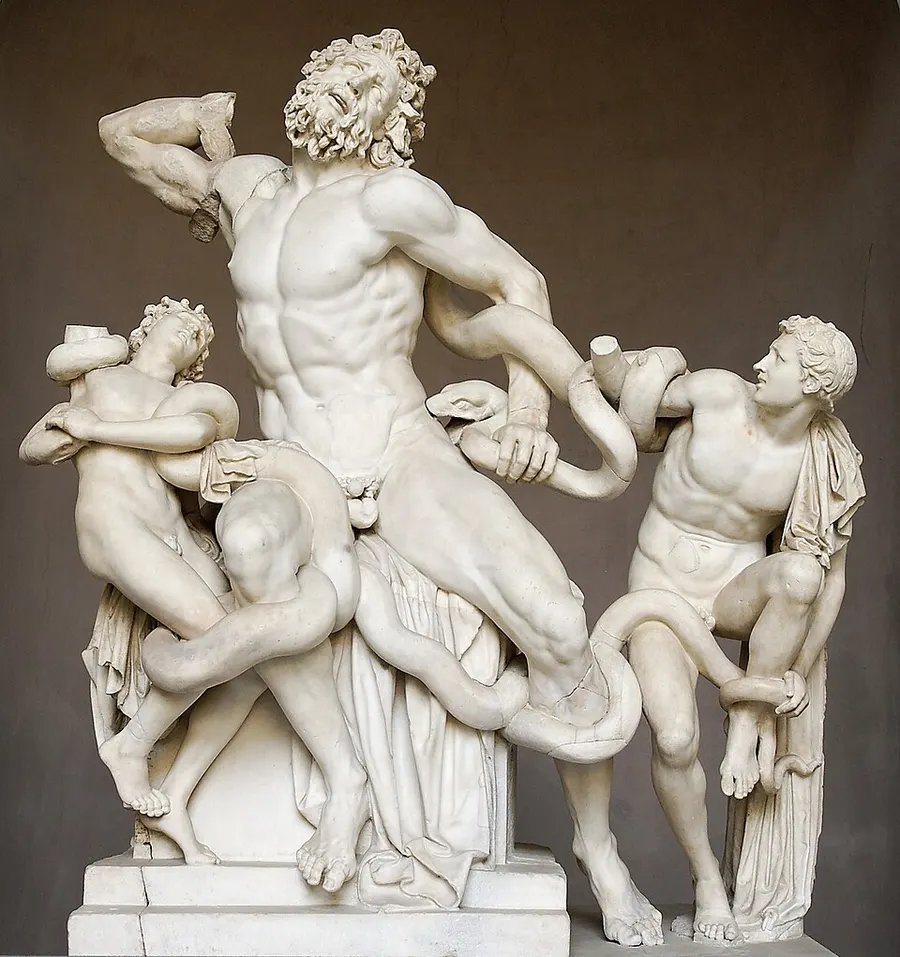
The group freezes the execution at its climax: the father’s whole body arcs backward, every muscle fighting the coils, his face caught not in a scream but in that more terrible suppressed groan that viewers from Pliny’s day to Winckelmann’s never stopped discussing; the elder son still struggling free, the younger already limp — three figures, three tenses of despair. Pliny the Elder records in his Natural History a Laocoön in the palace of the emperor Titus, by three sculptors of Rhodes, "to be preferred to all works of painting and bronze." The 1506 find matches the description closely — yet whether it is the Hellenistic original, a Roman copy, or a Roman re-creation remains debated (even the marble’s one-block-or-several question sits awkwardly with Pliny’s text), and both positions are recorded here.
Whatever its authorship, its aesthetic rank never wavered: the diagonal torsion of the three bodies and the restraint within agony became the West’s archetype for sublime suffering — Lessing simply titled his epoch-making 1766 treatise on the boundaries of the arts Laocoön. One statue, the origin-point of two disciplines.
Connects to🌊OdysseusGreek & RomanArchitect of the horse — it was his script Laocoön tried to tear🔱AeneasGreek & RomanWitness of the execution — through whom Virgil tells the taleSources: Virgil, Aeneid, Book II · Pliny the Elder, Natural History · The dispute over original vs. copy (debated by scholars, presented as such) · Lessing, Laocoön (1766)
- 🧭 Journey
Journey · One Excavation, Two Abductions
From the last layerBecause Pliny’s paragraph had survived a millennium, the marble could be recognized the day it surfaced — the text outlived the stone, and handed it back its identity on sight.
The pope’s envoys arrived the very day it surfaced in a vineyard in 1506 — three centuries later Napoleon abducted it to Paris for fourteen years.
On 14 January 1506, on the Esquiline, the citizen Felice de Fredis struck marble in his vineyard — and word reached the Vatican the same day. Julius II sent two experts whose names alone tell the story: the architect Giuliano da Sangallo, and Michelangelo, aged thirty. Sangallo identified it on the spot: this is Pliny’s Laocoön. The pope bought it at speed and installed it in the Belvedere courtyard beside the Apollo (own page on this site), opening the court to artists and scholars for study — the standard account dates the birth of the Vatican Museums to this act: **the statue was not acquired by a museum; the museum grew up around the statue.** For Michelangelo the shock was lifelong — two years later he climbed the Sistine scaffold, and the twisting bodies of the ceiling, the ignudi above all, carry Laocoön in their DNA.
The second abduction came in 1797: Napoleon’s Italian campaign, via the Treaty of Tolentino, forced the Papal States to "cede" their masterpieces; Laocoön was crated with the Apollo Belvedere to Paris, entered the city in a triumphal procession in 1798, and reigned fourteen years as a crown piece of the Musée Napoléon. After Waterloo it returned in the restitution mission led by the sculptor Canova. Its itinerary mirrors our Louvre-lens pages — the Venus’ vacancy-filling, Hammurabi’s concession-era journey: the history of Europe’s museums in those centuries is half Enlightenment, half armed transport.
And there is the arm — a parable of restoration. The father’s right arm was missing at excavation; Renaissance opinion (Michelangelo reportedly dissenting) settled on a heroically outstretched restoration, fitted for centuries. In 1905 the archaeologist Ludwig Pollak found a bent marble arm in a Roman stonemason’s shop — it proved original: Laocoön’s arm folds back on itself, more anguished, more inward than any guess. In the 1950s the Vatican removed the straight arm and attached the true one. Michelangelo, tradition says, had argued for the bend all along (recorded as tradition) — vindicated four centuries later by a junk-shop shelf.
Connects to🗿MichelangeloArt HistoryThe thirty-year-old witness at the pit — the ceiling’s bodies remember this day🎖️NapoleonEuropean HistoryThe emperor who abducted it to Paris for fourteen yearsSources: Records of the 1506 excavation · The Treaty of Tolentino (1797) and archives of Canova's efforts to reclaim it · Ludwig Pollak's discovery of the missing arm (1905) and the 1950s reconstruction
- 📍 Today
Today · Look at the Arm That Came Back
From the last layerThe lost-and-found arm makes it an exhibit whose restoration is itself restored — what you see is not a final state but a text still under revision.
Find the father’s right arm first — that backward fold is the whole evidence of four centuries’ wrong restoration and one miraculous correction.
It stands in a niche of the Octagonal Court of the Pio-Clementino — far calmer than the Sistine crush, so circle at leisure. Station one: the right arm — folded back, pressed toward the head, the joint seam still visible: the limb that came home from a mason’s shop in 1905. Now imagine it outstretched, as the Renaissance had it: the group’s energy would leak outward; the fold collapses all the agony inward. One limb’s direction rewrites the grammar of the whole work — which is why restoration history deserves reading as main text, not footnote.
Station two: step back for the geometry — three bodies and two serpents locked in an unstable, collapsing triangle; your eye is made to shuttle along the diagonals, and that unease is the design. Then the father’s face: not a scream, lips barely parted — here Winckelmann read his famous "noble simplicity and quiet grandeur" (coined for the Greek ideal at large), and Lessing asked why sculpture may not scream though poetry may, and wrote his Laocoön. Your looking, at this moment, stands on the foundations of modern aesthetics.
Three onward threads on this site. Myth: Odysseus and Aeneas in the Greek universe — one built the horse, one fled the burning city; then our "Troy to Rome" trail, whose step zero is the scene of Laocoön’s death. Art: this twisting torso → the ignudi of the Sistine ceiling (own page) — between the two pages you can watch influence happen with your own eyes. Provenance: read with the Apollo Belvedere next door and the Louvre-lens pages to assemble the full map of Napoleon’s great art-convoy. One statue, a crossroads of three universes.
Sources: Vatican Museums display notes · Winckelmann, Reflections on the Imitation of Greek Works · Lessing, Laocoön