← The Uffizi🌸 c. 1480🌐 中文
Primavera
Nine mythological figures in an orange grove, some five hundred plant species, a story that reads right to left — the Renaissance’s most famous puzzle-picture, unsolved for five centuries.
Where it livesThe Botticelli Rooms · Second floor, main route · Rooms 10–14 — follow signage
- ✨ Origin
Origin · A Painting That Reads Right to Left
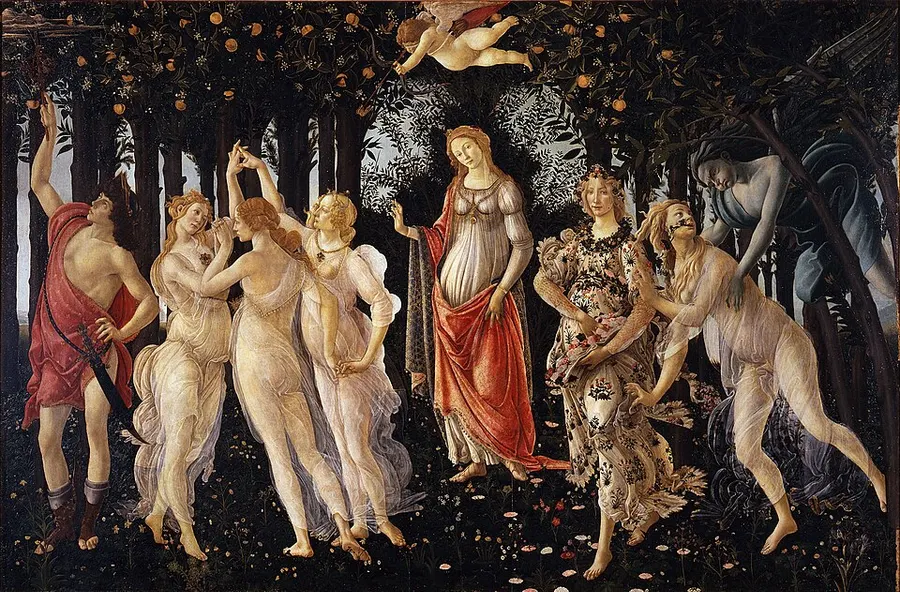
At the right, a pursuit and a seizure; at the left, rain clouds waved away — and presiding at center, Venus.
This picture gives you not a scene but a chain of events — and the chain runs backward, right to left. At the far right the wind-god Zephyr, ashen-faced, bursts through the trees and seizes the nymph Chloris; flowers spill from her mouth. In Ovid’s Fasti the abducted Chloris becomes Zephyr’s bride and is transformed into Flora, goddess of flowers — so the flower-gowned woman strewing blossoms beside her is not a third figure but the same woman one frame later: violence painted into transformation within a single step. At center Venus stands back half a pace beneath an arch of orange trees, a blindfolded Cupid drawing his bow above her; at left the Three Graces dance with linked hands, their veils painted like creased air; and at the far edge Mercury turns his back and lifts his caduceus to part the rain clouds — Venus’ garden-keeper, and the sentence’s full stop.
The botanical density is staggering: scholars have identified hundreds of plant species and well over a hundred flowering varieties in the meadow, nearly all true to the actual Tuscan spring, the orange trees — a Medici emblem — hanging with golden fruit. This is not scenery; it is a painted herbal.
For whom, and meaning what, has never been settled. A 1499 inventory places it in the townhouse of Lorenzo di Pierfrancesco de’ Medici of the cadet branch; the most circulated reading ties it to his 1482 marriage — the seizure-turned-transformation as a metaphor of matrimony, Mercury’s cloud-clearing as reason standing guard, Venus presiding over the humanists’ "education of love." The Neoplatonic reading (Ficino’s circle: sensual love ascending through beauty toward the divine) and the political one (a golden-age allegory of Medici rule) run alongside it — all recorded as interpretation, none documented. The riddle itself has become part of the painting’s power.
Connects to🌹AphroditeGreek & RomanPresiding at center — this is her garden🪽HermesGreek & RomanThe garden-keeper parting the clouds at left (Mercury, in Roman dress)🐚BotticelliArt HistoryThe painter who turned Ovid into a riddleSources: Ovid, Fasti, Book V · The 1499 Medici inventory · The three readings—marriage, Neoplatonic, and political (debated by scholars, presented as such)
- 🧭 Journey
Journey · From Bridal Chamber to the Botticelli Revival
From the last layerBecause the documentary record is one inventory line, interpretation became an open arena — its riddle-status is the joint product of missing documents and overabundant image.
It hung above a daybed in a Medici townhouse for generations, then slept three centuries unregarded — sharing one fate-curve with the Birth of Venus.
The Primavera’s first firm trace is that 1499 inventory: framed in white, hanging above a daybed (lettuccio) in Lorenzo di Pierfrancesco’s townhouse — not a gallery exhibit but part of the bedroom furniture. That detail explains the original context of Renaissance painting better than any theory: mythologies were house decoration, wedding gifts, displays of family taste; "artwork" is a status later ages appended.
It then drifted with the family’s divisions of property: the Villa di Castello (under the same roof as the Birth of Venus), the grand-ducal collections, the 1737 Family Pact binding everything to Florence — and after entering the Uffizi system it spent stretches in storage and secondary rooms, Botticelli’s name still at the bottom of art history’s trunk; an 1815 Uffizi survey even listed it among holdings of little value (per the museum’s own records).
Its turn shares a curve with the Birth of Venus: after the Pre-Raphaelites, Ruskin and Pater re-enthroned Botticelli, the Primavera’s riddle won it an even more durable scholarly afterlife — Aby Warburg’s 1893 dissertation took it as the starting point of iconology itself, and nearly every generation of art historians since has had to spar in this orange grove: Gombrich’s Neoplatonic reading, the botanists’ species census, the conservation lab’s pigment stratigraphy. Thus did a piece of bedroom furniture become a discipline’s proving ground. It settled permanently in the Uffizi galleries from 1919, and since the great restoration of 1982 has hung with the Birth of Venus in the same rooms.
Sources: The 1499 inventory · Aby Warburg, "Sandro Botticelli's Birth of Venus and Spring" (1893) · Uffizi restoration report of 1982
- 📍 Today
Today · Walk In with a Reading Order
From the last layerA century of scholarly combat left behind a ready toolkit of ways to look — you need not pick a side, only borrow their eyes.
Start at the right — where three women are really two — and read leftward to the tip of Mercury’s staff: this painting is a sentence, not a poster.
In the crowded Botticelli rooms the Primavera needs method more than the Birth does. Suggested route: stand first at the right end and watch Zephyr’s gray-blue skin (the picture’s only cold-toned figure), the flowers spilling from Chloris’ mouth and those woven into Flora’s gown perform a transfer of identity — once you confirm that three women are two frames, the whole painting flips from group portrait to timeline. Then move center for Venus: note she stands half a step behind everyone, and the canopy arches a halo-shaped clearing above her — Botticelli is using Madonna-composition grammar on a pagan goddess, and that borrowing is the Renaissance’s core maneuver. Finish leftward: the Graces’ veils, Mercury’s staff tipped at the clouds.
Second pass: read the ground. The meadow is not a green backdrop but a carpet woven of specimens — find cornflower, iris, daisy, wild strawberry, each painted to identifiable precision. With children in tow, flower-hunting is the best door into this picture.
Three onward threads. Myth: Aphrodite and Hermes in the Greek universe — chase down why the messenger god moonlights as guide of souls and patron of merchants; parting clouds is merely one of his gigs. Literature: Ovid’s Fasti and Metamorphoses are the script-library of all Renaissance mythological painting; our literature universe’s line from Homer to Dante picks up that thread. Contrast: the Birth of Venus in the same room (own page) — same painter, same goddess, same years; one a single instant of birth, the other a compound narrative of reign. Reading them as a pair is the Uffizi’s best free gift.
Sources: Uffizi Gallery display notes · Botanical surveys identifying the meadow species