← The Uffizi🐚 c. 1484–1486🌐 中文
The Birth of Venus
A goddess rides a shell out of the sea — the first monumental pagan female nude in Western painting a thousand years after antiquity closed.
Where it livesThe Botticelli Rooms · Second floor, main route · Rooms 10–14 — follow signage
- ✨ Origin
Origin · Beauty Risen from a Mutilation
In myth Venus rises from the foam of a sky-god’s severed flesh — Botticelli paints this violent beginning as purity itself.
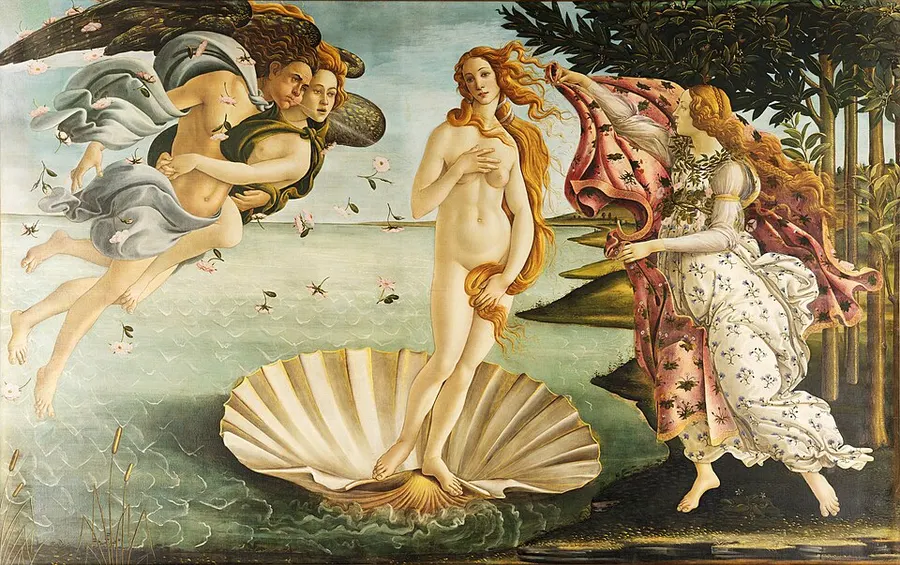
Start with the myth behind the paint. In Hesiod’s Theogony, Cronus castrates his father Uranus with a sickle and hurls the flesh into the sea — foam (aphros) churns, and out of it rises Aphrodite/Venus. The goddess of love and beauty carries a savagely violent birth certificate: she is the product of the sky’s first bloodshed. Botticelli chooses the next beat of the story: the goddess fully formed, standing on a shell, the wind-god Zephyr and his nymph blowing her ashore, a Hora of Spring rushing forward with an embroidered cloak. Roses drift down — legend says every rose was born the moment Venus landed.
In 1480s Florence this was an audacious object. For a medieval millennium, large-scale female nudes had all but vanished from Christian Europe outside Eve and the damned; Botticelli painted one nearly three meters wide — on canvas rather than panel, itself unusual — with a pose lifted from the ancient Venus Pudica statues, one of which the Uffizi building itself would later house. His cover was Medici Neoplatonism: Ficino’s circle argued that contemplating visible beauty is the soul’s ladder toward divine beauty — the pagan goddess got a theological passport, and nudity became philosophy. The patron is generally held to be Lorenzo di Pierfrancesco de’ Medici of the cadet branch (Vasari saw the picture at his Villa di Castello in 1550), though no commission document survives; recorded here as the standard account.
Now the painting’s "mistakes": Venus’ neck is anatomically overlong, her left shoulder slides at an impossible angle, her weight could never balance on the shell’s rim. None of this is failure — Botticelli abandons the volume and perspective his contemporaries labored over and bets everything on line: contours that run like song, gold strands of hair drawing decorative arcs in the wind. Beauty, for him, is a matter of line, not flesh. Four centuries later Art Nouveau and the golden age of illustration would claim that line as ancestor.
Connects to🌹AphroditeGreek & RomanThe subject — love and beauty born of the foam⚒️CronusGreek & RomanThe sickle-bearer — no mutilation, no birth🐚BotticelliArt HistoryThe painter who turned myth into a song of lineSources: Hesiod, Theogony · Vasari, Lives of the Artists (1550) · Poliziano's Stanze per la giostra and the Neoplatonic reading (the common scholarly view)
- 🧭 Journey
Journey · The Goddess Who Missed the Bonfire
From the last layerIts double offense — pagan goddess, nude — was why it needed the Neoplatonic passport; in the light of Savonarola’s fire the passport meant nothing, and geography did the saving.
Savonarola’s Bonfire of the Vanities devoured Florence’s pagan images — she survived because she hung in a country villa.
In the 1490s the wind over Florence turned. The friar Savonarola’s preaching dragged the city into religious fervor, and at Carnival 1497 citizens heaped their "vanities" — mirrors, wigs, pagan pictures — onto the Piazza della Signoria and set them alight. Vasari reports that Botticelli himself was swept up, his art turning to somber devotion; tradition adds that he burned some of his own mythologies (recorded as tradition). The Birth of Venus escaped for a reason almost comically plain: it was not in town. It hung quietly at the Villa di Castello while the city burned its images.
The next three centuries brought not peril but oblivion. Botticelli’s reputation collapsed after his death — to Vasari he was merely a once-decent, outmoded painter, and Baroque and academic taste had no use for his flat, decorative manner. The picture drifted with Medici property, was locked to Florence in 1737 by Anna Maria Luisa’s Family Pact (see the Journey layer of our Medusa page), and entered the Uffizi in the eighteenth century — hung in corners nobody visited.
It was the English, in the mid-nineteenth century, who fished him back. The Pre-Raphaelites and Ruskin’s generation, weary of academic "perfection," went looking for sincerity in the painters before Raphael, and Botticelli’s line answered their need; Walter Pater’s famous essay of 1870 canonized him for the Aesthetic Movement. By the 1890s The Birth of Venus had risen from dusty storage to the Uffizi’s signature image and the visual emblem of Florence itself. A painting’s rank never rests on execution alone but on what each age needs it to be — Botticelli waited four hundred years for an age that needed line again.
Sources: Vasari, Lives of the Artists · The Family Pact (Patto di Famiglia, 1737) · Walter Pater, Studies in the History of the Renaissance (1873)
- 📍 Today
Today · Read the Line, Not the Anatomy
From the last layerThe nineteenth-century re-coronation set today’s viewing conditions — crowds, glass, the "masterpiece" filter; to see it, first get past its fame.
Stand close enough to see the gold in the hair — the whole secret is how the contour sings, not whether the body is correct.
The Botticelli rooms are the Uffizi’s densest crowd, with the Birth and the Primavera facing each other. Skip the frontal scrum at first and enter from the side: look for contour — the nearly unbroken line running down Venus’ right side from neck to ankle is the painting’s melodic theme. Follow it into the hair, where raised lines of real gold make the tresses write in the wind. Then let yourself see what is "wrong": the overlong neck, the sliding shoulder, the impossible balance — you now know these are different pricing rules, not failed craft.
Second station, the supporting cast. At left Zephyr and his nymph fly entangled, cheeks genuinely puffed with blowing; every drifting rose is edged in gold. At right the Hora’s white gown is embroidered with cornflowers, and the shoreline at her feet is reduced almost to abstraction — Botticelli has no interest in background; everything is spent on the figure-frieze up front, like a tapestry enlarged. That flatness is exactly what the nineteenth-century aesthetes fell for.
Three onward threads. Myth: the Greek universe’s Aphrodite and Cronus — the family bloodshed behind the birth, then on to the Olympian succession. Art: three steps to the Primavera in the same room (own page here), watching one painter move one goddess from sea to orange grove; then the Botticelli figure page in our art-history universe. Contrast: our Venus of Urbino page — half a century on, a Venetian lays the goddess on a bed with her eyes open, and between the two Venuses runs the Renaissance’s whole revolution in how bodies may be looked at.
Sources: Uffizi Gallery display notes · Studies of Botticelli's technique (gold lines and canvas ground)