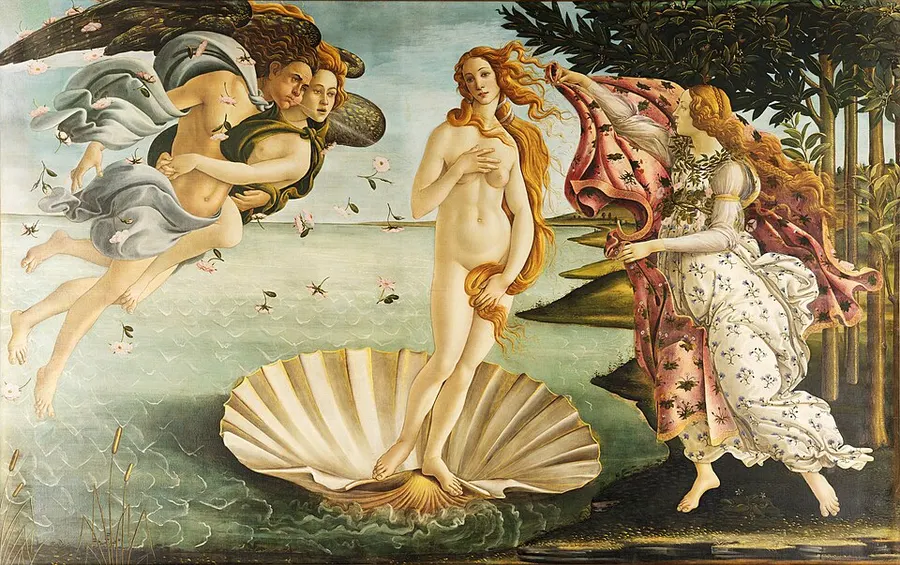
The goddess born from sea foam — the very scene Botticelli painted in "The Birth of Venus." She rules over love yet was married off to the ugliest god, Hephaestus, so her romances span gods and mortals alike. The Romans honored her as Venus — the family of Julius Caesar claimed descent from her.
Primary sourcesHesiod, TheogonyHomer, Iliad
Key stories
Born From the Foam
The Birth of Venus · Botticelli, c. 1485, the Uffizi
After Cronus castrated his father Uranus and threw the part into the sea, white foam rose from the water, and Aphrodite emerged from it, riding a shell to the shore of Cyprus. She is a generation older than Zeus — divine genealogy is always a tangled account.
One Apple for a War
When Paris judged the golden apple, her price was "the most beautiful woman on earth." She won the apple, but the cost was that Helen was already the Queen of Sparta — a bargain that lit the ten-year Trojan War directly. The love goddess’s gifts always come at a staggering price.
Mother of Aeneas
By the Trojan shepherd Anchises she bore Aeneas. On the night Troy fell, she guided her son as he carried his father and led his own child to safety. That fugitive’s descendants would found Rome — making Venus the "mother of the nation" to the Romans.
Version differences
On Aphrodite’s origin, Hesiod’s Theogony says she was born from the foam where Uranus’s severed part fell into the sea, a primordial goddess older than Zeus; Homer’s Iliad calls her the daughter of Zeus and Dione, of the same generation as Ares and Hephaestus. Both versions are ancient, and neither ever truly supplanted the other.
Below are how modern works borrow or reinterpret this name or story — not the original material. The two differ, so keep them apart.
Botticelli’s Birth of VenusOne of the most famous Renaissance paintings, depicting exactly the scene of Aphrodite rising from the sea on a shell (using her Roman name, Venus).
The word "aphrodisiac"English coined the word directly from her name.