← The Uffizi🕊️ c. 1472–1476🌐 中文
Annunciation (Leonardo)
Leonardo’s first large work, painted at about twenty — the angel’s wings studied from real birds, the Virgin’s arm "wrong," and the error possibly by design.
Where it livesThe Masters’ Route · Second floor, main route · Room 35, the Leonardo room — follow signage
- ✨ Origin
Origin · A Workshop Apprentice’s First Solo Flight
The subject was a thousand years old — young Leonardo treated it as an experiment in optics, botany and ornithology.
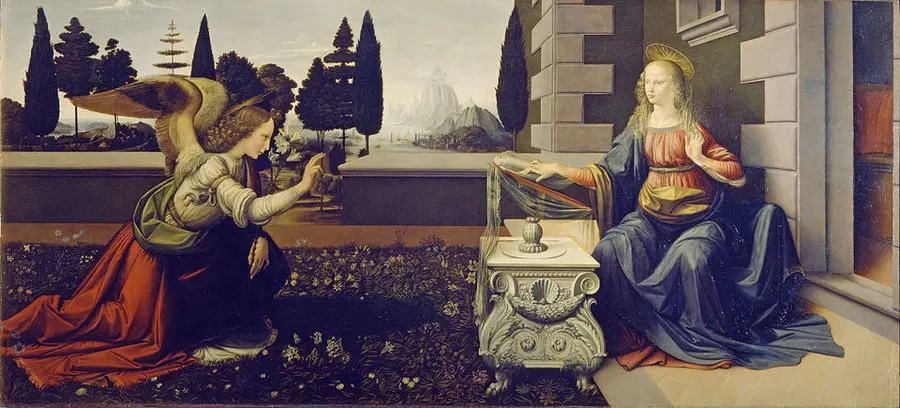
The Annunciation is among the most-painted subjects in Christian art: the angel Gabriel announces to Mary that she will conceive by the Holy Spirit and bear Jesus (Luke 1). By the 1470s everything about the scene was codified — angel left, Virgin right, lilies between, dove above. When young Leonardo took it on he was still one hand among many in Verrocchio’s workshop (the attribution wandered for years — the painting entered the Uffizi in the nineteenth century under Ghirlandaio’s name; today’s consensus gives it to Leonardo, possibly with workshop participation, both recorded), and he challenged none of the conventions. Instead, inside them, he replaced every element with a product of observation.
The wings are the most famous. Tradition gave angels decorative golden plumage; Leonardo’s Gabriel wears short, rounded raptor’s wings studied from life — brown, with true feather-layering (a later hand lengthened the tips; the original contour is still legible since restoration). He was already drawing birds in his notebooks: these wings are the first public appearance of a lifelong obsession with flight. Then the meadow: unlike Botticelli’s decorative flower-carpet, every plant here grows by botanical logic; and the harbor and misted mountains beyond are an early exercise in aerial perspective — distance rendered not by shrinking lines but by air itself turning blue and pale. The marble table before the Virgin quotes the tomb ornament his master Verrocchio made for the Medici — an apprentice saluting his teacher inside his own first major work.
And the famous "wrong arm": Mary’s right arm is disproportionately long, reaching the lectern. One popular explanation holds the panel was meant to hang high and be seen from below right, from which angle the perspective self-corrects (debated; recorded as debate) — if true, a twenty-year-old was computing the viewer’s position, and painting in his hands had already shifted from depicting a scene to engineering an act of seeing.
Connects to🌹MaryWorld FaithsThe Virgin receiving the news — the Christian story opens here🖼️Leonardo da VinciArt HistoryThe twenty-year-old author — first sighting of the flight obsession🎨Leonardo da VinciEuropean HistoryThe same man on history’s map — engineer, anatomist, courtier of all tradesSources: Gospel of Luke 1:26–38 · Attribution history (from the old Ghirlandaio label to the now-standard Leonardo attribution, presented as such) · The repainted wings and the "hung high, seen from below" hypothesis (debated by scholars)
- 🧭 Journey
Journey · From a Convent Wall to Anonymity to Flagship
From the last layerBecause the birth records are blank, the picture had to testify for itself — the observed wings and plants became the fingerprints that reversed the verdict four centuries on.
It hung quietly in a convent outside Florence for nearly four centuries — and when it entered the Uffizi in 1867 nobody called it a Leonardo.
Its provenance is abnormally short: no royal resales, no war loot, no Napoleon. From completion it stayed at the convent of San Bartolomeo a Monteoliveto outside Florence, hanging for nearly four hundred years — commissioner and occasion undocumented. In the church-property reorganizations after Italian unification it passed to the Uffizi in 1867, catalogued under the name Domenico Ghirlandaio.
The following decades made it a training ground for the young science of connoisseurship. Morellian scholars of the late nineteenth century re-assigned unattributed paintings by comparing habits — ears, fingers, drapery folds; the angel’s profile and the botany here matched Leonardo drawings in the Louvre, and by the early twentieth century the attribution to Leonardo (or Leonardo with workshop) became standard. A painting renamed from Ghirlandaio to Leonardo sees its value and wall-position transformed — connoisseurship rewrites not labels but the power structure of the gallery. It thus became the key physical witness to the early Leonardo: thirty years before the Mona Lisa, the whole method of observing the world was already running on this panel.
In 2007 it made a rare foreign trip to Tokyo, over open protest in Florence — objections descending directly from the 1737 Family Pact’s spirit: the city counts "the collection does not leave" as part of its identity. It went, and came back; but the quarrel is a reminder that every movement of a Renaissance masterpiece remains, to this day, a political event.
Sources: Uffizi accession archives of 1867 · History of attribution studies (the Morellian method) · Press reports on the 2007 Tokyo loan controversy
- 📍 Today
Today · Crouch, and Look from the Right
From the last layerBecause the attribution was settled on details, today’s looking-list is the connoisseurs’ old evidence-list — your eye on wings and plants was trained by that trial.
First see the arm go wrong from straight on; then walk to the right edge and drop your eyeline — test the five-hundred-year hypothesis yourself.
Room 35 runs far calmer than the Botticelli rooms, and this painting deserves a small experiment. Step one, stand dead center: the Virgin’s right arm — strangely long, yes? Hold that discomfort. Step two, walk to the picture’s right edge and drop your eyeline a little, imagining the panel hung above your head: from here the arm’s foreshortening visibly relaxes and the table’s edges fall into line. Whatever the hypothesis’ final fate (debated), those three steps let you feel a Renaissance painter negotiating with the viewer’s position — museums rarely offer an experiment you can run with your own feet.
Then three details. The wings: up close, the feather-layering and the seam where a later hand extended the tips — birdwatcher’s wings grafted onto an angel, observation’s manifesto over formula. The background: masts in the far harbor, mountains graying into mist, blue by blue — the Mona Lisa’s distances rehearsed here thirty years early. The marble table: lion’s feet and scrollwork carved in paint with more force than the drapery — an apprentice showing off, and a signature of homage to Verrocchio.
Three onward threads. The man: read our art-history Leonardo page against the Europe universe’s da Vinci page — one figure, two maps (painter / engineer-of-everything). Religion: Mary and Jesus in the religions universe — the Annunciation is frame one of the whole Christian storyboard. Venues: the Louvre lens’ Mona Lisa page — between this panel at twenty and that panel at fifty run precisely the thirty years inside his notebooks.
Sources: Uffizi Gallery display notes · Studies of atmospheric perspective and early Leonardo technique