The Pantheon
📍 Ancient CenterA temple to "all the gods" whose roof has never fallen in two thousand years — because it was once turned into a church.
- 🏛️ Myth
Myth · To All the Gods
"Pantheon" means "temple of all the gods," housing the whole Roman pantheon.
The Pantheon honored Rome’s chief gods — Jupiter, Mars, Venus — and nearly every one is a Greek god under a new name: Jupiter is Zeus, Venus is Aphrodite, Mars is Ares. Rome conquered Greece, then carried the Greek gods, unchanged, into its own temple.
🔗 Connects toSources:Cassius Dio, Roman History
- 🦅 Empire
↑ Because of the last layer:Precisely because it was the state temple to all the gods, the empire poured its finest engineering into it.
Empire · Hadrian’s Dome
The porch bears Agrippa’s name, but the dome was rebuilt a century later by Hadrian.
The great inscription "Agrippa built this" is in fact Hadrian’s doing: when he rebuilt it around 126 AD, he modestly kept the original builder’s name. The 43-metre concrete dome he raised is still the largest unreinforced concrete dome in the world — a single round opening, the oculus, is its only light source, and the way in for the rain. The summit of Roman engineering hides in this geometry that "stands without steel."
🔗 Connects toSources:The Pantheon portico inscription · Modern architectural surveys of the unreinforced concrete dome
- ✝️ Faith
↑ Because of the last layer:Precisely because the empire built it so strong and perfect, the Church found it worth taking over rather than tearing down.
Faith · Made a Church in 609
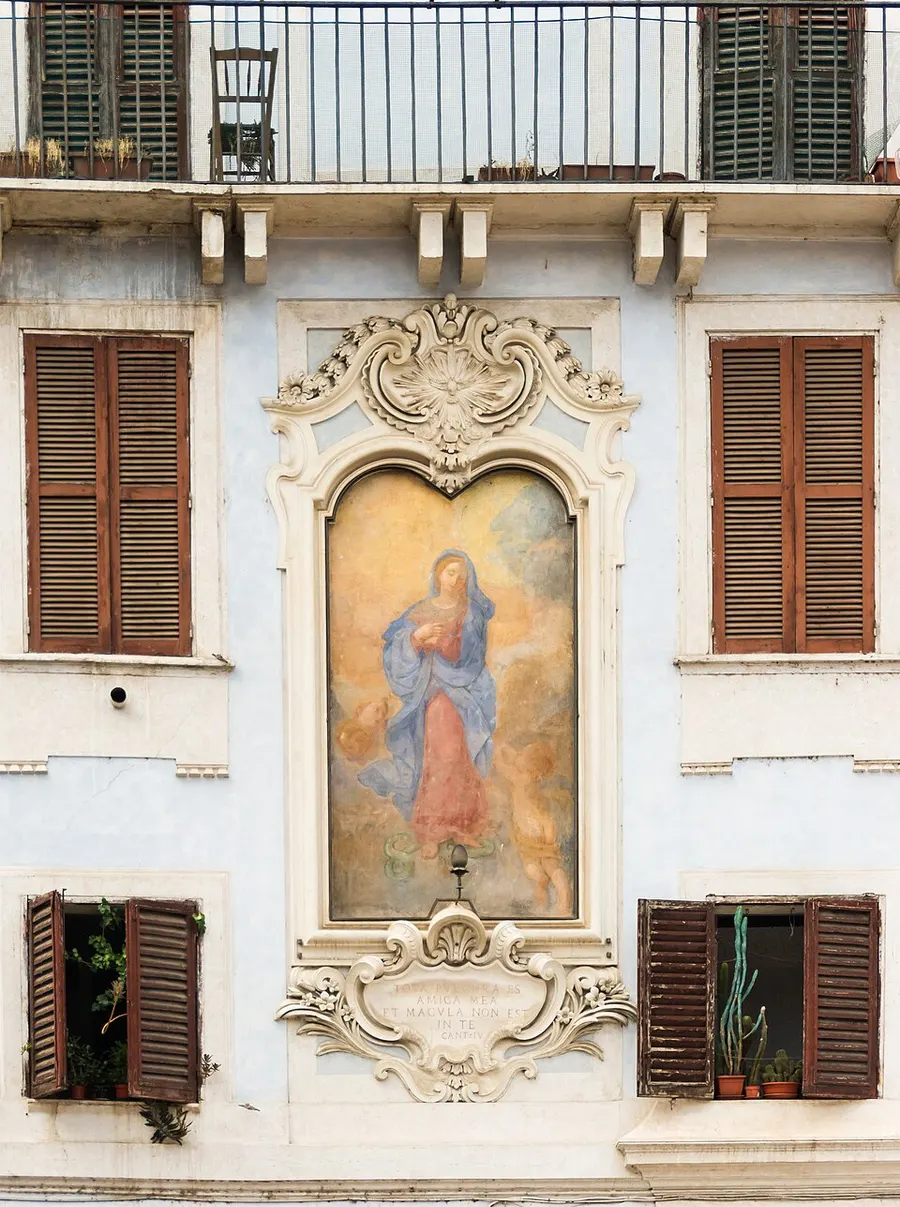
Because it became a church of the Virgin, it escaped the demolition that felled other pagan temples.
In 609 AD the pope consecrated this pagan temple as the church of "St Mary and the Martyrs." That step saved it: medieval Rome tore down nearly every pagan temple, and only the Pantheon, now a church, was preserved whole. That its roof still holds and its doors still hang is owed entirely to this handover of faith.
Sources:Liber Pontificalis (Book of the Popes)
- 🎨 Arts
↑ Because of the last layer:Precisely because it survived intact as a church, the Renaissance masters could measure and learn from this dome with their own hands.
Arts · Raphael Rests Here
The Renaissance master Raphael is buried here by his own wish; its dome inspired every great dome that followed.
Raphael left a dying wish to be buried in the Pantheon — he wanted to lie forever beneath this perfect geometry. And the dome itself became the textbook of the Renaissance: Brunelleschi building the dome of Florence Cathedral, Michelangelo building the dome of St Peter’s, both came back here to measure it and learn from it. An ancient Roman temple, across fourteen centuries, gave the Renaissance a lesson.
🔗 Connects toSources:Vasari, Lives of the Artists
- 📍 Today
Today · You Stand on the Original Floor
Much of the marble floor beneath you is original 2nd-century work, gently draining at the center.
The Pantheon’s most astonishing quality is not how old it is, but how whole. The colored marble floor under your feet is largely original to Hadrian’s day; when rain falls through the oculus, it lands straight on the floor, drained away quietly by the slight central camber and hidden holes. Two thousand years on, it still works exactly as first designed.
Sources:Modern surveys of the Pantheon floor and drainage system
🔭 Meanwhile in the world
In Rome:Hadrian rebuilds the Pantheon, raising the great unreinforced concrete dome.
At the same time, elsewhere:In the same century, Zhang Heng of the Han built his seismoscope, and India’s Kushan Empire was at its height.
🧭 Trails through here
Free email course
Rome in 7 Lessons
Before you go, load the stories behind every stone. Seven emails, Colosseum to Sistine — so on the ground you see more than ruins.
That email didn’t look right — try again?
Free · unsubscribe anytime · Privacy