The Colosseum
📍 Ancient CenterA killing-arena for fifty thousand, raised on the drained private lake of the tyrant Nero — as a gesture of "giving the land back to the people."
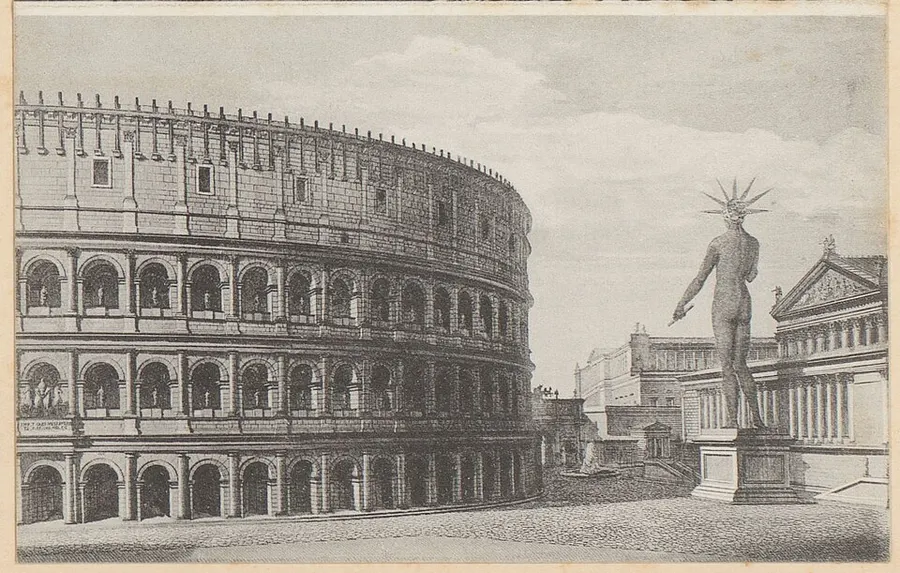
- 🦅 Empire
Empire · The Arena Given Back
Completed in 80 AD: the Flavian emperors drained Nero’s private lake and built a public arena on the spot.
After the tyrant Nero burned his own palace, the Flavian emperors Vespasian and Titus filled in the artificial lake he had seized and, on this "private" ground, built an arena dedicated to all Romans — a political statement written in stone: the land the emperor took is given back to the people. The opening ran a hundred days of beast-hunts, mock sea-battles, and executions. The gladiators were mostly captives and slaves — the revolt of a Spartacus grew out of exactly this system.
🔗 Connects toSources:Suetonius, The Twelve Caesars · Martial, On the Spectacles
- ✝️ Faith
↑ Because of the last layer:Precisely because the empire made it a stage for execution and spectacle, later ages imagined it a holy site of Christian martyrdom.
Faith · The Legend of the Martyrs
From the Middle Ages the Church claimed it as a site of Christian martyrdom — which is what saved it.
After the games ended, the Colosseum became a quarry, its marble stripped to build churches and palaces. It was the legend that "martyrs’ blood was spilled here" that led the Church to consecrate it in the eighteenth century and raise the Stations of the Cross, halting the demolition. Faith gave this pagan ruin a reason to survive.
Sources:Pope Benedict XIV, decree of consecration, 1749
- 📍 Today
↑ Because of the last layer:Faith saved its core, yet did not stop its outer walls being carried off to raise new sanctuaries.
Today · The Half-Missing Ring
The ruin you see is half earthquake, half hauled away to build St Peter’s.
The vanished stretch of the south outer wall is not disaster but harvest — Renaissance Rome treated it as a free stone-yard, and St Peter’s Basilica and the Palazzo Farnese are built partly from its stone. The "ruined" look you see is, in fact, the raw material of another great building.
Sources:Renaissance-era records of quarrying Roman monuments for building stone
🔭 Meanwhile in the world
In Rome:The Colosseum opens with a hundred days of games.
At the same time, elsewhere:In the same era, Ban Chao of the Han was binding together the statelets of the Western Regions, and the Gospel of Matthew had likely just been written.
🧭 Trails through here
Free email course
Rome in 7 Lessons
Before you go, load the stories behind every stone. Seven emails, Colosseum to Sistine — so on the ground you see more than ruins.
That email didn’t look right — try again?
Free · unsubscribe anytime · Privacy