← Versailles🏡 Built 1783–1786🌐 中文
The Queen’s Hamlet and the Petit Trianon
In the back garden of Europe’s largest palace, the queen built a fake village — thatched roofs, dairy cows, a henhouse — to escape the one thing she could not: Versailles itself.
Where it standsThe Trianon Estate · Open grounds · The English garden north of the Petit Trianon — follow the estate map
- ✨ Origin
Origin · An Anti-Versailles
Rousseau taught that nature was true and the court all falsehood — so the queen, who read him, built a "nature" inside the court. The paradox began with the first bundle of thatch.
To read this fake village, first read what it was against. Marie-Antoinette arrived from Vienna at fourteen and fell straight into the panopticon described on our King’s Bedchamber page: watched waking, watched eating, watched giving birth. In 1774 the new king Louis XVI gave her the Petit Trianon — an exquisite neoclassical pavilion — with a sentence scandalous for its time: "This place is yours." She promptly made it an anti-Versailles enclave: entry by the queen’s personal invitation only, the king himself included; etiquette suspended; evening company seated without regard to rank. To the Versailles machine this was not a holiday. It was mutiny.
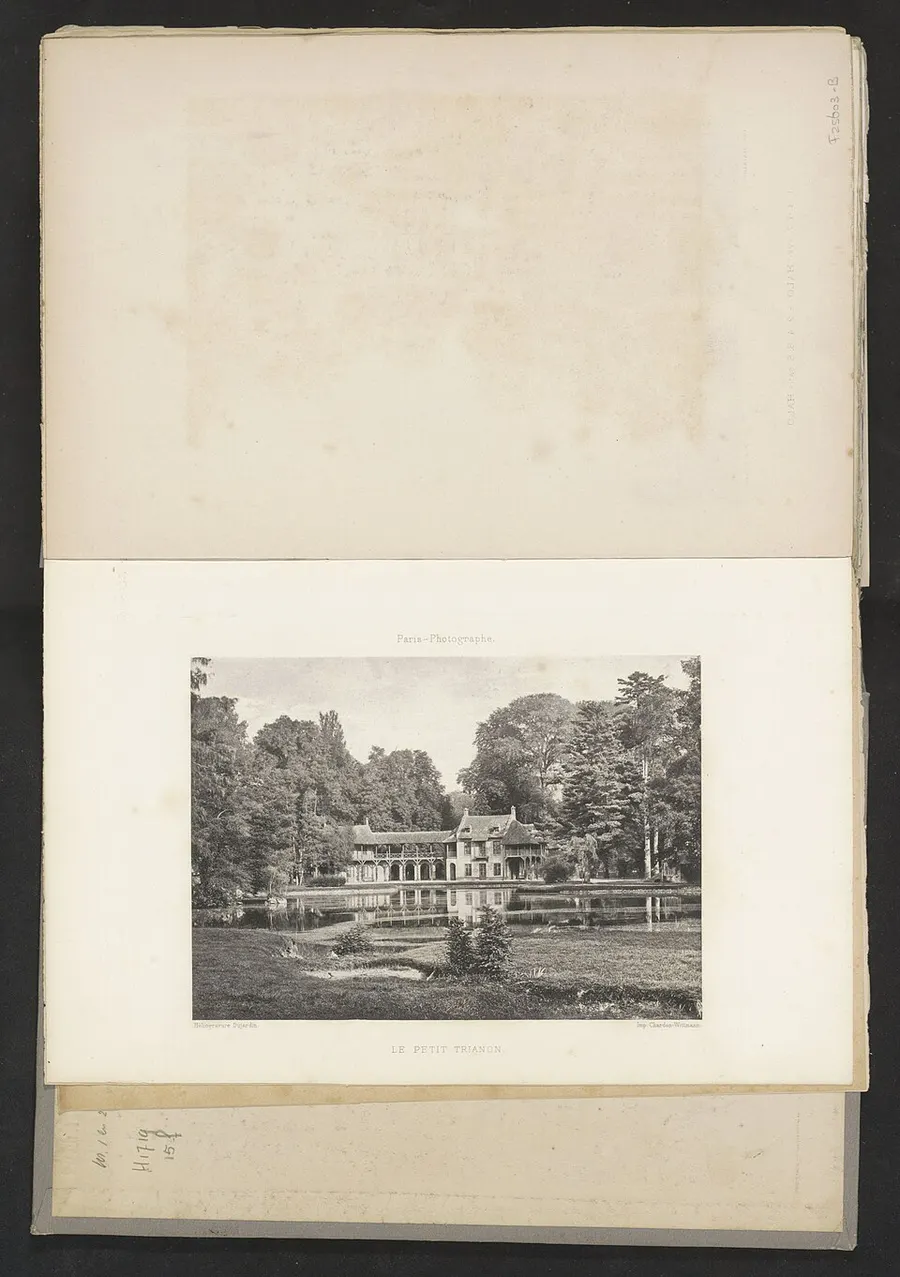
The Hamlet proper rose in 1783–86 to designs by the architect Richard Mique: twelve buildings around an artificial lake — a mill, a dairy, a henhouse, a fishing tower got up as a lighthouse, and the Queen’s House itself — façades artificially aged, painted cracks on the plaster, silk and porcelain within. Nor was it an empty stage set: this was a working farm with a real farmer, its cows and poultry supplying the table; the queen milked and fed hens with her children (Sèvres porcelain milking pails survive). The intellectual ground was Rousseau: Émile and La Nouvelle Héloïse ruled the salons, and "return to nature, work with your hands, let feeling replace etiquette" was the spiritual fashion of that generation of aristocrats. After Rousseau died in 1778 the queen made a pilgrimage to his island grave — homage to the philosopher who had taught her to flee courts. As for the famous tales of perfumed, ribboned sheep — mostly later embroidery, thinly attested in contemporary sources, and flagged as such here.
And here the paradox closes: she spent royal money to escape the royal role, building an expensive fake village to reach for a concept of the "real." Rousseau had attacked the roots of inequality; what crossed the palace wall was only the pastoral imagery. Ideas passing through court walls tend to arrive as decoration.
Connects to💐Marie AntoinetteEuropean HistoryThe Hamlet’s mistress — who built it to escape Versailles📖RousseauPhilosophySource of "return to nature" — the philosopher whose grave she visited in homageSources: Construction archives of the Petit Trianon and the hamlet (Richard Mique's design) · Surviving Sèvres porcelain · Critical review of anecdotes such as the perfumed sheep (little contemporary confirmation, noted as such)
- 🧭 Journey
Journey · The Price of Escape
From the last layerAn order built on being seen cannot forgive the wish to exit — the deeper she hid in the fake village, the more surely the world drew her as a real criminal.
The village she built to hide from the court became, in the world outside, the prosecution’s exhibit: "the queen plays farm with the treasury."
Trianon’s walls kept out courtiers, not imagination. The old nobility excluded by the queen’s invitation system nursed the grudge and painted the enclave as a den of secrets; the pamphleteers of Paris took over from there — "Little Vienna," "the abyss of expense." People barred from a door will furnish the room behind it with whatever they hate most. The Diamond Necklace Affair of 1785 delivered the fatal blow: swindlers bought a colossal necklace in the queen’s forged name, and though the courts cleared her, the public retained one fact only — that everyone had found the purchase believable of her. Reputations are not bankrupted by proof but by plausibility. By 1789 the image of Madame Déficit playing milkmaid in a fake village while the people lacked real bread was the revolution’s most efficient cartoon; squandering the treasury duly appeared among the charges compiled at her trial in 1793.
The village’s physical journey was mild by comparison: neglected after the Revolution, its farmhouses leased to actual farmers — the fake village finally became a real one, history delivering the joke deadpan. Napoleon assigned the Trianon estate to family use; restorations followed across two centuries, the latest waves completing after 2006 (the Queen’s House reopening around 2018), funded in part by fashion houses such as Dior — two hundred years on, the aesthetics industry again paying for her aesthetic legacy, a loop worth savoring.
Seen from today, the Hamlet is a rare psychological document: the person at the very center of European power writing, in architecture, "I want out." Everywhere else Versailles is evidence of power wanting to be seen; this is the one place that is evidence of power wanting to vanish — which may make it the most honest architecture in the whole domain.
Sources: Trial records of the Affair of the Diamond Necklace · Studies of Revolutionary-era pamphlets · Archives of the Trianon restoration after 2006
- 📍 Today
Today · Keep Half a Day, and Walk Where the Crowd Thins
From the last layerReal farmers once ran it, fashion houses paid to restore it — the "authenticity" you feel today is itself the sediment of its two-century journey.
Nine in ten visitors stop at the Hall of Mirrors — those willing to walk twenty more minutes get the quietest, most piercing corner of Versailles.
Practicalities first: the Trianon estate is ticketed separately from the palace (included in the passport ticket), a 20–25 minute walk or a ride on the little train. The hours when the main palace is most crushed are exactly when this corner is emptiest — schedule it for the second half of your day and you beat the crowd by design. Suggested order: Petit Trianon (her private rooms, and the site of the invitation system) → the English garden → the full circuit of the Hamlet’s lake.
Three things at the Hamlet. First, the walls of the Queen’s House: lean close at the "cracks" — they are painted on. The artificial aging is still legible through today’s restoration: an eighteenth-century distressed-finish filter, and the one detail that X-rays the entire project. Second, the dairy and the mill: this was no film set — the dairy really produced, while the mill never ground a single sack (pure ornament). Real and fake alternate building by building, like a psychometric chart of exactly how much reality she wanted. Third, walk to the far bank and look back: twelve thatched roofs doubled in the lake — an image of utterly harmless beauty, and in its day the pamphlets’ favorite exhibit of the queen’s guilt. What separates beauty from indictment? Only whether the viewer stands inside or outside the gate.
Within this site the thread completes a full character arc: the Queen’s Bedchamber (her inside the institution) → here (her in flight) → her figure page in the Europe universe (her road to the scaffold). Read the three stations in sequence and you carry away the heaviest lesson Versailles can give: the first person this palace destroyed was the one who lived at its very center.
Sources: Visitor information for the Trianon estate · Documentation on the reopening of the Queen's Hamlet around 2018