← Versailles🪞 Built 1678–1684🌐 中文
The Hall of Mirrors
One 73-meter corridor holding three centuries of Europe: Louis XIV flaunted power here, the German Empire was proclaimed here, and the First World War was signed to its end here — all before the same wall of mirrors.
Where it standsThe Palace · Main floor, between the King’s and Queen’s apartments · The 73-meter gallery facing the garden axis — follow the visit route
- ✨ Origin
Origin · When Mirrors Were a State Secret
In the 17th century large mirrors were Venetian-monopoly high tech — Louis XIV built this wall by poaching craftsmen and banning imports: the gallery is a declaration of victory in an industrial war.
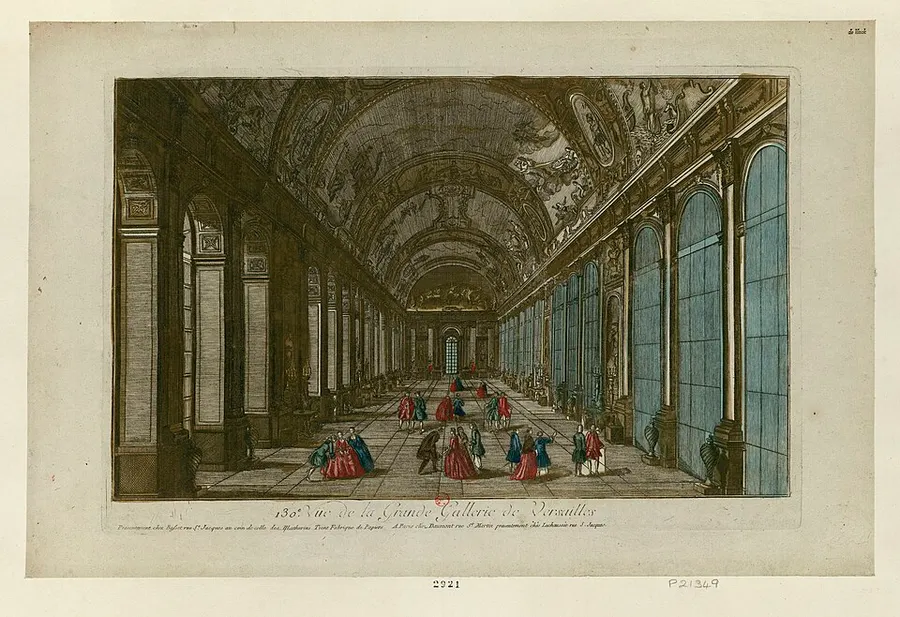
Today you can buy a large mirror with pocket change, which makes 1678 hard to feel: back then only Murano in Venice could make big flat glass mirrors, the craft was a state secret of the Republic, emigrating craftsmen were treated as traitors, and defectors were said to have been poisoned by Venetian agents. A large mirror could cost as much as a master painting. Louis XIV’s minister Colbert lured Murano craftsmen away with gold and diplomatic cover, founded the royal mirror works in Paris (later Saint-Gobain — still making glass today), and banned Venetian imports. The gallery sets 17 mirrored arches against 17 windows — 357 panes in all — and every pane announces: France no longer needs Venice. On opening day, this corridor was the equivalent of lighting a tower with entirely home-grown chips.
The architect was Jules Hardouin-Mansart, who enclosed what had been an open terrace: windows on one side, mirrors on the other, and beyond the windows Le Nôtre’s great garden axis — by day the mirrors drag the whole garden indoors; at dusk the sun sets along the axis and the wall ignites gold. Overhead, Charles Le Brun’s thirty ceiling canvases star no god but Louis XIV himself, a painted chronicle of his wars. Until then, European ceilings belonged to gods and allegories; putting a living monarch up there was presumption of a solar order — absolutism’s bluntest visual claim.
The hall was never a ballroom; it was power’s daily theater. Courtiers crossed it each day hoping to be seen as the king passed; foreign envoys were deliberately made to walk its full 73 meters toward the throne under the gaze of hundreds of mirrors — and of their own reflections. The Siamese embassy of 1686 and the Persian embassy of 1715 were immortalized in paint doing exactly that walk. The space itself is a technique of rule: before you reach the king, his wealth — and your smallness — have already argued his case.
Connects to👑Jules Hardouin-MansartArchitectureArchitect of the hall — the man who turned a terrace into a theater of power☀️Louis XIVEuropean HistoryThe Sun King — the ceiling’s only subject is his own warsSources: Official architectural archives of the Palace of Versailles · Archives of Colbert's royal manufactory (the forerunner of Saint-Gobain) · Records of Le Brun's ceiling-painting program
- 🧭 Journey
Journey · Three Rewrites of Europe Before One Wall
From the last layerPrecisely because it was built as the supreme stage of French power, the enemy came here to crown an emperor and France insisted on returning here for the signature — the holier the stage, the more it attracts humiliation and revenge.
In 1871 the German Empire was proclaimed here — in 1919 the Treaty of Versailles was signed in the same room. Both venues were chosen on purpose.
A room cannot travel, but history kept moving in and redefining it — the hall’s journey is a journey of identity. The first rewrite came in October 1789: the women of Paris marched on Versailles, the royal family was escorted to the capital, the candles went out, and for eighty years the hall was an oversized relic, its furniture auctioned off by the Revolution.
The second rewrite was the cruelest. On 18 January 1871, with Paris under Prussian siege, the German princes were assembled in this gallery to proclaim the German Empire and crown Wilhelm I — the ceremony stage-managed by Bismarck. To crown a German emperor beneath ceiling paintings in which Louis XIV boasts of his victories over German states was humiliation calibrated to the centimeter: the triumphs your Sun King painted on the ceiling, we now invert in his mirrors. France remembered the date for forty-eight years.
The third rewrite was the revenge itself. On 28 June 1919 the victors of the First World War staged the signing of the Treaty of Versailles back in this hall — Clemenceau required the German delegates to sign their defeat in the very room of 1871. The date was chosen with equal care: 28 June, five years to the day since Sarajevo — the day Archduke Franz Ferdinand was shot became the formal full stop of the war that bullet ignited. The treaty’s severity planted the next war’s seeds; Keynes published the prophecy that same year. One corridor, three dates — 1684, 1871, 1919: three centuries of European pride, humiliation and revenge, all caught in the same mirror.
Connects to⚙️BismarckEuropean HistoryStage-managed the 1871 proclamation of the German Empire here💥Archduke Franz FerdinandEuropean HistoryThe treaty was signed here five years to the day after his assassinationSources: Records of the proclamation of the German Empire on 18 January 1871 (painted by Anton von Werner) · Records of the treaty signing on 28 June 1919 · Keynes, The Economic Consequences of the Peace (1919)
- 📍 Today
Today · Three Centuries in Seventy-Three Meters
From the last layerAll three dates happened in a room that never moved — so viewing becomes standing inside the site itself.
One way to walk it: find Louis XIV on the ceiling at the door, hold 1871 at midpoint, hold 1919 before the exit — then turn back once for the axis outside the windows.
Practical first: the Hall of Mirrors is the crowd’s summit at Versailles — the first hour after opening or the last before closing is when it breathes; in a crush, keep to the window side: fewer people, better light, and the axis in view.
Walk it in three beats. First, at the entrance look up: the central ceiling panel, The King Governs Alone (1661), is the whole story’s ignition — Louis XIV at twenty-two abolishing the office of chief minister; the other twenty-nine canvases are the consequences of that decision. He is easy to find: always at the luminous center of the crowd. Second, stop mid-gallery at the mirror wall: on 18 January 1871 the raised swords of the German princes flashed near where you stand — Anton von Werner’s famous Proclamation of the German Empire shows this room from almost this angle; pull the painting up on your phone and hold it against the space, goosebumps guaranteed. Third, near the exit end: the signing table of 28 June 1919 stood by the windows mid-gallery, the room silent as the German delegates signed, guns saluting outside — what they saw is almost exactly what you see. That is what a room-as-exhibit means: nothing was moved to a museum; you are standing inside the original.
Before leaving, turn back to the windows. The garden axis runs straight to the horizon, and on that axis the Apollo Fountain waits (it has its own page here) — the Sun King’s sun-god chariot bursting from the water. To walk from the hall into the garden is to pass from power’s indoor theater to power’s open-air map.
Sources: Palace of Versailles visitor-route notes · Anton von Werner, The Proclamation of the German Empire (for comparison)