← Versailles⛪ 1699–1710🌐 中文
The Royal Chapel
The king heard mass from the upper tribune, the court stood below looking up at the king, and the altar lay at the bottom — even church-space at Versailles ran on hierarchy: men watch the king, the king watches God.
Where it standsThe Palace · Two stories high; the royal tribune on the main floor · Near the start of the visit route — follow signage
- ✨ Origin
Origin · Divine Right, Drawn in Section
Mansart’s final work: a two-story white sanctuary built as the king’s private line to God.
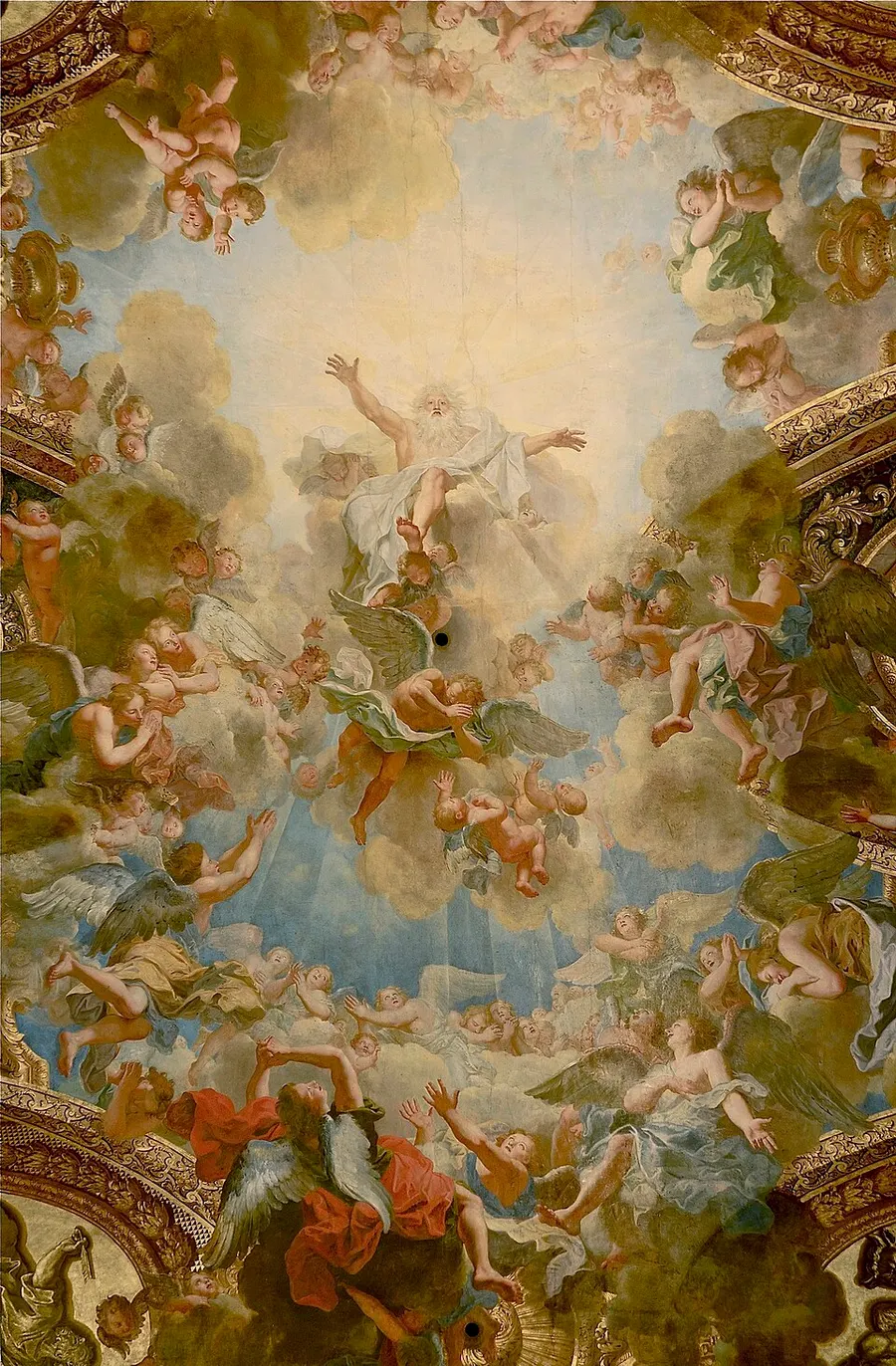
This is the fifth and final chapel of Versailles, begun in 1699 by Jules Hardouin-Mansart — architect of the Hall of Mirrors — completed after his death in 1708 by his brother-in-law Robert de Cotte, and consecrated in 1710: the Sun King’s last great project at Versailles. The first impression is how unlike Versailles it is: no gilded walls, no mirrors — pale stone, white colonnades, light pouring from high windows; contemporaries called it a Hall of Mirrors offered to God. The ceiling triptych presents the Trinity; the organ blazes gold above the altar at the east end — displaced from its traditional west-end perch because the king’s tribune occupies that position. Even the grammar of church space yields to kingship.
The section drawing is the theology: two stories — king and royal family in the upper tribune (level with the palace’s main floor, reachable from the royal apartments without descending a stair), courtiers standing in the nave below, the altar at the far depth. At daily mass all faced the altar — but the records are explicit: the court’s true posture was gazing up at the king in his gallery, while the king alone faced God. "Men watch the king; the king watches God" is not a figure of speech but a spatial fact performed every morning: Divine Right poured in stone, an abstraction you can walk into. In his last years Louis XIV grew devout under Madame de Maintenon’s influence, and the chapel is the spiritual self-portrait of that final phase — the sun of Apollo turning toward the light of God.
It was also the stage for the dynasty’s rites of passage — royal baptisms and weddings. The most consequential came on 16 May 1770: the fifteen-year-old Dauphin Louis married the fourteen-year-old Austrian archduchess Marie-Antoinette here. The two teenagers could not know the wedding was also the old regime’s last great firework: nineteen years later, the same couple would be marched out of this palace by the crowd.
Connects to👑Jules Hardouin-MansartArchitectureThe chapel’s architect — his final work☀️Louis XIVEuropean HistoryThe Sun King turned devout — this was his last great projectSources: Construction archives of the Royal Chapel (Hardouin-Mansart and Robert de Cotte) · Records of the court Mass ritual · Records of the 1770 royal wedding
- 🧭 Journey
Journey · From Sanctuary to Concert Hall
From the last layerLosing its sacred function is what preserved it — as a monument it received a nation-scale restoration the Church itself might never have funded.
The Revolution stripped its sacred function and two centuries of weather ate its stone — the great restoration of 2017–2021 re-stitched it whole.
After 1789 the chapel followed the secularization arc common to European church buildings, only more theatrically: its plate was confiscated and melted in the Revolution, worship ceased, and in the two centuries since it has never returned to regular sacred use. Its identity today is historic monument and concert hall — the core venue of Versailles’ Baroque music seasons, where Lully and Charpentier, who wrote for Louis XIV’s masses, are performed again in the very acoustics they wrote for. The function came full circle: a space born for musical liturgy, inherited at last by the music.
Its physical journey was no less perilous. Water worked through the lead roof and carved stone for generations, and by the early twenty-first century whole ranks of façade statuary stood at the edge of collapse. The 2017–2021 campaign was Versailles’ largest single restoration in half a century: the roof structure rebuilt, lead and gilding relaid, over a thousand stones replaced, and fourteen contemporary carvers re-cutting cornice angels and saints from the original models. Through the works the chapel vanished inside a colossal scaffold cocoon — when it emerged, the Paris press wrote of the chapel "leaving its chrysalis." The campaign leaned deliberately on traditional craft — hand-cut stone, wrought lead — becoming a living exhibition of the trades themselves.
One detail worth keeping: of the roughly thirty million euros, a great share came from private and corporate patronage (Versailles’ standing model — Dior at the Trianon, Rolex and others elsewhere). Three centuries ago this building proclaimed on tax revenue that kingship came from God; today it proclaims on sponsorship that heritage belongs to everyone. The change in the donor list is the ledger of a change in sovereignty.
Sources: Archives of the 2017–2021 chapel restoration · Information on the Versailles Baroque music festival
- 📍 Today
Today · See It From Both Floors
From the last layerThe restoration returned it to its 1710 brightness — the white you see is the white of the Sun King’s final project on its opening day.
The route usually shows it first from the king’s tribune, then from the floor below — take both angles, because the hierarchy is written in sightlines.
This is often the first stop on the palace route, before the crowds thicken — resist the pull toward the Hall of Mirrors; these three minutes pay. From the tribune (the king’s angle): note your relation to the altar — a full story above it, your sightline clearing the courtiers’ heads to land on the sanctuary; this was Louis XIV’s standard morning view, and the illusion of being level with God is calculated architecture. Then descend to the nave (the courtiers’ angle): look up at the tribune rail — three centuries ago your gaze would have met the king’s seat there. Then the white columns and the light: Corinthian orders carrying not a dome but a flat vault with high arched windows — the tall-window luminosity of French Gothic translated into classical dress; specialists call it a Gothic church in classical clothing.
Don’t skip the floor: at the center of the marble inlay, two interlaced L’s — Louis’ monogram is everywhere, including under your feet. The gilded organ above the altar, built in 1710 by the Clicquot dynasty of organ-makers, still sounds in concerts after the restoration — if your dates align with the music season, buy a ticket and hear the room with a courtier’s ears: the reverberation among stone and glass is precisely the splendor Baroque motets were written for.
Two reading lines onward within this site. The wedding line: the two teenagers married here in 1770 — pick up her next nineteen years at the Queen’s Bedchamber and the Hamlet pages, and the ending in the Europe universe; one wedding in one chapel is the opening scene of that whole arc. The power-space line: the chapel (men watch the king, the king watches God) → the King’s Bedchamber (the bed as altar) → the Hall of Mirrors (power’s public stage) — three rooms, three grammars of looking, and together the complete owner’s manual of the Versailles machine.
Connects to💐Marie AntoinetteEuropean HistoryMarried here in 1770 — the first scene of her Versailles yearsSources: Palace of Versailles visitor-route notes · Archives of the Clicquot organ