← The Uffizi🌀 c. 1505–1507🌐 中文
The Doni Tondo
The only finished panel painting universally accepted as Michelangelo’s — the Virgin’s body wound into a sculptural spiral, the nude youths behind her pointing straight at the Sistine ceiling three years on.
Where it livesThe Masters’ Route · Second floor, main route · Room 41, Michelangelo and Raphael — follow signage
- ✨ Origin
Origin · A Sculptor Made to Paint
All his life he signed himself sculptor and scorned the brush — this round panel proves that even painting, he carved.
The commission came from the Florentine merchant Agnolo Doni — by standard account tied to his 1504 marriage to Maddalena Strozzi (both family crests appear on the original frame), and the tondo, the round format, was Florence’s fashion for bridal chambers and family homes. Michelangelo had just raised the David and was the most sought-after sculptor in the city; easel painting sat close to a demotion in his self-image — he would sign letters for the rest of his life "Michelangelo, sculptor."
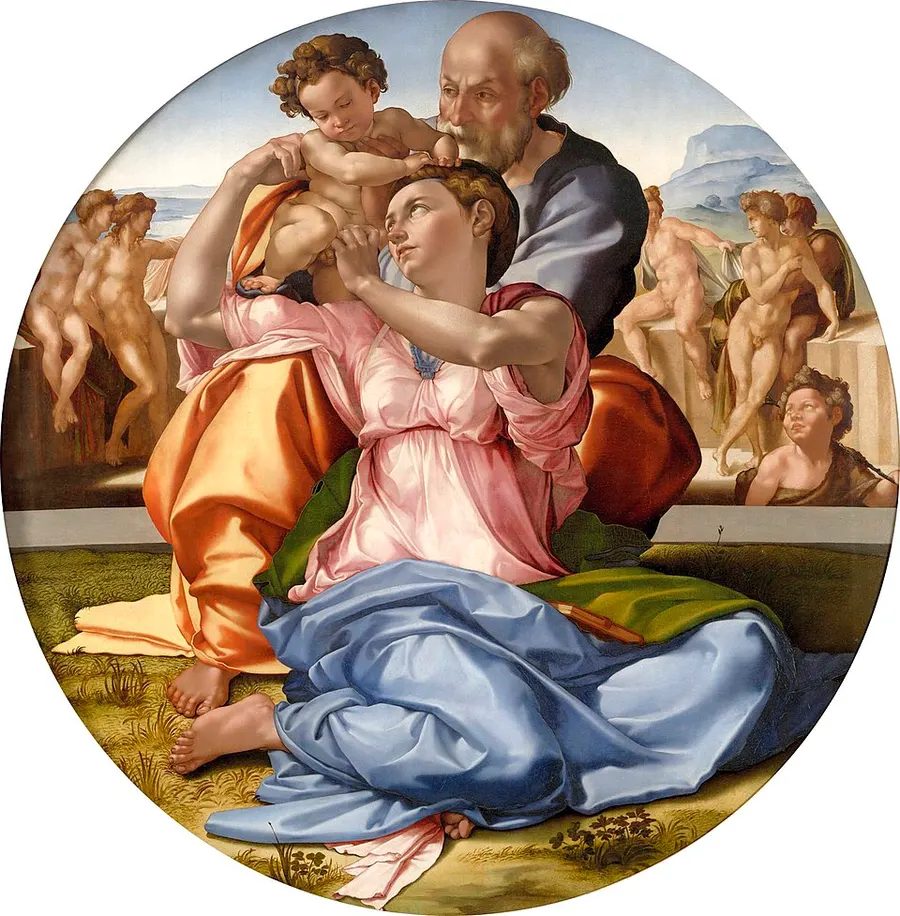
So this panel, about 1.2 meters across, became a demonstration of sculpture performed in pigment. The Virgin does not sit cradling the Child; she wrenches up and back, receiving him over her shoulder from between Joseph’s knees (or handing him up — the direction is debated; recorded as debate): one body holding four actions at once — crouch, twist, turn, reach — the prototype of the figura serpentinata. Color, too, refuses soft transition and glints like polished stone: rose, bright yellow and lake blue swap abruptly at the folds (the cangiante method), an unnatural palette the Mannerists would canonize half a century later.
Most puzzling is the background: behind a low stone parapet five nude youths lounge against one another, narratively unconnected to the Holy Family. The standard reading takes foreground–middle–background as three ages — grace, law, and the pagan world before Christ (the infant Baptist stands exactly in the transitional band), the nudes standing for humanity before revelation; marriage-custom and Neoplatonic readings also circulate, all recorded as interpretation. Whatever the answer, those five bodies are a verifiable trailer: the ignudi of the Sistine ceiling three years later (own page in our Vatican lens) rehearse their entire vocabulary here.
And the famous price story: Vasari has Doni balking at 70 ducats and offering half, whereupon Michelangelo doubled the price to 140 — and was paid. True at Vasari’s word, but it captures precisely what was happening: the artist was ceasing to be a wage-paid craftsman and beginning to price his own genius.
Connects to🌹MaryWorld FaithsThe Virgin wound into a sculptural spiral✝️JesusWorld FaithsThe Child passed over the shoulder🗿MichelangeloArt HistoryThe self-styled sculptor — carving in pigmentSources: Vasari, Lives of the Artists · Research on the coats of arms on the original frame · The "three ages" reading of the background nudes (debated by scholars, presented as such)
- 🧭 Journey
Journey · It Never Left Florence
From the last layerBecause it was a private marriage commission and not church property, it traveled the quiet family-to-duke-to-museum route — the intimacy of the commission set the radius of the journey.
From the Doni house to the Medici collections to the Uffizi’s Tribuna — a journey of under five kilometers, an influence spread across Europe.
Set against the treaty-hauled, war-convoyed objects of our Louvre and Vatican pages, the Doni Tondo’s provenance is a startlingly short straight line: generations in the Doni family, then the Medici collections, entering the grand-ducal gallery that became the Uffizi around 1635, and from the eighteenth century long displayed in the museum’s most exalted room, the octagonal Tribuna. From birth to today it has never left Florence — total physical displacement under five kilometers, with the 1737 Family Pact adding legal insurance to its stillness.
But a painting that does not move is not an influence that does not move. Copies, prints and studies circulated from the sixteenth century; the serpentine twist and the cangiante palette became the starting point for two generations of Mannerists — Pontormo, Bronzino, Rosso — practically a school’s birth certificate. The farther echo is in the Vatican: in 1508 Julius II pressed the unwilling Michelangelo onto the Sistine scaffold, and the hundreds of bodies on that ceiling are this panel enlarged and multiplied (our Vatican lens page on the ceiling tells that four-year ordeal). To read the Doni Tondo is to hold the key to the Sistine — watch one body twist in the Uffizi, then go to Rome and watch three hundred.
The frame deserves its line too: the carved and gilded ring bears five projecting heads (Christ and angels), by standard account designed with Michelangelo’s participation and cut by the Tasso family of woodcarvers — painting and frame are one work, so do not filter the gold ring out as packaging. Two major twentieth-century restorations (the latest concluded with the 2010s rehang) confirmed the paint layer exceptionally intact: the sharp colors you see today stand very close to what the Doni couple hung in their bridal chamber.
Connects to🗿MichelangeloArt HistoryWho scaled this body-vocabulary up to the Sistine three years later🗿MichelangeloEuropean HistoryThe same man on Europe’s map — the genius popes and republics fought overSources: Records of the Medici collection and its display in the Uffizi Tribuna · The Family Pact (Patto di Famiglia, 1737) · Studies of its influence on Mannerism
- 📍 Today
Today · Count the Motions in One Body
From the last layerFour hundred years of standing still made it the most reliable calibration point — the eye you tune here works in Rome, and in every Mannerist gallery after.
Count four directions of motion in the Virgin, then read the nudes behind — a Sistine trailer screened inside the Uffizi.
In Room 41 it usually commands a wall alone, the gilt ring recognizable from far off. Step one, take a motion inventory: legs folding to the lower left, waist twisting right, head tilting back, arms reaching upper right — four directions alive in one body, none dislocated. Compare the Venus you just saw in the Botticelli rooms: Botticelli’s beauty is a matter of contour, Michelangelo’s a matter of torque. The rooms sit minutes apart on foot; between them the Renaissance shifts its center of gravity from line to body.
Step two, go close for the color. Find the Virgin’s right sleeve: rose flips to yellow exactly on the ridge of the fold, no transition — cangiante, two polished faces of a stone changing in the light. Then the flesh: Joseph’s gray hairs cut like chisel marks, the highlights on the Virgin’s arm hard as marble glare. "A sculptor’s painting" is not metaphor here; it is technical description.
Step three, step back for the three depths: Holy Family — infant Baptist — nude youths, the standard "three ages" laid near to far. And look up at the five heads projecting from the frame — the frame is part of the work.
Three onward threads. Venues: the Vatican lens pages on the Sistine ceiling and Last Judgment — this tondo is their prologue; synchronize watches here before Rome. The man: the art-history Michelangelo page for the three-way rivalry with Leonardo and Raphael (Raphael hangs beside him in this very room — compare on the spot). Religion: Mary in the religions universe — read this twisting Virgin against the motionless Virgins of Byzantine icons, and one line of sight covers half the history of the Madonna image.
Sources: Uffizi Gallery display notes · The cangiante technique and restoration reports