← The Uffizi🛏️ 1538🌐 中文
The Venus of Urbino
Titian moved the goddess out of the sea and the grove into a Venetian bedroom — and gave her open eyes that meet yours. Three centuries of the Western nude answer that gaze.
Where it livesThe Masters’ Route · First floor galleries · Room 83, the Titian room — follow signage
- ✨ Origin
Origin · The Order Said "the Nude Woman"
The buyer’s letters never call her Venus, only la donna nuda — the mythological dress came later.
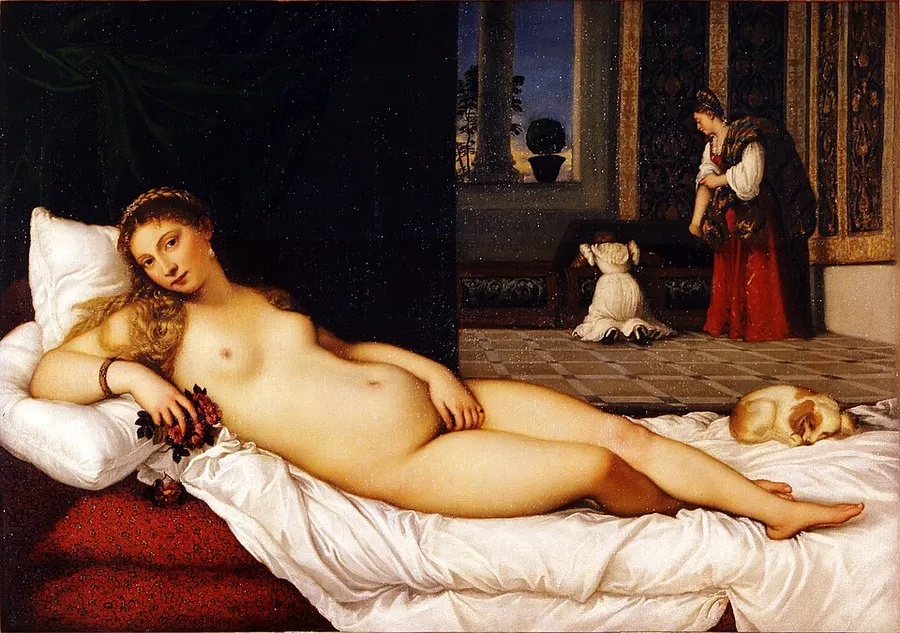
In 1538 Guidobaldo della Rovere, heir to the Duke of Urbino, pressed his agent to collect a picture from Venice; his letters call it, again and again, la donna nuda — "the nude woman." Not once Venus. That naming detail is the key: Titian paints first a credible Venetian bedroom — the couch, the rumpled sheets, evening light at the window, two maids rummaging in the dowry chests (cassoni) in the corner, a small dog asleep at her feet — and only then sets an idealized body inside the real space. "Venus" reads like a respectable label that let a private commission hang decently in a palace.
The composition descends directly from the Sleeping Venus of his master and peer Giorgione (c. 1510, finished by Titian himself after Giorgione’s early death): same recline, same hand. But Titian made two decisive changes — he moved her from wild meadow to interior, and he opened her eyes. A sleeping goddess is an object of viewing; a woman with open eyes is a subject who knows she is seen, and looks back. Who she is remains argued: the marriage-allegory reading (dog = fidelity, chests = household, roses = love — fitting Guidobaldo’s 1534 marriage) runs alongside the courtesan-portrait reading; debated, both recorded. The two agree on one fact: that gaze writes the viewer into the picture — you are no longer outside it; you are what she is looking at.
Technically it is the Venetian manifesto: no Florentine contour, the body built in layered glazes of color and light, warm flesh sounding against deep green curtain and dark red couch through color alone. Florence argued for line (disegno), Venice for color (colorito) — the central quarrel of sixteenth-century Italian art, and this canvas is Venice’s loudest closing statement.
Connects to🎨TitianArt HistoryHead of the Venetian school — building bodies from color, not line🌹AphroditeGreek & RomanThe borrowed name — a goddess-label making a private commission respectableSources: Letter of Guidobaldo della Rovere (referring to "la donna nuda") · Its descent from Giorgione's Sleeping Venus · The dispute over marriage allegory vs. courtesan portrait (debated by scholars, presented as such)
- 🧭 Journey
Journey · A Dowry, a Scandal, and an Echo
From the last layerBecause the original hid the awareness-of-being-seen under a goddess-label, every later tearing of the label — Twain’s fury, Manet’s rewrite — is a sequel to that gaze.
In 1631 it entered the Medici household as della Rovere dowry; three centuries later Manet posed his Olympia the same way, and Paris erupted.
Its first journey was a dynastic marriage: in 1631, the della Rovere line extinct, the last heiress Vittoria married Grand Duke Ferdinando II de’ Medici, and the Urbino collections entered Florence as inheritance — the Venus changed cities as dowry. Long displayed in the Uffizi’s Tribuna, it became compulsory viewing — and compulsory whispering — for the Grand Tour generations; in travel writing of the eighteenth and nineteenth centuries it is "the most dangerous picture in Florence." Mark Twain, in A Tramp Abroad (1880), delivered the famous roar calling it the foulest and most obscene picture the world possesses — an outburst that is itself now a document: it records the genuine discomfort that gaze produced in a Victorian audience.
The real historical echo detonated in Paris. In 1863 Manet painted Olympia on this template: same recline, same hand, same level stare — but the goddess-label torn off. She is a Parisian courtesan; the lapdog is replaced by a bristling black cat, and a maid presents a client’s bouquet. At the 1865 Salon the outrage proved the critics had understood perfectly: Manet stripped away Titian’s respectable mythological wrapping and put the naked fact — you are looking at a woman who knows she is looked at — on the table. Olympia hangs today in the Musée d’Orsay (our Orsay lens gives that scandal its own page) — so the two paintings footnote each other across the Alps and three centuries: see the original gaze in the Uffizi, then watch it ignite modernity at Orsay.
One wartime aside: during the Second World War it was evacuated with much of the Uffizi to castles in the Tuscan countryside, escaping bombardment and looting before returning (per the museum’s records).
Connects to🎩Édouard ManetArt HistoryWho rewrote her as Olympia in 1863🎨TitianArt HistoryAuthor of the original gazeSources: Archives of the 1631 della Rovere inheritance · Mark Twain, A Tramp Abroad (1880) · Studies of its influence on Manet's Olympia
- 📍 Today
Today · Meet the Gaze
From the last layerManet’s rewrite raised the original in retrospect — the spot where you stand before her is a viewing platform built by three centuries of argument.
Stand in the line of her sight and take the three seconds of being seen by a painting — then read every prop in the room as testimony.
Room 83 sits on the first floor, a stretch past the Botticelli crowds, and usually runs calm. First, the simple thing: stand square before the picture and meet her gaze — neither invitation nor shyness, but a calm knowingness. Compare these three seconds with your minutes before the Birth of Venus: Botticelli’s goddess looks past you into vacancy; Titian’s looks at you. The Western tradition of the viewer being viewed by the painting has one of its principal springs here.
Second, read the painting as a room, every prop a piece of testimony: the sleeping lapdog (fidelity — or its irony, depending on your school); the two maids and the open dowry chests behind (the housekeeping code of marriage); the small roses in her right hand (Venus’ flower, and a bride’s); the potted myrtle on the windowsill (Venus’ sacred plant — the picture’s one piece of hard mythological evidence). The full ammunition of both the marriage and the courtesan readings lies in these few square meters; you may judge the case on site.
Third, the craft: go close to the flesh — no contour line anywhere, modeling carried entirely by shifts of color; then watch the grays of the rumpled sheet and the curtain’s deep green push the body’s warmth forward. This is colorito, Venice’s answer.
Three onward threads. Scandal: the Orsay lens’ Olympia page — the same pose igniting Paris three centuries on; the pair is this site’s model cross-museum connection. People: the art-history Titian page (the Venetian line) and the Manet page (modernity’s opening). Myth: back to Aphrodite in the Greek universe, tracing the long depreciation and reappreciation of the name "Venus" — from theogony to a bedroom label.
Sources: Uffizi Gallery display notes · Studies of the Venetian school's colorito technique