← The Uffizi🛡️ c. 1597–1598🌐 中文
Medusa (Caravaggio)
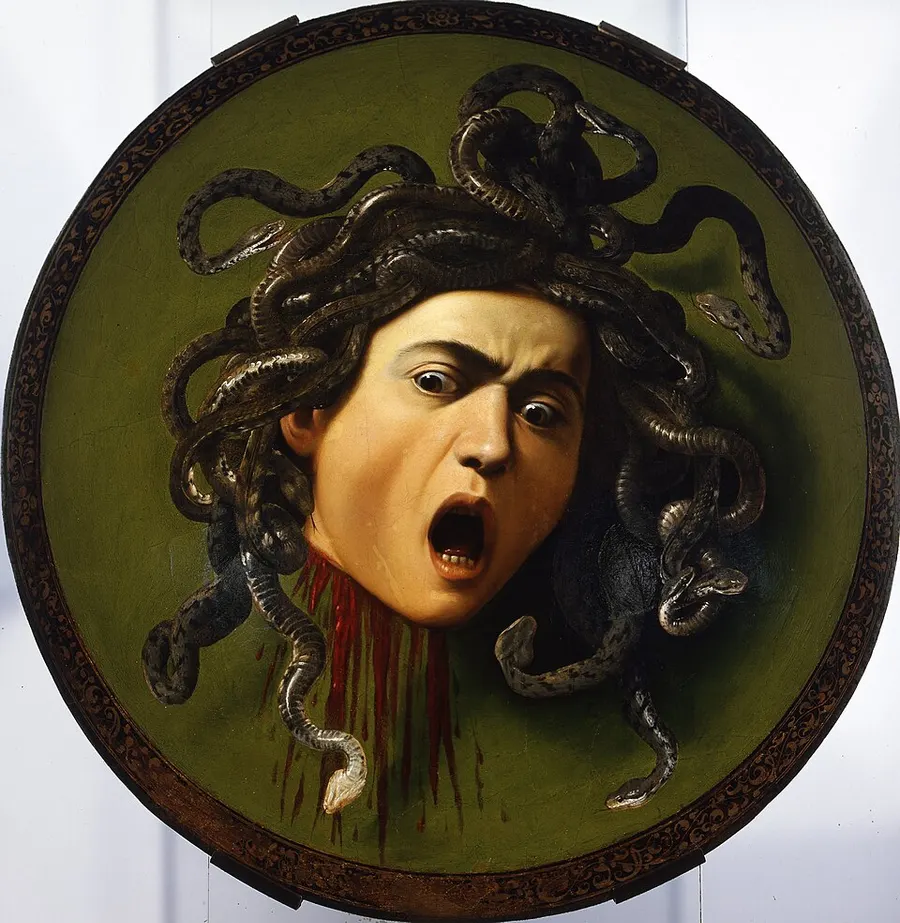
A beheading painted on a convex wooden shield — the snakes still writhing, the mouth still crying, and the face, by standard account, Caravaggio’s own.
Where it livesThe Caravaggio Rooms · First floor galleries · Around Room 90 — follow signage
- ✨ Origin
Origin · Painting Himself as the Monster
In the myth Perseus beheads the Gorgon by watching her in a mirrored shield — Caravaggio turns the shield itself into the painting, and gives the monster his own face.
The mythological ground first. Medusa was a mortal woman, violated by Poseidon in Athena’s temple (or his lover there — the ancient versions contradict one another; both recorded), and transformed by the goddess into a snake-haired Gorgon whose gaze turned all to stone. The hero Perseus, sent for her head, used the polished shield Athena gave him as a rear-view mirror, never meeting her eyes, and struck — and the severed head, still petrifying in death, ended fixed upon Athena’s own shield, the aegis. A Medusa painted on a shield is therefore no painter’s whim; it closes the myth’s own loop. Her head belongs on a shield.
Around 1597 Cardinal del Monte in Rome — then Caravaggio’s protector — needed a gift for Grand Duke Ferdinando I de’ Medici of Tuscany. He chose an actual ceremonial wooden shield, convex, some 55 cm across, and set his violent-tempered young painter to work on it. Caravaggio did two things that entered history. First, an optical trick: the surface bulges outward, yet with light and shadow he makes it read as hollow — the head seems to hang in darkness behind the shield’s face, the blood jetting from the neck on your side of the plane. Second, the model: the standard account (supported by comparison with his self-portraits and by early sources) holds that the wide-eyed, screaming face is the painter’s own. And the instant he chose is the cruelest available: not fear before the blade, not stillness after, but the moment of being dead and still conscious — she has just seen her own death.
Why paint yourself as the beheaded monster? No document answers; only the life that followed annotates. Caravaggio painted decapitation again and again — Judith and Holofernes, David with the Head of Goliath, where Goliath’s head is likewise a self-portrait; in 1606 he killed a man in fact, was condemned to death, and died a fugitive four years later. Placing himself in the victim’s position was this man’s basic posture toward the world.
Connects to🐍MedusaGreek & RomanThe subject — a monster the gods made and a hero beheaded🛡️PerseusGreek & RomanThe mirror-shield beheader — this shield replays his weapon🦉AthenaGreek & RomanAuthor of the curse, final wearer of the head🕯️CaravaggioArt HistoryThe painter who lent the monster his faceSources: Ovid, Metamorphoses, Book IV · Variant versions of the Poseidon episode (presented as such) · The self-portrait theory (the common view, compared with contemporary self-portraits)
- 🧭 Journey
Journey · A Diplomatic Gift Strapped to a Suit of Armor
From the last layerBecause it was made a real shield and not an easel picture, it spent its first life in an armory rather than a gallery — the support decided what it was first seen as.
Delivered to Florence in 1598, it was strapped to the arm of a Persian-armored mannequin in the Medici armory — displayed as a weapon for two centuries.
The shield’s first address was not a gallery but an armory. Arriving in Florence around 1598 as del Monte’s gift (whether timed to a dynastic occasion is debated in the sources), it was treated by the Medici as a genuine ceremonial weapon: inventory records show it mounted on a wooden mannequin dressed in Persian armor, gripped on the figure’s left arm, displayed among swords and firearms. For the first two centuries of its life, that is, viewers saw it as one sees a famous blade — a magical piece of equipment, a living replica of Athena’s aegis. The court poet Marino wrote verses on it, casting the Grand Duke as shield-bearing Perseus; the gift’s political subtext was legible to everyone — may Medici power petrify its enemies as the Gorgon’s head does.
Its passage from weapon back to painting tracks the growth of the very concept of the artwork. After the Medici line ended and the 1737 Family Pact bound the collections to Florence, the armory was gradually dispersed and the shield entered the Uffizi’s galleries in the nineteenth century — onto a wall at last, at picture-viewing distance. Twentieth-century imaging (X-ray, infrared reflectography) confirmed revisions beneath the surface and clarified its relation to a privately held "first Medusa" (the so-called Murtola version, c. 1596) — the full account of the two versions remains discussed; recorded as such.
The major restoration of 2002–2003 stabilized the cracking wood and lifting paint, and its report confirmed one moving detail: the shield’s back still carries the pads and strap-marks of its parade harness — the physical evidence of its two hundred years as a weapon survives.
Sources: Inventory archives of the Medici armoury · Giambattista Marino's poem · The 2002–2003 restoration report and the dispute over the Murtola version (debated by scholars)
- 📍 Today
Today · Watch Convex Play Concave
From the last layerIts armory centuries left a unique viewing hint: see it once as equipment — imagine it advancing on an arm toward you — and you are closer to its intent than any picture-frame context allows.
Approach from the side — confirm the surface bulges, then step to the front and watch it hollow itself. The illusion takes five seconds.
The Caravaggio rooms come late in the Uffizi route, on the first floor, when most visitors are worn down — and this shield conveniently asks not for long contemplation but for one maneuver. Approach from the side: confirm the wood genuinely bulges toward you. Then step to the front: the head abruptly sinks into a black well behind the surface. Walk it twice and you have personally run art history’s most famous convex-concave trick — depth forged from gradients of light, your eye seeing "deep" while knowing "flat," even "bulging."
Then stop at the face. The knotted brows spell not ferocity but disbelief; the mouth hangs between a scream and a gasp; the eyes do not meet yours — she stares into the void below, at what has just happened to her. Set this against the Greek universe’s Medusa figure page on this site: the myth wrote her a monster, Caravaggio paints her a victim. That angle of sympathy is seventeenth-century — and startlingly modern.
Third look, snakes and blood: no two snakes twist in the same direction (painted, tradition says, from live water-snakes; recorded as tradition), and the jets from the neck verge on the ornamental — savage content, cool handling: the Caravaggio signature.
Three onward threads. Myth: Medusa, Perseus and Athena in the Greek universe — victim, executioner and rule-maker, the triangle from which all this shield’s tension flows. The man: the art-history Caravaggio page, the full arc from Roman star to killer on the run (our religions universe’s David-and-Goliath figure page carries the picture where he paints himself as Goliath). The city: three minutes’ walk from the museum door, Cellini’s bronze Perseus of 1554 stands in the Loggia dei Lanzi — Medusa’s head aloft, her body underfoot. The head inside the shield and the head above the square face each other across the street: Florence keeps both sides of one myth within a ten-minute walk.
Sources: Uffizi Gallery display notes · Optical analysis of the convex illusion · Cellini's Perseus (Piazza della Signoria)