🕊️Thought & FaithWorld Faiths
🏠 Home🌐 中文
World FaithsFAITHS
☯️

Laozi

NameLi Er (one account of his name)

Founder of Daoism, Author of the Dao De Jing

Where the Faith Begins · Founding Prophets & Central Figures
DaoismThe Dao De JingNon-Action

Who they are

Daoist tradition honors Laozi as its founder and as "the Supreme Elder Lord." According to the Records of the Grand Historian, he served as keeper of the Zhou archives (roughly a national librarian), and Confucius once sought instruction from him on ritual. Legend says that in old age, seeing the Zhou dynasty decline, he rode west out of the Hangu Pass and, at the keeper Yin Xi’s request, left behind the five-thousand-word Dao De Jing before vanishing without a trace. The Dao De Jing opens with "the Dao that can be spoken is not the eternal Dao" and expounds "the Dao follows nature" and "govern by non-action" — the shared core classic of Daoist philosophy and the later Daoist religion.

Primary sourcesThe Dao De Jing (Laozi)

Key stories

Confucius Asks Laozi About Ritual
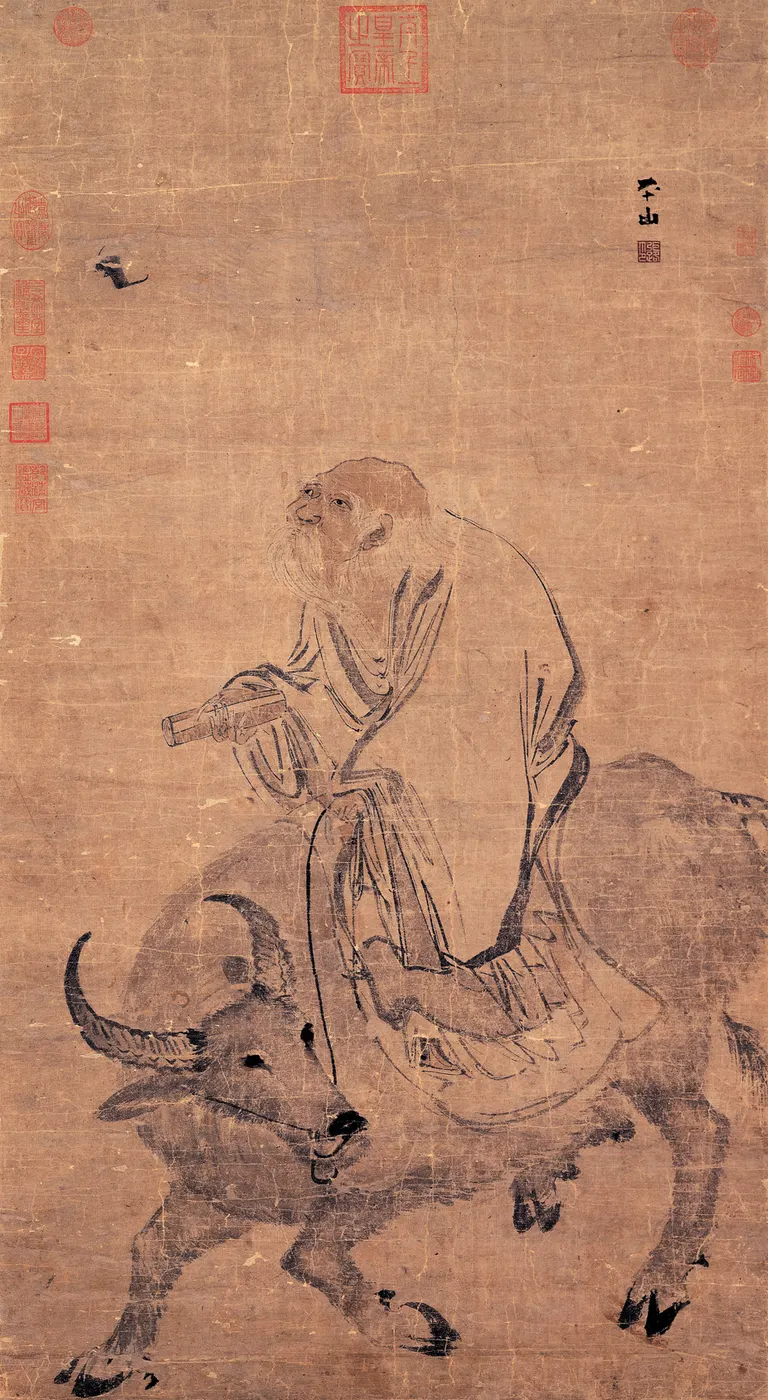
Laozi Riding an Ox
Laozi Riding an Ox · Zhang Lu, Ming dynasty

The Records of the Grand Historian records that Confucius once went specially to consult Laozi on ritual. Laozi admonished him: "a good merchant hides his goods as if empty; a gentleman of full virtue looks as though a fool," urging Confucius to shed his pride and his many desires. Returning, Confucius sighed to his disciples that Laozi was like a dragon "riding the wind and clouds up to heaven," beyond fathoming — a scene often cited as the meeting point of Confucian and Daoist thought.

Purple Vapor From the East, Writing at Hangu Pass

It is said that Laozi, seeing the house of Zhou in decay, rode a green ox west into seclusion; the keeper of Hangu Pass, Yin Xi, saw a purple vapor coming from the east and knew a sage was near, and begged Laozi to leave a work before departing. Laozi then wrote the five thousand words, in two parts — the "Classic of the Dao" and the "Classic of Virtue" — the Dao De Jing, and passed out of the gate, his fate a mystery ever after.

Version differences

Laozi’s historicity is debated among scholars, and Sima Qian’s Records of the Grand Historian itself preserves several accounts of his life; later Daoism deified Laozi as the "Supreme Elder Lord," an evolution at the level of religious faith, distinct from the philosophical Laozi of the Dao De Jing text. What this "Laozi" entry presents is the historical image of the thinker.

Relationships

Echoes today

Below are how modern works borrow or reinterpret this name or story — not the original material. The two differ, so keep them apart.

"Govern by non-action" (idiom)In modern Chinese, often used for a management style that does not over-intervene and follows the natural course, straight from the Dao De Jing’s core political-philosophical concept.
The taiji diagram (yin-yang fish)The emblematic symbol of Daoism, widely appearing in modern design, martial arts, and pop culture, symbolizing the cosmology of yin and yang mutually giving rise to and completing each other.

Appears in

Curiosity mailCurious about world civilization? Leave your email — we’ll tell you when there’s something worth a look.

Free · unsubscribe anytime · Privacy