🦉Thought & FaithPhilosophy
🏠 Home🌐 中文
PhilosophyAGORA
🌑

Schopenhauer

Original nameArthur Schopenhauer

German Philosopher, Representative of Voluntarist Pessimism

Those Who Reanswered "How Should We Live" · Modern & Contemporary Thinkers
VoluntarismPessimist PhilosophyEast–West Comparative Philosophy

Who they are

Arthur Schopenhauer (1788–1860) was a German philosopher deeply inspired by Kant’s distinction of "phenomenon and thing-in-itself," yet proposing an answer utterly different from Kant’s: the thing-in-itself is not unknowable but is in fact the blind, endless, never-satisfied "will to live" (Will), and all natural phenomena and human behavior are in essence the objectification of this irrational primal will. Because the will itself is forever in a state of craving without satisfaction, life is therefore in essence full of suffering — even when some desire is momentarily satisfied, what follows is often not lasting joy but emptiness and boredom, immediately to be driven again by new desire, round and round, forming the famous pessimistic undertone of his system. In his later years he was one of the earliest Western philosophers to systematically study and highly esteem the thought of the Hindu Upanishads and Buddhist philosophy, holding that the Buddhist wisdom of "liberation" chimed with his own thought of "momentarily transcending suffering through the denial of will and aesthetic contemplation" — an important pioneer of East–West comparative philosophy in the history of Western philosophy.

Primary sourcesSchopenhauer, The World as Will and Representation

Key stories

Life as a Pendulum

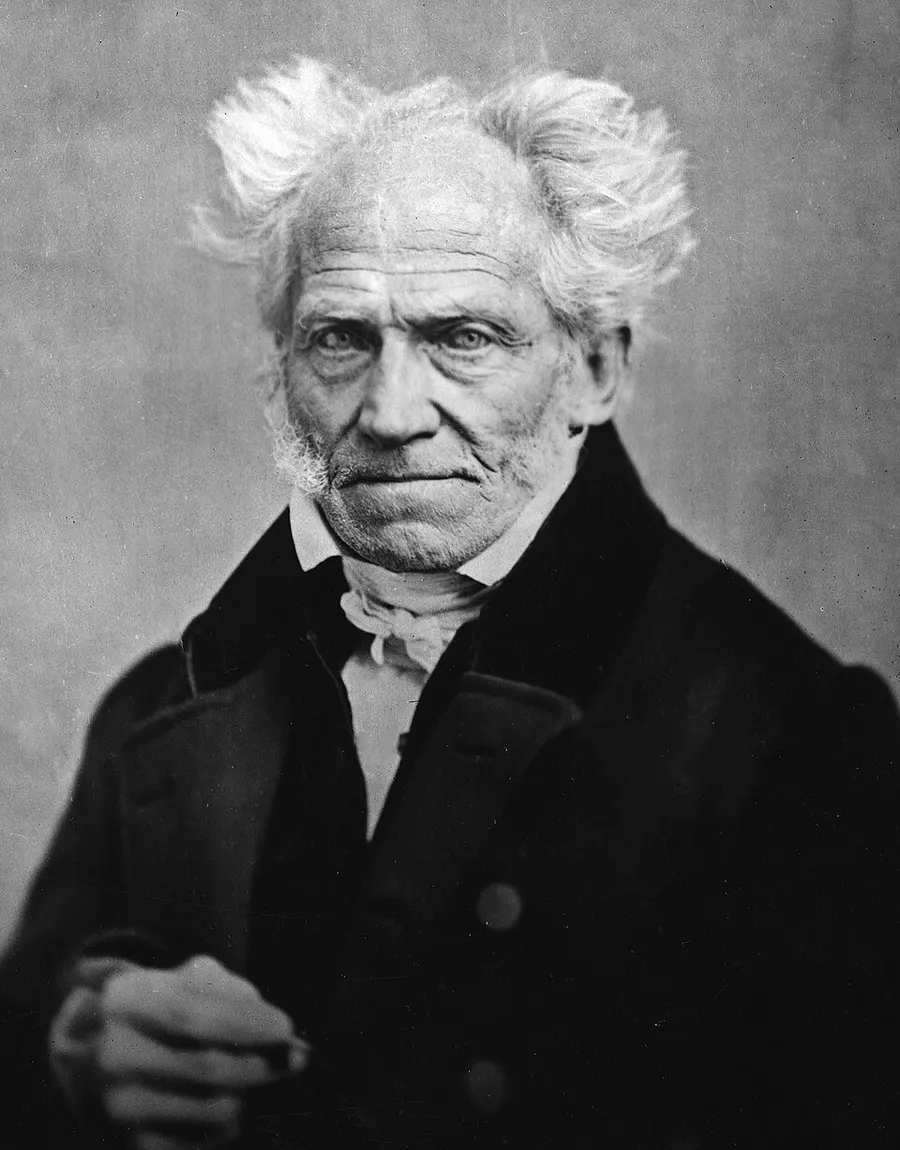
Arthur Schopenhauer
Arthur Schopenhauer · photograph by J. Schäfer, 1859

Schopenhauer likened life to a pendulum swinging between suffering and boredom: when a desire is unsatisfied, one sinks into the suffering of seeking and not attaining; once a desire is satisfied, the suffering recedes for a moment, only to be soon replaced by the emptiness and boredom of "having nothing to do," giving rise in turn to new desire, so that life circles endlessly between these two poles, never at peace — a pessimistic conclusion later partly inherited and fundamentally reversed by Nietzsche (who held that one should actively affirm this eternal craving itself, rather than seek to deny or flee it).

The Showdown of Lecturing at the Same Hour as Hegel

In his youth Schopenhauer taught at the University of Berlin and deliberately scheduled his own course at the same hour as the then-ascendant Hegel, seeking to prove that his philosophy could draw more listeners — with the result that his classroom stood all but empty, hardly anyone attending; this self-assured but face-losing "showdown" also reflects, from the side, how he long failed to win the recognition he deserved in his lifetime, rising to fame only gradually in his later years.

Relationships

Mentor

Echoes today

Below are how modern works borrow or reinterpret this name or story — not the original material. The two differ, so keep them apart.

The "pendulum theory" (a common metaphor)The metaphor of likening life to a pendulum swinging between suffering and boredom is still widely cited to discuss the cycle of desire in modern consumer society.

Appears in

Curiosity mailCurious about world civilization? Leave your email — we’ll tell you when there’s something worth a look.

Free · unsubscribe anytime · Privacy