← The Musée d’Orsay🐈 Painted 1863, exhibited 1865🌐 中文
Olympia
The same reclining nude had been painted since Titian without a blush — Manet changed one thing: she looks straight at you. Paris exploded. The scandal-year-zero of modern art begins with that gaze.
Where it livesThe Middle Galleries · Ground level, Manet galleries · Around Room 14 — follow signage
- ✨ Origin
Origin · Swapping the Goddess for the Neighbor
The composition quotes Titian’s Venus of Urbino stroke for stroke — but Venus has become a Parisian courtesan, and drowsy modesty a level, wide-awake stare.
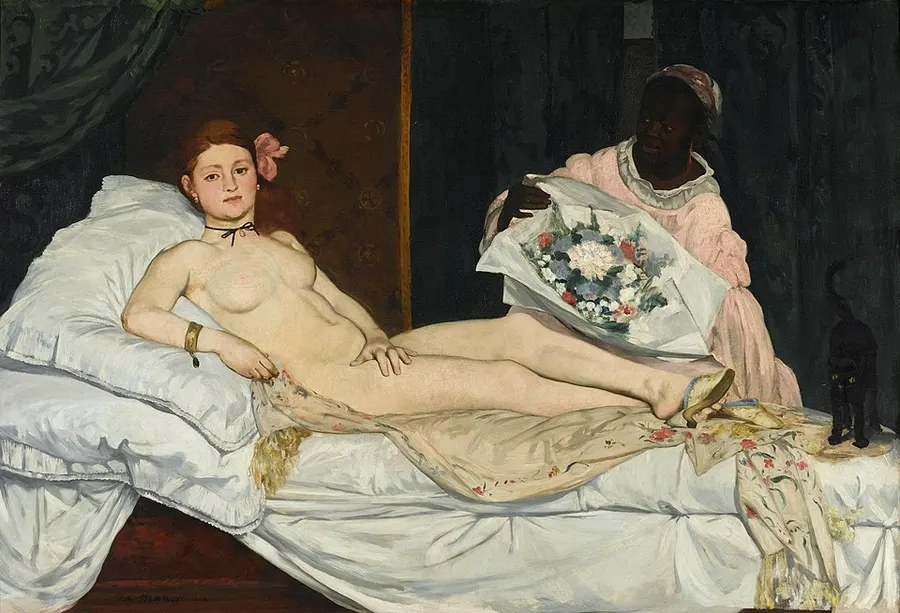
To read this painting, first see what it copies. In 1863 the thirty-one-year-old Manet built it on Titian’s Venus of Urbino of 1538: the same reclining nude, the same bed and curtain, the same attendant at right. In academic tradition this was not theft but the high road — a nude was fine art so long as she bore the name Venus and gazed mistily elsewhere. Manet dismantled the pact clause by clause: the goddess became a contemporary Parisian courtesan ("Olympia" was a fashionable nom de guerre of the demi-monde), the faithful dog at Venus’ feet (emblem of fidelity) became a black cat with arched back and raised fur, the servant’s bouquet announced a client in the wings — and, most lethal, the gaze: no modesty, no aversion, chin level, looking calmly straight at you. The viewer, one second a gentleman appreciating art, is the next second a customer being seen.
The model was Victorine Meurent — Manet’s model of choice and a painter herself (she died poor; her own work has only recently been recovered). The same year she appears in Manet’s other bomb, Le Déjeuner sur l’herbe: the same level stare, the same uproar. Together the two canvases were a controlled demolition of the academic nude: Manet proved the scandal was never nakedness, but the admission that this is a real woman, here and now.
The handling was provocation too. The academy built porcelain flesh from countless glazes; Manet laid on broad flat planes under a hard frontal light, the body lit as if by flash — critics jeered at "the playing-card figure," "the color of a corpse," while Cézanne would later say that flatness opened everything. Standard art history now sets Olympia at the threshold of modern painting — not for what it shows, but for refusing four centuries of painting’s pretense that it was not painting.
Sources: Comparison with Titian's Venus of Urbino (Uffizi) · Collected reviews from the 1865 Salon · Studies on the life of Victorine Meurent
- 🧭 Journey
Journey · From Public Enemy to National Relic
From the last layerBecause the gaze made accomplices of its viewers, the fury was volcanic — and the same gaze is why the next generation refused to let it leave France.
At the 1865 Salon it was rehung near the ceiling to keep canes away — twenty-five years later Monet raised a national subscription to buy it for France.
When the 1865 Salon opened, the scene before Olympia bordered on riot: crowds jeered, canes were brandished — press reports tell of attempts to run the canvas through — and the administration rehung it high above a doorway, "too high to reach or see." Caricatures mauled her for weeks; Manet wrote to Baudelaire that insults were falling on him like hail. For the next two decades the painting was effectively homeless, remaining with Manet until his death in 1883 — at once the most famous and the most unsellable picture in Paris.
The turn came from his peers. In 1889, on word that an American buyer was circling, Monet acted: he opened a public subscription, gathered some twenty thousand francs over two years from painters, writers and collectors, bought Olympia from Manet’s widow, and in 1890 presented it to the French state — on condition it enter the national collections. It is one of art history’s rare scenes: a canonization crowdfunded by artists, nailing yesterday’s scandal into the nation’s scripture. The painting entered the Musée du Luxembourg (then the holding house for living and newly dead artists), and in 1907, at the instance of Prime Minister Clemenceau — Manet’s old friend — moved into the Louvre itself: the scandal hung among the Titians, the class-jump complete. It passed to the Jeu de Paume’s Impressionist galleries in 1947, and to Orsay in the great migration of 1986.
From hung-at-the-ceiling-against-canes to crown of the national museum took eighty years. The curve has been replayed ever since — by the Impressionists entire, by Van Gogh, by every avant-garde of the twentieth century: pilloried first, enshrined after. Olympia’s journey is the type specimen of that curve.
Sources: Press reports and caricatures from the 1865 Salon · Manet's letters to Baudelaire · Archives of the 1889–90 subscription and donation · Records of its 1907 entry into the Louvre
- 📍 Today
Today · Meet the Gaze
From the last layerCanonization never defused it — the curators hang her at eye level precisely so you can take the 1865 shock yourself.
The experiment is simple: stand square before her and hold the stare for ten seconds — a hundred and sixty years on, the charge has not drained.
Run the experiment before the details: stand square, about two meters off, and hold her gaze. Most people break within seconds — congratulations, you have reproduced the Paris reflex of 1865. The mechanism rewards dissection: her eyes sit near the geometric center of the canvas, pupils painted sharp and certain (contrast Titian’s Venus: gaze adrift, focus dissolved); add the lifted chin and the hand pressed on the thigh — not a hand of modesty but a hand that says this far — and three details lock the painting’s power relation: who is looking, who is looked at, and who decides.
Then the four emblems, in order. ① The black cat — back arched, fur up, eyes round, planted at the bed’s foot facing you: the antonym of the faithful dog, and a bawdy pun of the day painted in plain sight. ② The bouquet — still in its paper, a client’s compliment just delivered, the servant’s face asking what reply to send. ③ The black ribbon at the throat and the one slipper — two accessories that make nakedness more naked; it was exactly this half-undressed actuality that enraged the critics. ④ The signature — Manet signed on the bedsheet, like a proof of presence.
Three onward threads on this site. Art history: the Monet and Degas pages in this museum — it was Olympia’s battlefield that cleared their ground; then the Titian line and the odalisques in our Louvre lens, and between the two museums you can walk the whole arc of the nude’s descent from goddess to person. Women: pick up our "Women Who Ruled" trail and the Art History universe — women looked at and women in power are recto and verso of one history. Provenance: from hung-at-the-ceiling to bought-by-subscription, set beside our Van Gogh page (unsold in life) and the Louvre’s Liberty page (hidden by the state) — three endings for the unaccepted, completing the spectrum of art’s relations with its age.
Sources: Musée d'Orsay display notes · Standard studies interpreting the painting's iconography