← The Musée d’Orsay🚪 1880–1917, never declared finished🌐 中文
The Gates of Hell (Plaster Original)
A door Rodin made for a museum never built, worked for thirty-seven years and never finished — The Thinker and The Kiss both climbed down from this gate.
Where it livesThe Great Nave · The sculpture terraces of the nave · At the head of the nave — follow signage
- ✨ Origin
Origin · A Door Opened onto Dante’s Hell
An 1880 state commission: a bronze portal for a future museum of decorative arts, subject open — Rodin chose Dante’s Inferno.
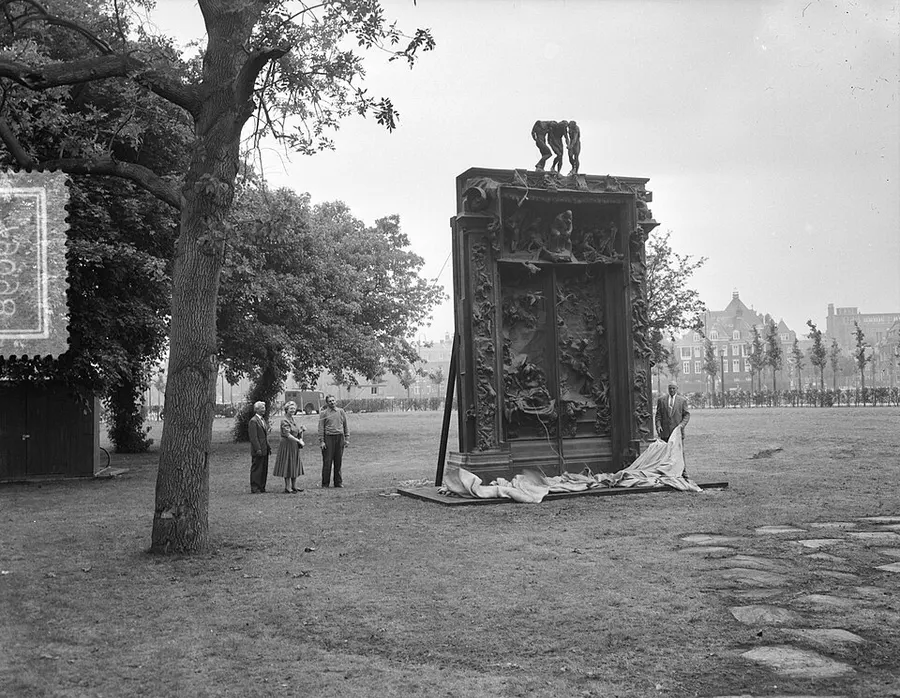
In 1880 Rodin, forty, had just won the libel war over The Age of Bronze — a figure so lifelike the jury suspected him of casting from a living body — and his star was rising. The French state offered a dignified commission: a monumental bronze portal for a planned museum of decorative arts, subject at his discretion. Rodin chose Dante — he had carried the Commedia for years — and took the Inferno as his program: above the lintel The Thinker gazing into the pit (first titled The Poet — Dante himself); across the panels nearly two hundred figures falling, clutching, boiling over — Paolo and Francesca (later freed as The Kiss), Ugolino crawling over his starved sons, three bowed spirits ringed together (The Three Shades). The reference was legible to everyone: Ghiberti’s Gates of Paradise on the Florence Baptistery — Rodin would make the nineteenth century’s answering Gates of Hell.
Then came sculpture’s most famous unfinished project: the museum was cancelled within a few years and the client evaporated — but Rodin could not stop. For thirty-seven years the door became his private cosmos and casting-tank of characters: figures added, cut, shifted, then enlarged into independent works — The Thinker, The Kiss, The Three Shades, Ugolino, the Crouching Woman… most of the celebrated sculptures of his later life are alumni of this door. The door itself stayed forever in progress: at his self-financed pavilion at the 1900 World’s Fair he exhibited the plaster — deliberately stripped of most of its projecting figures. Asked when it would be finished, he answered, in substance: were the cathedrals ever finished?
Deeper still, the door marks a turn in the idea of sculpture itself. Its figures refuse architectural order, surging half-in half-out of the surface — incompletion converted from defect into method (a lesson Rodin took from Michelangelo’s unfinished Slaves on his 1876 pilgrimage to Italy). Modern sculpture’s creed that the fragment can be whole squeezed out, one could say, through the crack of this unfinished door.
Connects to🤔Auguste RodinArt HistoryThirty-seven years at work on one door🔥DanteClassical LiteratureDirector of the door’s two hundred figures — author of the Inferno🗿MichelangeloArt HistoryTeacher of incompletion-as-method — object of Rodin’s Italian pilgrimageSources: Archives of the 1880 government commission · Records of Rodin's solo exhibition at the 1900 World's Fair · Corresponding scenes in Dante's Inferno (Paolo and Francesca: Canto V; Ugolino: Canto XXXIII)
- 🧭 Journey
Journey · The Door’s Several Afterlives
From the last layerBecause it went unfinalized for thirty-seven years, the unique working-state plaster exists at all — incompletion became its most complete form.
Rodin never saw the door cast in bronze — the plaster before you is the working state he left at his death in 1917.
Version-criticism first: in Rodin’s lifetime the door was never cast — he never stopped revising, never declared it done. At his death in 1917 his will gave his entire estate and casting rights to France (founding the Musée Rodin), and from his plasters several bronzes were then cast — Paris, Philadelphia, Tokyo, Stanford — **every bronze Gates of Hell is posthumous**. What stands at Orsay is the thing closer to Rodin’s hand than any bronze: the plaster line, arrested at the state of his last touch. To see a bronze is to see the work; to see the plaster is to see the workbench.
Its berth at Orsay carries a geographic destiny too: when Rodin showed the door in his self-built pavilion at the 1900 World’s Fair, the pavilion stood by the place de l’Alma, minutes from here — and the Gare d’Orsay was infrastructure for that very fair. Door and station were classmates of 1900; eighty-six years later the classmates met under one roof when Orsay opened in 1986 and set later-nineteenth-century sculpture along the nave’s platforms, this door closing the sequence at its head. The curatorial logic locks tight: Orsay narrates the birth of modernity, and this door is that birth on sculpture’s side.
Its spawned universe had long since gone global: The Thinker, enlarged and cast, became perhaps the most reproduced sculpture on earth — campus gates to cemeteries, including Rodin’s own grave, where one sits watching over his sleep; The Kiss, freed from the door, turned so tender the world forgot its source — few recall that in Dante the lovers are lashed by the winds of hell. A door never hung in any building ended by dispatching its population across the planet.
Sources: Archives of Rodin's bequest and the founding of the Musée Rodin (1917) · Records of the posthumous bronze casts in various collections · Documentation of the Pavillon de l'Alma at the 1900 World's Fair
- 📍 Today
Today · Spot the Celebrities on the Door
From the last layerOnly the working plaster makes the search possible — bronze hands you conclusions; plaster hands you the process.
A missing-persons list: the Thinker on the lintel, the proto-Kiss at lower right, Ugolino at left — each find snaps a world-famous sculpture back into place.
It stands at the head of the nave, over six meters tall — first back away and take the whole door in: the Ghiberti-style skeleton of lintel, twin valves and jambs is still faintly legible, but the figures have long since burst every gridline. Then run the search. ① Lintel center: the small original Thinker sits in place — watch him overlooking the throng here, then recall every enlarged version you have met: he was Dante, contemplating the hell he wrote. ② Above him at the crown: The Three Shades, one body cloned three times at different angles of bowing — in Dante they point to the inscription "abandon all hope, you who enter." ③ Mid-lower panels: hunt the entangled pairs; the proto-Kiss, Paolo and Francesca, hides in the churn of the right valve (position varies by version — failing to find them is no defeat: Rodin at one stage removed them as too happy for hell, a widely told remark filed as anecdote). ④ Left valve: Ugolino on all fours crawling over his children — the most harrowing scene of Inferno XXXIII.
The plaster is a bonus, not a compromise: without bronze’s glare, the relief reads clearer in matte white — and up close you can trace mold seams and Rodin’s own revisions. Few spots in the museum bring you nearer the artist’s hand.
Three onward threads. Literature: the Dante page in our Literature universe holds the full map of the Commedia; and read this door beside our Vatican Last Judgment page — Michelangelo’s Charon comes from the same poet, and the pair shows how one poem fed Western art for four centuries. Sculpture: the Rodin and Michelangelo pages in Art History join into the lineage of the aesthetics of the unfinished. And the city thread: from the door, look up at the vault — door and station, classmates of 1900; you are standing in their reunion.
Sources: Musée d'Orsay display notes · Correspondence with Cantos III, V, and XXXIII of the Inferno