← The Musée d’Orsay🩰 Original in wax, 1878–1881; this is a posthumous bronze cast🌐 中文
Little Dancer Aged Fourteen
The only sculpture Degas ever exhibited: a wax girl with real hair, a real tutu, a real ribbon — reviled in 1881 as a specimen of criminality. She was a fourteen-year-old ballet student.
Where it livesThe Middle Galleries · The Degas galleries · In her own vitrine — follow signage
- ✨ Origin
Origin · Wax, Real Hair and a Ribbon
Degas broke sculpture’s oldest rule: no bronze, no marble — tinted wax, dressed in actual clothes. The critics detonated on sight.
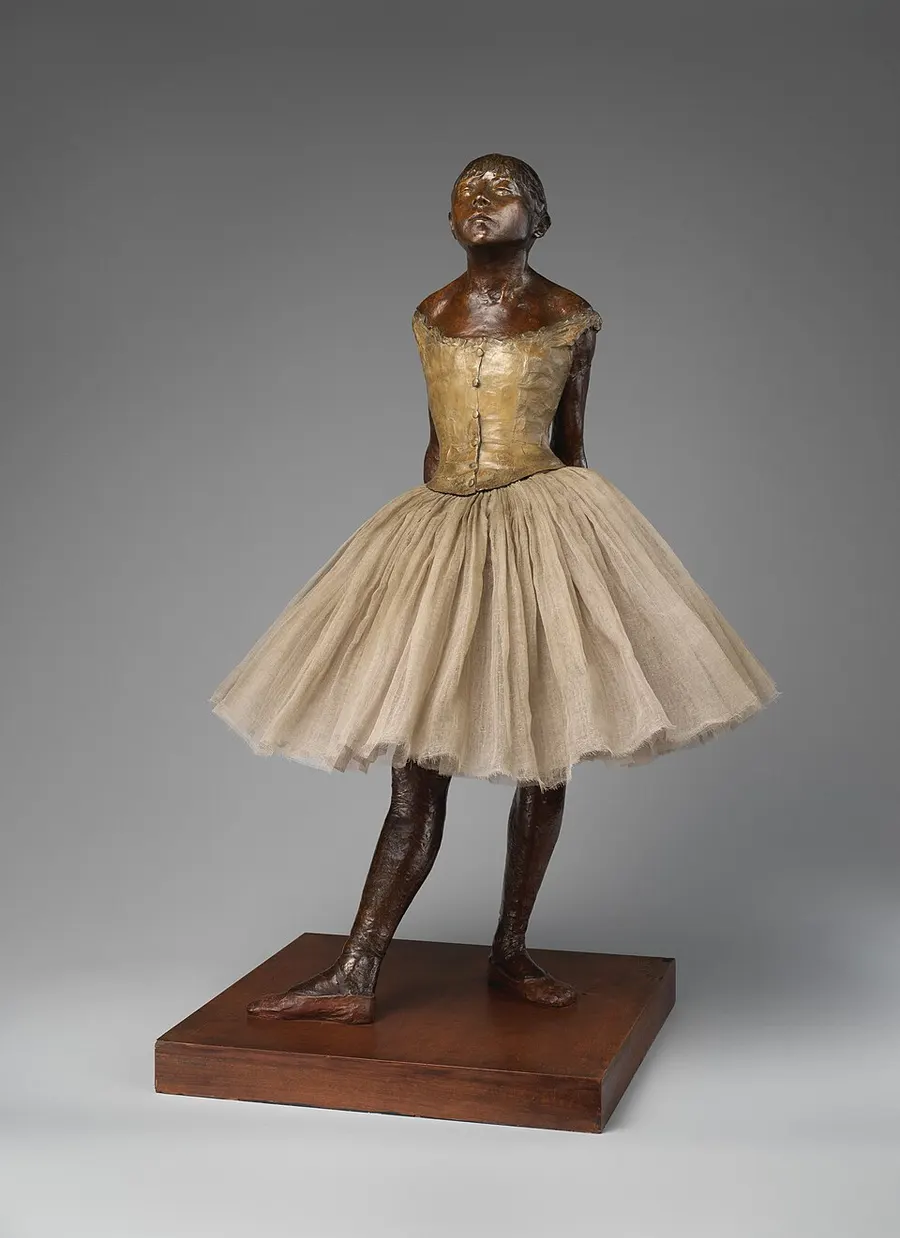
The model was Marie van Goethem, daughter of poor Belgian immigrants and a student of the Paris Opera ballet school — the girls its era called petits rats: poor, drilled daily, their small wages feeding families, and always under the gaze of the wealthy "protectors" who haunted the wings. Degas drew her again and again: three-quarter stance, hands clasped behind, chin defiantly lifted — fourth position, worn with an unflattering, unappeasing tiredness. Between 1878 and 1881 he built the figure in tinted wax at two-thirds life size, then committed sculpture’s scandal of the century: colored wax imitating skin, a real horsehair wig, an actual fabric bodice and tulle tutu, a real satin ribbon in the plait — the line between sculpture and waxworks, between art and the actual object, punctured in one gesture.
At the sixth Impressionist exhibition of 1881 she appeared in a glass case — the only sculpture Degas ever showed in his life. The reception was catastrophic: critics called the face "bestial," "ape-like," and the cruelest reviews borrowed the era’s fashionable Lombrosian criminal physiognomy outright — a "specimen of degeneracy" belonging in a pathology museum, not an art gallery. The vitrine poured fuel on it: exactly how medical and anthropological specimens were then displayed. Half the fury aimed at the heresy of materials; the other half at class — to set a petit rat un-idealized inside the temple of art was to drag the social reality behind the Opera’s velvet curtain into the light.
Degas withdrew her to his studio for the remaining thirty-six years of his life, never exhibited her again, and refused to cast her in bronze — wax, he said in substance, was more alive. She and nearly a hundred wax studies were rediscovered by the world only at his death in 1917.
Sources: Collected reviews of the sixth Impressionist exhibition (1881) · Studies on the life of Marie van Goethem · Contemporary accounts that Degas refused to cast the work in bronze (paraphrased, noted as such)
- 🧭 Journey
Journey · One Wax Daughter, Many Bronze Sisters
From the last layerBecause Degas refused the bronze and locked her away, nearly all her public life happened after his death — thirty-six years of silence, then a century of noise.
After Degas died in 1917 his heirs authorized the bronzes he had withheld — the wax original now lives in Washington, her bronze sisters worldwide, one of them at Orsay.
After Degas’ death about a hundred and fifty wax and clay figures were inventoried in his studio, most cracked or collapsed — the Little Dancer the best preserved among them. From 1918 his heirs contracted the Hébrard foundry to cast some seventy of them in bronze, in editions of roughly twenty-odd — **every bronze Little Dancer is posthumous** — with the tutu still of real fabric and the ribbon still real satin, the original’s transgression of mixed materials faithfully carried over. From the 1920s the bronzes entered the great museums and the market: Orsay, Tate, the Met each keep one; and since 2009 individual casts have repeatedly broken auction records for sculpture — the figure once consigned to the "pathology museum" now the most expensive girl in the market.
The wax original traveled the more storied road: acquired in the Mellon line of American collectors and given around 1999 by Paul and Bunny Mellon, she now stands in the National Gallery in Washington — the real hair and the century-old tutu intact. As for Marie herself: dismissed from the Opera for missed classes soon after the scandal, she then vanishes from the record — researchers to this day chase only scraps. Every transfer of the statue is documented; no ledger tracked the model. That asymmetry is the work’s sharpest footnote.
And the reversal of reputation runs the curve this site keeps meeting (see our Olympia and Van Gogh pages): the "criminal specimen" of 1881 is today a core text wherever the nineteenth century’s child labor, class and the ethics of looking are written about; since the 2010s her story has become musicals and novels, and Marie van Goethem — the expelled petit rat — has finally, a hundred and forty years on, become the protagonist.
Sources: Archives of the Hébrard foundry casts (from 1918) · Collection records of the wax sculpture at the National Gallery of Art, Washington · Scholarly literature on Marie van Goethem
- 📍 Today
Today · Circle the Vitrine and Re-See Her for 1881
From the last layerHer bronze sisters let her stand in a dozen cities at once — and on this one the tulle is still being replaced: the journey is present tense.
Three stations: the lifted chin, the hands behind the back, the hem of the real tutu — then ask yourself: what in this face was ever "criminal"?
She stands in a freestanding vitrine you can circle fully — a display that reenacts the original 1881 staging (a glass case then too), its meaning inverted: the same box, once a specimen jar, now a reliquary. Take three stations as you circle. One, front-left, the face: eyes closed, chin lifted — not arrogance but the switched-off fatigue of a body holding a position too long; recall what the critics read into this face and you have touched the violence of looking in the age of physiognomy. Two, from behind at an angle, the hands: clasped and stretched behind her, drawing the shoulder blades tight — daily ballet discipline, and a whole body visibly under regulation. Three, close in at the material borders: bronze skin, actual tulle, a satin bow — three substances meeting on one body; tulle ages, and the museums periodically re-dress her, so the skirt you see is a living component: this sculpture still requires a wardrobe.
Use the neighbors for contrast: Degas’ ballet paintings and pastels nearby show the stage’s glitter against this backstage exhaustion — recto and verso of one Opera; his bathers show the same eye trained on every body that is not posing.
Three threads onward. The ethics of looking: read with Olympia — the watched courtesan and the watched child worker; Manet and Degas demolishing one wall from two doors. Class: the relevant figures in our Wealth and Power universes — nineteenth-century Paris’s shine and the petits rats’ wages sit on one balance sheet. And the fame curve: Olympia (reviled → national treasure), Van Gogh (unseen → deified), the Little Dancer (specimen → protagonist) — three curves completed within one museum floor. It is Orsay’s most honest lesson as the museum of modernity: modernity invented not only new ways of painting, but new ways of being seen — and of being overlooked.
Sources: Musée d'Orsay display notes · Records of the replacement and conservation of the tutu