← The Musée d’Orsay🚉 1877🌐 中文
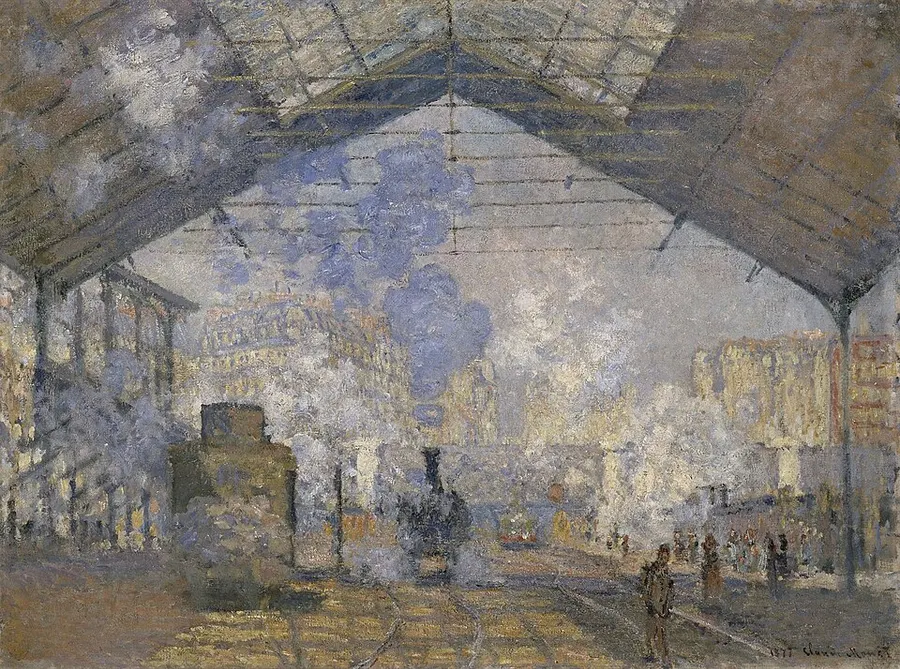
The Gare Saint-Lazare
Monet talked the stationmaster into "performing" steam for him and set up his easel on the platforms for a dozen canvases — Impressionism’s declaration that steam and iron deserve painting as much as water lilies.
Where it livesThe Upper Impressionist Gallery · Level 5, Monet galleries · The Impressionist gallery — follow signage
- ✨ Origin
Origin · An Easel Planted in the Industrial Age
Early in 1877 Monet put on his best clothes, presented himself to the stationmaster as "Monet, the painter" — and, once approved, directed steam like a dispatcher.
By the famous anecdote passed down through Renoir’s son Jean: early in 1877 the penniless Monet dressed in his finest, presented his card, and asked to see the stationmaster of Saint-Lazare. The official had never heard of any Monet, but the bearing impressed him — permission was granted, locomotives were held, fireboxes stoked, steam blown on request, departures even briefly delayed so the vapor could pile into clouds beneath the glass roof (details per family anecdote, flagged as such). Over the following three months Monet planted his easel on platforms and trackside and painted roughly a dozen Saint-Lazares — one station under changing hours, weathers and angles: some face the great shed, steam glowing blue-violet against the light; others take the switchyard outside, the iron of the Pont de l’Europe slicing the sky. It was the first systematic rehearsal of his later series method — haystacks, Rouen Cathedral, water lilies: the true subject not the thing but light and time.
Why a railway station? The choice was the manifesto. The academy held that history, myth and heroes deserved paint; Baudelaire had called since 1863 for painters of "the heroism of modern life." Saint-Lazare was the busiest station in Paris and the Impressionists’ own gateway — Monet rode from it to paint at Argenteuil, and the trains to the Normandy coast left from its platforms. To choose it was to declare: the cathedrals of our age are stations, and the clouds of our age are steam. At the third Impressionist exhibition in April 1877 seven of the canvases hung together — the critics split as usual, but even Zola wrote the defense: our artists must find the poetry of stations as their fathers found that of forests and rivers.
Technically it was a gamble: to paint steam is to paint what is vanishing, its contours changing by the minute. Monet chased the swelling vapor with short slanted strokes, banished black from the shadows in favor of blues, violets and rose-greys — and set the geometry of iron against the turbulence of cloud, industry and nature squaring off as equals on one canvas for the first time.
Connects to🌅MonetArt HistoryThe man with the easel on the platform — the series method premieres hereSources: The stationmaster anecdote relayed by Jean Renoir (given as anecdote) · Catalogue of the third Impressionist exhibition (1877) · Zola's 1877 review
- 🧭 Journey
Journey · From Ridiculed Steam to the National Collection
From the last layerBecause it painted the cathedral of its age, fate housed it at last inside one — a station taking in a station.
The "illegible steam" scattered into private hands, then trickled into the public collections — reuniting in 1986 with its twin station at Orsay.
At the 1877 exhibition the canvases reaped mockery in equal measure with praise — one critic sneered at "hallucinations of locomotives," steam painted as if the pigment had not dried. Yet unlike Olympia’s public-enemy fate, the Saint-Lazare series found its believers fast: the department-store magnate Ernest Hoschedé, Impressionism’s die-hard collector (after his bankruptcy his wife Alice would later marry Monet — art history’s private entanglements never untangle), the dealer Durand-Ruel and others bought in. The dozen canvases then scattered like stars: Chicago, the National Gallery in London, Harvard’s Fogg — one apiece. Orsay’s Gare Saint-Lazare — the classic view straight into the shed — entered the national collections through the line of great donors around Count Isaac de Camondo: first the Louvre, then the Jeu de Paume in 1947, then Orsay in the great migration of 1986.
That last move gave the painting an exhibition context unique on earth: an 1877 canvas of a steam station hanging inside a steam-age station of 1900. As you stand before it on Orsay’s upper level, the same species of iron-and-glass roof arcs over your head — painting and building footnoting each other. The twin reading formed by this page and our Station page is Orsay’s greatest Easter egg.
The longer echo runs through art history: the method Monet drilled at Saint-Lazare — one subject under many lights — grew into the Rouen Cathedral series fifteen years on and the water lilies thirty years on: from painting things to painting time itself. Twentieth-century critics, looking back, conventionally set the Saint-Lazare series as the first milestone on that road; and the act of painting industry as epic passed onward to the Futurists, the Precisionists, and the infrastructure photographers of our own day. Three months on a platform; an echo of a century and a half.
Sources: Records of the dispersal and collecting of the series · Archives of the Camondo donation · Records of the 1986 transfer to the museum
- 📍 Today
Today · Look Up and Match the Password
From the last layerThe station-housing-station context gives this canvas a layer it has nowhere else — a layer collectible only in person.
One movement while you look: lift your eyes from the glass roof in the paint to the glass roof above your head — in a second, 1877 and 1900 shake hands.
No painting in Orsay rewards the inside-outside game like this one. Step one, stand square: let the shed’s triangular glass roof fill your eyes — see how the backlit steam is built from broken strokes of blue, violet and rose-grey, with scarcely one stroke of actual white; the black locomotive is the heaviest anchor in the picture, holding down the whole rising chaos. Step two, look up: Orsay’s own vault and glass hang above you — the twin from the same engineering age. Step three, optional ritual: afterwards, go behind the great clock on this floor and look at the Seine through the dial — in one painting, one building and one clock you have walked the full circle of steam-age Paris.
Three close readings. ① The small figures on the platform — travelers and railwaymen in a few strokes, faceless yet each with a posture: Monet’s interest in people has yielded to light, one of the watersheds dividing Impressionism from all painting before it. ② The rails and points along the lower edge, throwing back the sky like silver cracks. ③ The apartment blocks of the Europe quarter ghosting through the steam at right: city, machine and weather sharing one breath.
Onward: our Station page (the building itself) is this painting’s twin — read them together; the Monet figure page in the Art History universe shows what the method became (haystacks → cathedrals → water lilies); for the counterpart, return to Olympia — Manet moved the modern person into paint, Monet the modern scene, and between them painting annexed the nineteenth century. And one cross-universe egg: in our History of Technology universe wait the railway engineers of the Stephenson line — the man who painted this steam and the men who made it stand two clicks apart on this site.
Sources: Musée d'Orsay display notes