← The Musée d’Orsay🚂 Opened 1900; museum since 1986🌐 中文
The Gare d’Orsay (the Building Itself)
Exhibit number one is the building: a railway station rushed up for the 1900 World’s Fair, nearly demolished for a parking lot in the 1970s — now holding the world’s greatest trove of Impressionism.
Where it livesThe Great Nave · The whole building · Look up as you enter — the two golden clocks are your landmarks
- ✨ Origin
Origin · A Railway Station Hidden in Stone
Forbidden to bare iron on the elegant Left Bank, the architect wrapped a steel station in a classical stone shell — and wrapped up a prophecy.
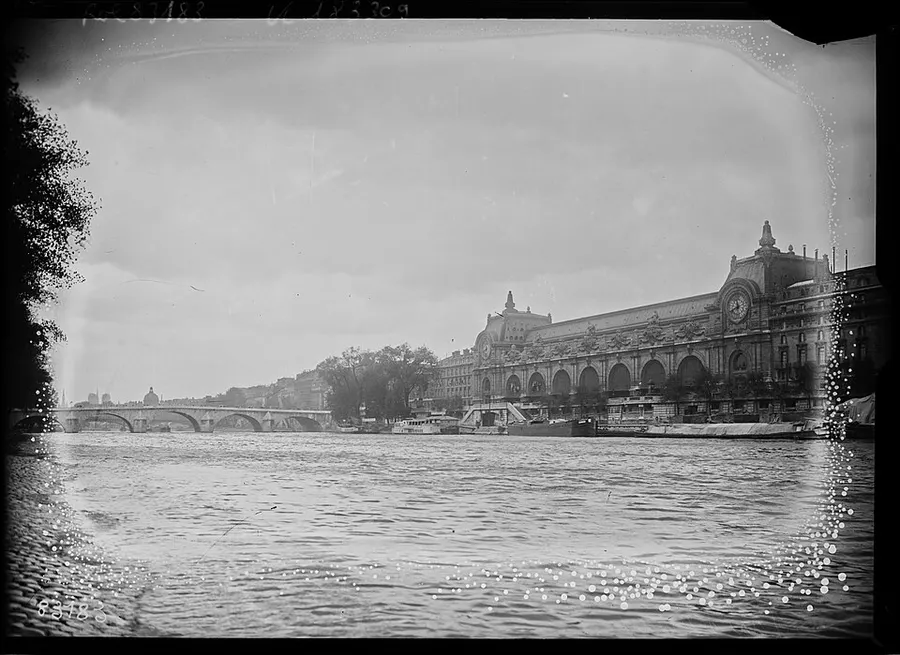
In 1897 the Orléans railway company secured a burning-hot parcel: the Left Bank of the Seine, directly opposite the Louvre — the most fastidious address in Paris. The city’s conditions were severe: no naked iron of the Eiffel type; the building must be worthy of the palace across the water. The architect Victor Laloux answered with two skins: inside, the most advanced steel train-shed of its day (more steel than the Eiffel Tower) serving electrified tracks — steam smoke being unfit for the city center, this was among Paris’s first electrified main-line termini; outside, a limestone facade with colossal clocks and statuary, impersonating a palace of fine arts. It opened on 14 July 1900, just ahead of the World’s Fair crowds. The painter Édouard Detaille left the famous quip: the station is so beautiful it might as well be the palace of arts — let the trains have the palace, and give this to art. Eighty-six years later the joke came true to the letter.
Its career as a station lasted thirty-nine years, and it died of its own modernity: platforms sized for the trains of 1900 proved too short as electrified consists lengthened through the 1930s — main-line service ceased in 1939, leaving only suburban runs. For nearly half a century the great shell then drifted through central Paris: a wartime parcel center for prisoners, a reception point for returning deportees at the Liberation; Orson Welles shot The Trial inside it; a theater company rehearsed in the waiting rooms; an auction house used it for storage. A building erected for speed, made obsolete by speed, then demoted to the city’s attic — the prologue of its journey, and very nearly its epilogue.
Sources: Archives of Victor Laloux's architectural design (1898–1900) · Operating records of the Chemin de fer d'Orléans · The remark by Édouard Detaille (given as a contemporary account)
- 🧭 Journey
Journey · From the Demolition List to the House of Impressionism
From the last layerBecause it had been wrapped to look like a palace of arts, eighty years later the city could imagine making it one — the disguise turned out to be a prophecy.
The demolition permit was granted in 1970 — but Paris, sick with regret after razing Les Halles, made this station the first act of penance.
In 1970 the permit to demolish the Gare d’Orsay was duly signed, with a grand hotel among the schemes for the site — just as Paris finished tearing down Les Halles, the "belly of Paris," and drowned in public remorse. The wind reversed: by 1973 the new preservationist mood prevailed and the station entered the register of historic monuments; in 1977 the government under Pompidou’s successors resolved to make it a museum of art from 1848 to 1914 — precisely the gap between the Louvre (the classical) and the Centre Pompidou (the modern). The periodization was itself a masterstroke: France laid its three museums out as a single timeline, and Orsay took the chapter in which modernity was born.
The 1980s conversion, its interiors by the Italian architect Gae Aulenti, refused to pretend the station away: the great vault, the coffered ceiling and the giant clocks were all exposed, with stone galleries built into the train hall — sculpture on the "platforms," paintings in the "waiting rooms." President Mitterrand opened it in December 1986. The core collection arrived by migration: the entire Impressionist holdings of the Jeu de Paume, joined by academic, Realist and Symbolist works gathered from the Louvre and beyond — Manet, Monet, Renoir, Degas, Van Gogh and Cézanne moving into a railway station together.
The most delicious layer: the building and its collection are contemporaries. The Impressionists painted exactly this Paris of steam and steel — Monet’s Gare Saint-Lazare series (own page on this site) dates from 1877, the same technological age as Orsay’s iron ribs. A station now houses the paintings of stations: building and collection exhibiting each other, unique among the museums of the world.
Connects to🌅MonetArt HistoryPainter of the contemporary station — his Saint-Lazare series hangs inside this oneSources: The 1970 demolition permit and the 1973 heritage-listing records · Gae Aulenti's conversion design (1980–86) · Records of the 1986 museum opening
- 📍 Today
Today · Read the Building Before the Paintings
From the last layerThe conversion deliberately kept the station’s skeleton — reading the building is not nostalgia but the first lesson the curators wrote into the route.
Don’t bolt for the Impressionists: stand two minutes in the nave, find the platforms, the clocks, the vault — every painting after gains a layer.
Visitor dynamics first: nearly everyone charges to the top-floor Impressionist gallery, treating the nave as a corridor. Reverse it. Plant yourself on the central axis: beneath your feet ran the tracks; the raised stone terraces flanking you are the platforms; under the coffered vault above once hung steam and whistle-blast — this hall is the museum’s largest exhibit of the year 1900. Then find the two golden clocks: one at the head of the train hall, one on the river facade. Behind the upper river clock is the famous viewpoint — through the great translucent dial you look over the Seine toward Montmartre, standing exactly where travelers once checked the hour: the same clock face, exchanged from the anxiety of catching a train to the leisure of a view. That one glance compresses the building’s eighty-year reversal of fortune.
Carry three cross-references upstairs. ① Monet’s Gare Saint-Lazare (own page): the iron and steam in the canvas are this building’s twin — a station’s painting seen inside a station, the loop closed. ② Degas’ Little Dancer (own page): a fourteen-year-old ballet student of exactly the era that rode such trains into town. ③ Van Gogh’s self-portrait (own page): the whirling brush of 1889 stands only eleven years from the steel vault of 1900 — under one roof you watch modernity detonate on the two fronts of painting and engineering at once.
And the grand view across this site: the Louvre (a classical palace) → Orsay (an industrial-age station) — of all our venues, only here are building and collection the same age. Versailles tells absolutism through a hall of mirrors; the Vatican tells faith and Renaissance through a chapel; Orsay tells how modernity arrived — and how it was nearly demolished and saved — through a railway station. Read the four venues together and you hold Europe’s complete set-change record: from throne, to altar, to machine.
Sources: Musée d'Orsay visitor-route notes · Information on the great clock viewpoint