← The Louvre🗿 c. 150–125 BC🌐 中文
Venus de Milo
A goddess a farmer dug out of his field in 1820 — the missing arms were never found, and the not-finding is what made her an icon.
Where it livesSully Wing · Level 0, Greek sculpture galleries · Greek Antiquities — follow museum signage
- ✨ Origin
Origin · An Aphrodite of the Hellenistic Age
Conventionally identified as Aphrodite — made a century after the Classical peak, in a more theatrical, more worldly Greece.
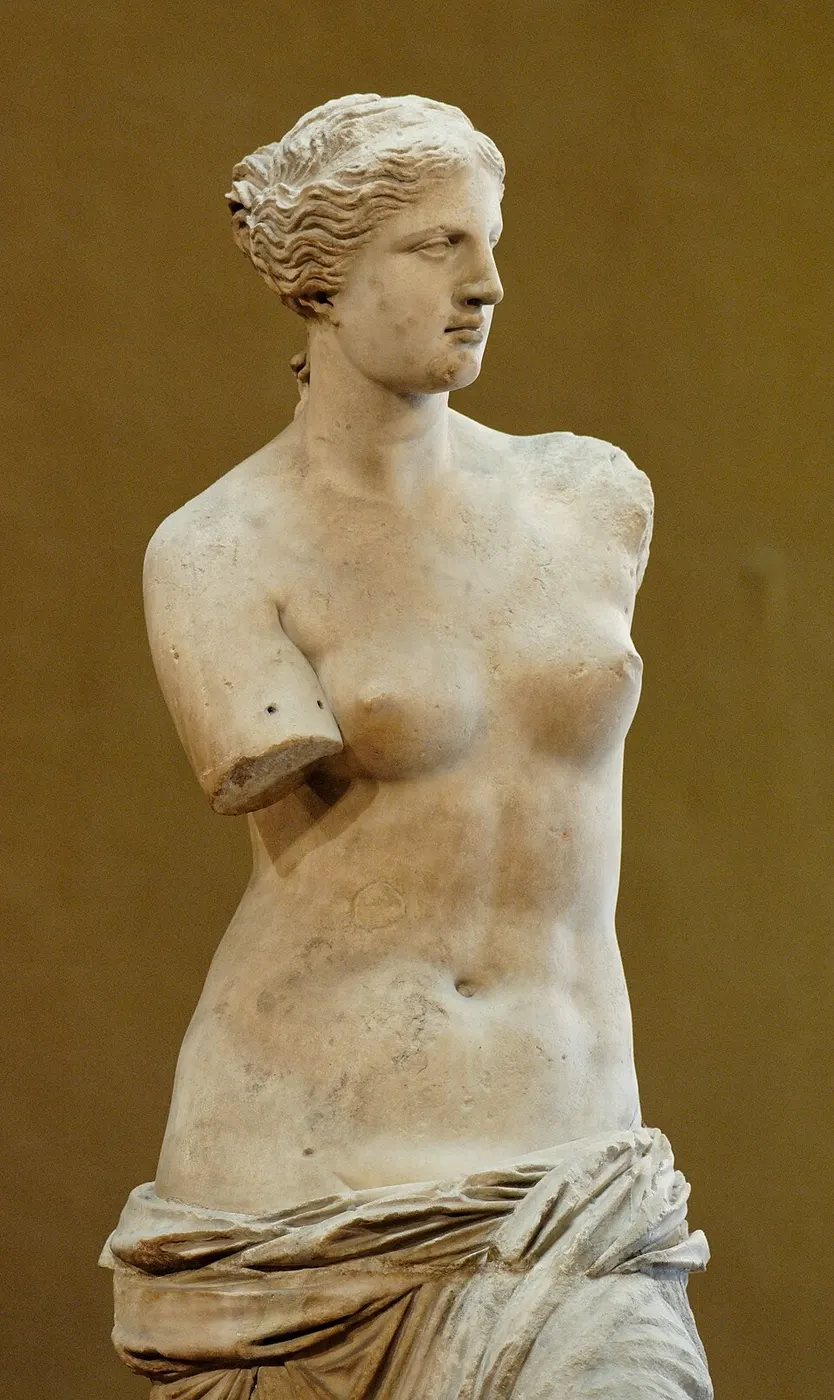
She was carved two centuries after the golden age of the city-states. Alexander’s conquests had carried Greek art to Egypt and Mesopotamia — and brought the gods down from their pedestals. Hellenistic sculpture no longer sought the restrained stillness of the Classical peak; it embraced torsion, drapery, drama. Read her pose: torso twisting left, hip thrust right, weight on the right leg — a spiral running crown to toe, the extreme case of what art history calls the S-curve. The robe slipping at her hips is caught at the instant of almost-falling, marble carved into the weight of cloth. That trick of suspense is the Hellenistic signature.
Technically she is two blocks of Parian marble, the join hidden along the drapery line at the hips — standard practice for cost and transport. Nor was she always this austere white: her earlobes are pierced, dowel holes at arm and wrist once anchored metal jewelry, and traces of pigment survive. Two millennia ago she wore bracelets and earrings and painted color, standing in a niche of temple or gymnasium. Today’s "pure classical whiteness" is half the bleaching of time, half a nineteenth-century fantasy.
Who made her? A broken statue base found nearby at the excavation bore the inscription "…[Alex]andros son of Menides, of Antioch… made this," recorded in a contemporary drawing — and then the base vanished. One widely told account holds that a base naming an obscure Hellenistic craftsman was inconvenient for those who preferred attributing her to the Classical masters, the line of Praxiteles; whether the base truly belonged to this statue, and whether its loss was accident or intent, remains debated — both versions are laid out here. What she held is equally unresolved: the golden apple of the Judgment of Paris (the very apple that started the Trojan War), a mirror, a spindle — all argued, none proven.
Sources: Louvre Department of Greek Antiquities, catalogue notes · Records of the 1820 discovery and sketches of the inscribed base (the base is lost and its attribution disputed, noted as such)
- 🧭 Journey
Journey · A National Replacement
From the last layerUnearthed broken and nameless, she could be given a whole new identity — "our Venus" — with nothing to contradict it.
After Napoleon fell France had to return the looted Medici Venus — a year later this one surfaced on Melos, and France moved fast.
In April 1820, on Ottoman-ruled Melos, a farmer named Yorgos Kentrotas was quarrying stones at the edge of his field when he broke into an ancient niche holding a marble goddess in two halves. By luck, a French naval ensign, Olivier Voutier, was amateur-excavating on the island that day; he witnessed the find, sketched it on the spot and alerted his superiors. Word climbed to the French ambassador in Constantinople, the marquis de Rivière — then came months of haggling, rival bidders and a race to the harbor. The most famous version has the French brawling with competitors on the beach, the arms snapping off in the scuffle and sinking — a cinematic tale now essentially debunked: the earliest records show she was armless when found. Legend outruns archive; half her fame was fed by legend.
Timing mattered more. Five years earlier, after Waterloo, France had been forced to return the treasures Napoleon looted from Italy — including the most celebrated ancient statue in Europe, the Medici Venus. The Louvre’s antiquities galleries had lost their heart overnight. Now the Aegean offered an unclaimed Venus: Rivière bought her, presented her to Louis XVIII in 1821, and the king passed her to the Louvre. French scholars and press then ran a half-century canonization campaign, promoting her as older and purer than the Medici — a genuine Greek original (the Medici is a Roman copy), though the "Classical masterpiece" label was marketing: she is Hellenistic, which is precisely what made the vanished base so inconvenient.
She has scarcely left the museum since. Her one great voyage was to Tokyo and Kyoto in 1964 — France deploying her as cultural diplomacy of state-gift rank, exactly as the Mona Lisa had gone to America in 1963. A statue acquired in the nineteenth century to fill a hole in national prestige became, in the twentieth, the prestige itself.
Connects to🎖️NapoleonEuropean HistoryWhose lootings and their forced return left the vacancy she filledSources: Archives of the 1820 discovery on Melos and its acquisition · On-site sketches by Olivier Voutier · Critical review of the "beach tug-of-war" legend about the missing arms (disproven, noted as such)
- 📍 Today
Today · Walk Around Her, Don’t Face Her
From the last layerThe national story needed a perfect Venus — and the forever-missing arms let every age attach its own imagination.
She was made to be circled: the best view is from behind her shoulder — then go find the little holes.
The front is always crowded, but the spiral only resolves in the round: from forty-five degrees behind her right shoulder, the torsion of the torso, the turn of the head and the hanging weight of the almost-falling drapery finally connect into one line. She stands on the axis at the end of a long gallery — the curators are inviting you to approach through space. Take the walk.
Then hunt the details. Earlobes: pierced for metal earrings. Right upper arm and left wrist: dowel holes for bracelets or armlets. Deep in the hair-knot and drapery folds: faint pigment traces in the right light. The left foot: entirely a nineteenth-century plaster restoration, subtly off in color and grain. The dowel sockets at the shoulder breaks show the arms were carved separately and attached — one more reason the "snapped off in the beach brawl" tale fails: attached arms are the first parts to come loose and scatter. The nineteenth century produced endless restoration proposals — apple, shield, mirror, spindle — and a plaster-armed model was actually exhibited in Paris to public indifference. People had already fallen in love with the loss itself.
Leave with one question: if the arms were dug up on Melos tomorrow, would she be greater — or merely ordinary? The missing arms let every age attach its own imagination: the secret she shares with the Mona Lisa’s smile. Blankness reads as divinity. And a practical tip: the Sphinx of Tanis waits a few minutes away toward the Egyptian galleries in this same wing — goddess to gatekeeper, one staircase apart.
Sources: Louvre display notes · Technical examination records of the statue (joins, drill holes, restorations)