← The Louvre🐈⬛ c. 26th–19th century BC (dating debated; reinscribed by later kings)🌐 中文
The Great Sphinx of Tanis
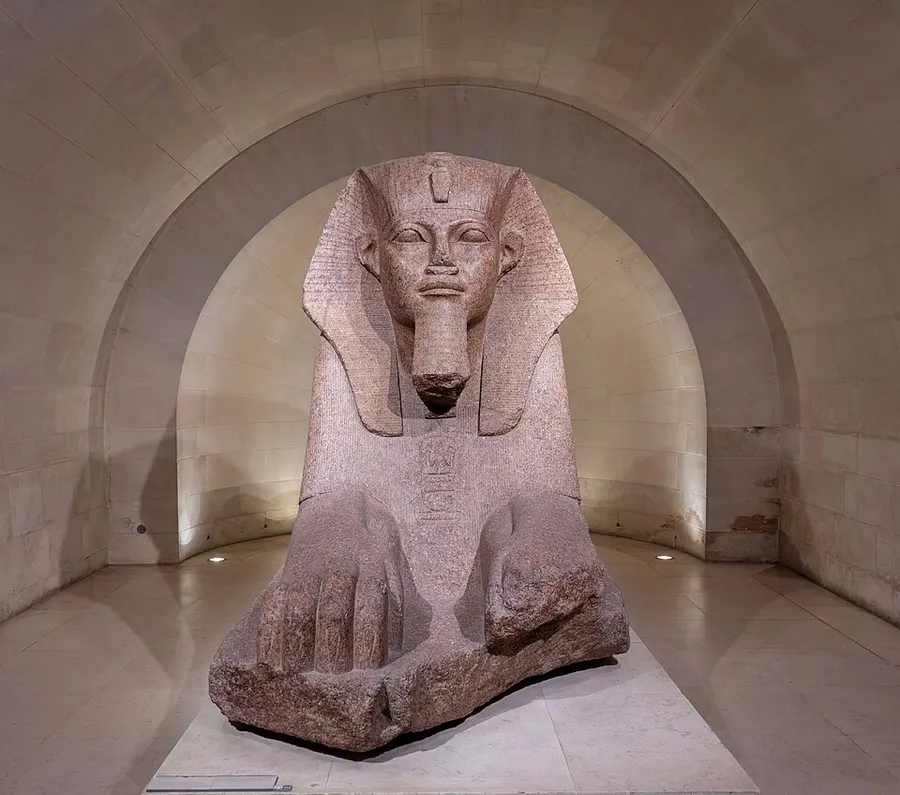
Gatekeeper of the Louvre’s Egypt: one block of rose granite bearing the names of several pharaohs — later kings ground off their predecessors’ cartouches and carved their own.
Where it livesSully Wing · Level 0, entrance to the Egyptian galleries · The crypt — follow museum signage
- ✨ Origin
Origin · A King’s Head on a Lion’s Body
The sphinx is the standard portrait of pharaonic power: human intellect steering leonine strength, crouched at a temple gate — a guardian, not a riddler.
First, unlearn what Greek myth taught you: the Egyptian sphinx asks no riddles. The riddling, murderous Sphinx is a Greek remix (Oedipus’s opponent — female, winged). In Egypt it is a shesep-ankh, a "living image": the pharaoh incarnate, a human head (intellect and rule) set on a lion’s body (sun and strength), crouched in pairs or avenues before temple gates as guardian of sacred ground. This one is nearly three meters long and over twenty tons, cut from a single block of Aswan rose granite — stone too hard for bronze tools, shaped by pounding with harder dolerite balls and then polished. The labor in this one piece gives you a bodily sense of what "Old Kingdom state mobilization" meant.
Which pharaoh it was first carved for remains debated: the Louvre leans toward the Twelfth Dynasty of the Middle Kingdom (c. 19th century BC, around Amenemhat II), while some scholars argue from the facial style for the Fourth Dynasty of the Old Kingdom (26th century BC). And the difficulty of dating is precisely its most interesting feature — it kept being taken over by later kings.
Look closely at the chest, shoulders and base: the oval frames (cartouches) hold the names of more than one pharaoh — legible ones include Ramesses II of the Nineteenth Dynasty, his son Merneptah, and Shoshenq of the Twenty-Second. In Egypt a monument was inheritable property: grind off the predecessor’s name, cut your own (Egyptologists call it usurpation) — saving the cost of a new colossus while announcing that eternity has changed owners. Several centuries of royal signatures overlie one another on this single body: the sphinx is a stone chronicle, repeatedly overwritten.
Sources: Louvre Department of Egyptian Antiquities, catalogue notes (dating disputed, noted as such) · Studies identifying the cartouches (Ramesses II / Merneptah / Shoshenq)
- 🧭 Journey
Journey · Before Paris, It Moved House Within Egypt
From the last layerFor a millennium pharaohs took turns claiming it; in the nineteenth century the claimant became museum-age Europe — different methods, kindred logic.
Tanis was not its birthplace — that city’s colossi were secondhand monuments, hauled wholesale from Ramesses’ abandoned capital.
The sphinx’s journey began before it ever left Egypt. Tanis, where it was found, lies in the northeastern Delta and served as capital of the Twenty-First and Twenty-Second Dynasties (from c. 1070 BC) — yet archaeologists slowly noticed something odd: the colossi, obelisks and columns of Tanis carry Ramesses II’s names, in stones and styles older than the city itself. The answer: the nearby Ramesside capital Pi-Ramesses had been abandoned when its branch of the Nile silted up, and the later dynasties treated the old city as a monument quarry, hauling its statuary wholesale to their new seat. This sphinx almost certainly took up its post secondhand — it had survived one dynastic relocation and reuse before any European laid eyes on it. Usurpation happened not only on cartouches but at the scale of entire cities.
Its departure from Egypt belongs to the Egyptomania of the 1820s: Napoleon’s 1798 expedition and its great illustrated survey lit the fire; Champollion’s 1822 decipherment of hieroglyphs poured fuel on it. European consuls in Egypt ran agents who excavated and bought antiquities in bulk for resale to royal collections and museums — an era that founded Egyptology and emptied countless Egyptian sites in the same motion; both halves belong on the record. This sphinx was documented at the Tanis ruins around 1825 and entered the Louvre in 1826 through those consular-collection channels.
That same year the Louvre created its Department of Egyptian Antiquities and made Champollion himself the first curator — a man who would not set foot in Egypt until 1828–29, having until then read the entire civilization from paper and stone. The sphinx’s arrival and the institutionalization of Egyptology are two faces of a single moment: Europe began to possess Egypt’s stones and to genuinely read them at the same time.
Sources: Studies on the relocation between Tanis and Pi-Ramesses · Louvre accession records of 1826 · Founding archives of the Egyptian Antiquities department (1826, with Champollion as its first curator)
- 📍 Today
Today · Read the Names Before You Enter Egypt
From the last layerThose layered names are exactly why it makes the perfect opening line to three millennia of Egypt.
Circle to the chest and shoulders and find the cartouches — several layers of royal names on one body: a pocket history of the pharaohs.
The curators placed it in the crypt of the Sully wing — the first great object you meet entering the Egyptian galleries, dim-lit, holding a room of its own. That staging is no accident: it guarded temple gates on the Nile for three thousand years and is doing the same job in Paris. Pause three seconds at the threshold to feel the design, then approach.
Three moves. First — no touching, but lean close to the granite’s polish: surfaces pounded out with stone balls four millennia ago are still smooth, and a phone light raked across the shoulder reveals the faintest tool marks. Second, hunt the cartouches on chest and shoulders: some cuts visibly overlie older grinding — usurpation’s crime scene, name layered upon name. Third, the face: the false beard, the nemes headcloth, the worn nose — noses are lost to weathering and centuries of damage, and no single legend about it deserves your belief.
Understand this one object and you hold the key to the whole department: upstairs, from the seated scribe to the mummy masks, one theme runs through — stone, names and images deployed against time. Three thousand years of Egypt are three thousand years of new kings writing themselves on old stone; and its present posting, guarding the Louvre beside the Seine, is simply the newest chapter of that same story. If you have strength left, the galleries upstairs still follow lines Champollion laid out — the man who read the stones and the stone itself, kept in one building: the Louvre’s most restrained and most affectionate piece of curation.
Sources: Louvre display notes