King of the Franks, Crowned "Emperor of the Romans"
Those Who Drew the Lines on the Map · Founders & Monarchs
The Frankish KingdomThe Carolingian DynastyReviving the Western Roman Imperial Title
Who they are
Charlemagne (c. 742–814) was King of the Franks who, through decades of campaigns, united much of present-day France, Germany, and northern Italy, building the largest political entity in Europe since the fall of the Western Roman Empire. On Christmas Day 800, Pope Leo III crowned him "Emperor of the Romans" in Rome, symbolizing the revival of the Western Roman imperial title after more than three centuries. He promoted reform of writing and education (the "Carolingian Renaissance"), and the unified Carolingian minuscule script became the direct source of later Latin print type. After his death the empire was divided among his grandsons, but the political imagination of the "Holy Roman Empire" endured for nearly a thousand years.
Primary sourcesEinhard, Life of CharlemagneThe Royal Frankish Annals
Key stories
The Christmas Coronation
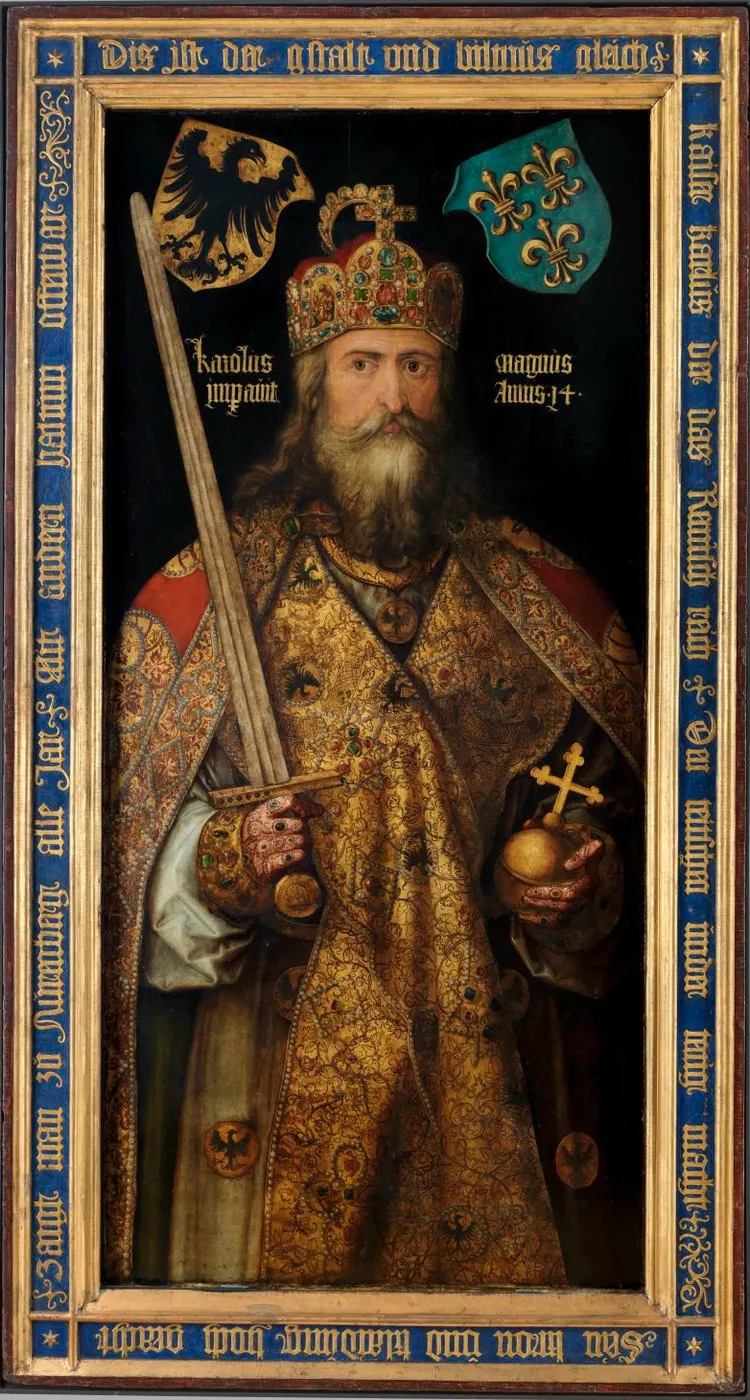
Charlemagne · Albrecht Dürer, c. 1512
On Christmas Day 800, as Charlemagne worshipped in St. Peter’s Basilica in Rome, Pope Leo III suddenly placed the crown on his head, and the crowd hailed him "Augustus." Whether the arrangement had been agreed with Charlemagne beforehand is itself disputed in the sources, but it marked the formal revival of the "Roman emperor" title in Western Europe and sowed the seeds of centuries of struggle between church and imperial power.
The Carolingian Renaissance
Though Charlemagne’s own reading and writing were limited (tradition holds he only tried to learn to write late in life), he vigorously promoted educational and cultural revival, bringing in the English scholar Alcuin to run the court school and introducing the unified "Carolingian minuscule" to replace the chaotic local hands before it — a script later imitated by Renaissance humanists and indirectly shaping the form of today’s Latin print type.
Version differences
Whether Charlemagne’s coronation was agreed in advance with the pope or was a unilateral political act by the pope is read differently by Einhard and by later historians, and whether Charlemagne himself was displeased by this "unexpected" coronation has long been debated among scholars.
Below are how modern works borrow or reinterpret this name or story — not the original material. The two differ, so keep them apart.
The "Charlemagne Prize"The "Charlemagne Prize," awarded each year by the important EU city of Aachen to those who have contributed to the cause of European unity, is named directly for him, symbolizing his historical image as a "pioneer of European unity."