Those Who Changed How Humanity Thinks · Masters & Thinkers
RelativityQuantum TheoryModern Physics
Who they are
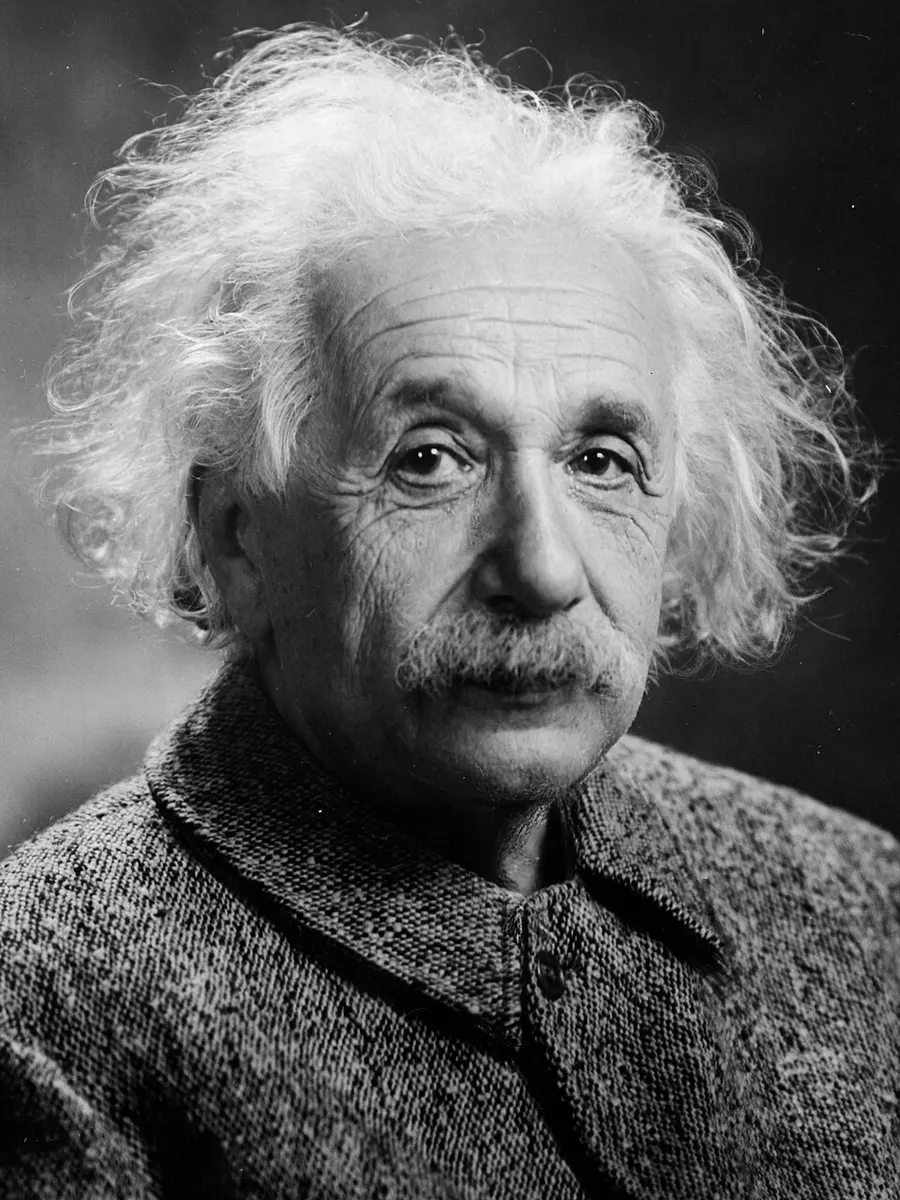
Albert Einstein (1879–1955) was born in Germany and was the most influential theoretical physicist of the 20th century, publishing in his "miracle year" of 1905 a run of epoch-making papers on special relativity, the photoelectric effect, and more, and in 1915 further proposing general relativity, reinterpreting gravity as a geometric effect of the curvature of spacetime and fundamentally revising and extending the bounds of Newtonian mechanics. He won the 1921 Nobel Prize in Physics for his explanation of the photoelectric effect. As a Jew, he moved to the US after the Nazis came to power and never returned to Germany, and in later years actively took part in public efforts against nuclear proliferation and for world peace.
Albert Einstein · photograph by Orren Jack Turner, 1947
In 1905, still only an ordinary clerk at the Swiss patent office, Einstein published in a single year four epoch-making papers, on the photoelectric effect, Brownian motion, special relativity, and mass-energy equivalence (the famous E=mc²); physicists came to call it his "miracle year," which utterly changed the course of modern physics.
An Eclipse Observation Confirms General Relativity
In 1919 the English astronomer Eddington led an expedition to Africa to observe a total solar eclipse, measuring that starlight passing near the sun did indeed bend by the angle Einstein’s general relativity predicted; the result stirred the whole scientific world and lifted Einstein from a figure known within physics to a world-famous public icon of science.
Below are how modern works borrow or reinterpret this name or story — not the original material. The two differ, so keep them apart.
"Einstein" as a byword for "genius"His name has become in many languages an everyday byword for "genius" and "supreme intelligence," and his signature tousled hair and tongue-out photograph are among the most recognizable images of a scientist in global popular culture.