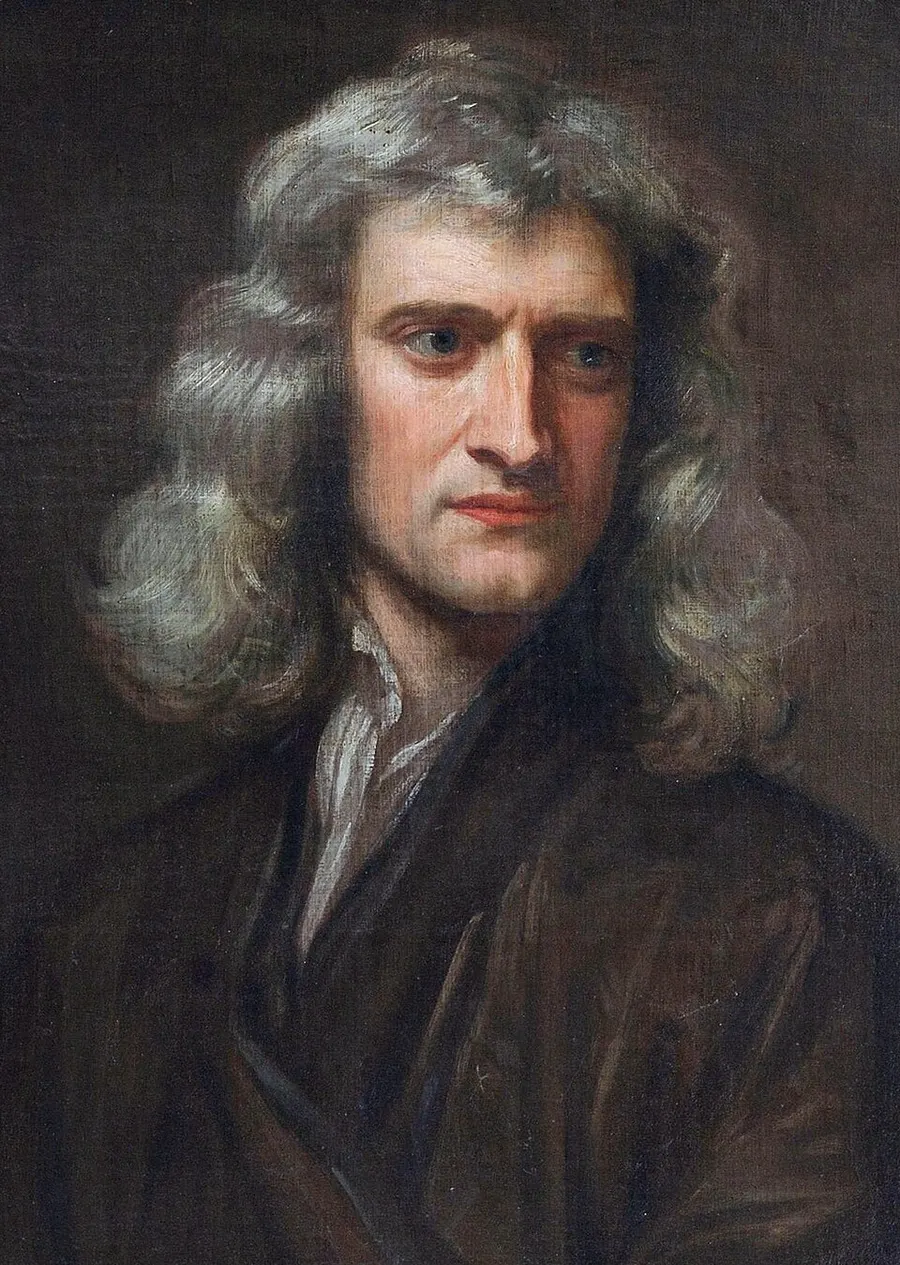
English Physicist and Mathematician, Founder of Classical Mechanics
Those Who Changed How Humanity Thinks · Masters & Thinkers
Universal GravitationClassical MechanicsCalculus
Who they are
Isaac Newton (1643–1727) was an English physicist and mathematician whose 1687 Mathematical Principles of Natural Philosophy systematically set out the three laws of motion and the law of universal gravitation, uniting the motion of the heavens and of objects on earth within one mathematical framework — the culmination of the Scientific Revolution, and for nearly two centuries the foundation of physics, until Einstein’s relativity in the 20th century revised the bounds of its validity. He and the German mathematician Leibniz independently invented calculus at almost the same time, and the two waged a long, bitter dispute over priority in their later years.
Primary sourcesNewton, Mathematical Principles of Natural PhilosophyArchives of the Royal Society
Key stories
The Apple and Gravitation (Legend and Fact)
Isaac Newton · Godfrey Kneller, 1689
The most widely told version is that Newton was struck by a falling apple under a tree and thereby grasped the law of universal gravitation — a story spread through Newton’s own recounting to friends late in life; though the details may be embellished, historians broadly hold that its core (an apple’s fall setting him thinking about gravity) has some basis in the sources.
The Calculus Dispute With Leibniz
Newton and the German mathematician Gottfried Leibniz developed the core methods of calculus independently at almost the same time, but a fierce dispute over "who invented it first" erupted and ran for decades, drawing in both camps and even the academic worlds of their respective nations — one of the most famous priority disputes in the history of science.
Version differences
The story of the "falling apple" spread through Newton’s own recounting late in life to his friend Stukeley, and its core has some basis in the sources, but the specific details (whether an apple really struck his head) are very likely a later artistic embellishment.
Below are how modern works borrow or reinterpret this name or story — not the original material. The two differ, so keep them apart.
"Newton’s apple tree"The apple tree thought to have "inspired Newton," on his family estate in Lincolnshire, England, still lives, and its grafted descendants have been transplanted to university campuses around the world in commemoration.