Scottish Philosopher, the Great Synthesizer of Empiricist Skepticism
Those Who Reanswered "How Should We Live" · Modern & Contemporary Thinkers
EmpiricismSkepticism About CausationThe Problem of Induction
Who they are
David Hume (1711–1776) was one of the most important philosophers of the Scottish Enlightenment, who pushed the empiricist tradition begun by Locke and Berkeley to a thoroughgoing skeptical extreme. He raised a strikingly subversive doubt about "causation," the most basic concept of human cognition: we never truly "perceive" a necessary logical connection between cause and effect; what we observe is only the "constant conjunction" of two kinds of events repeatedly succeeding each other in the past, and the inference that the future will be the same is but a "belief" the mind forms from habit, not a necessary truth reason can strictly prove — this "problem of induction" is still one of the core unresolved difficulties in the philosophy of science. Kant later admitted that it was precisely Hume’s skepticism about causation that "awoke me from my dogmatic slumber," directly prompting him to build his whole system of critical philosophy in response.
Primary sourcesHume, A Treatise of Human Nature, An Enquiry Concerning Human Understanding
Key stories
Causation Is Only "Habit"
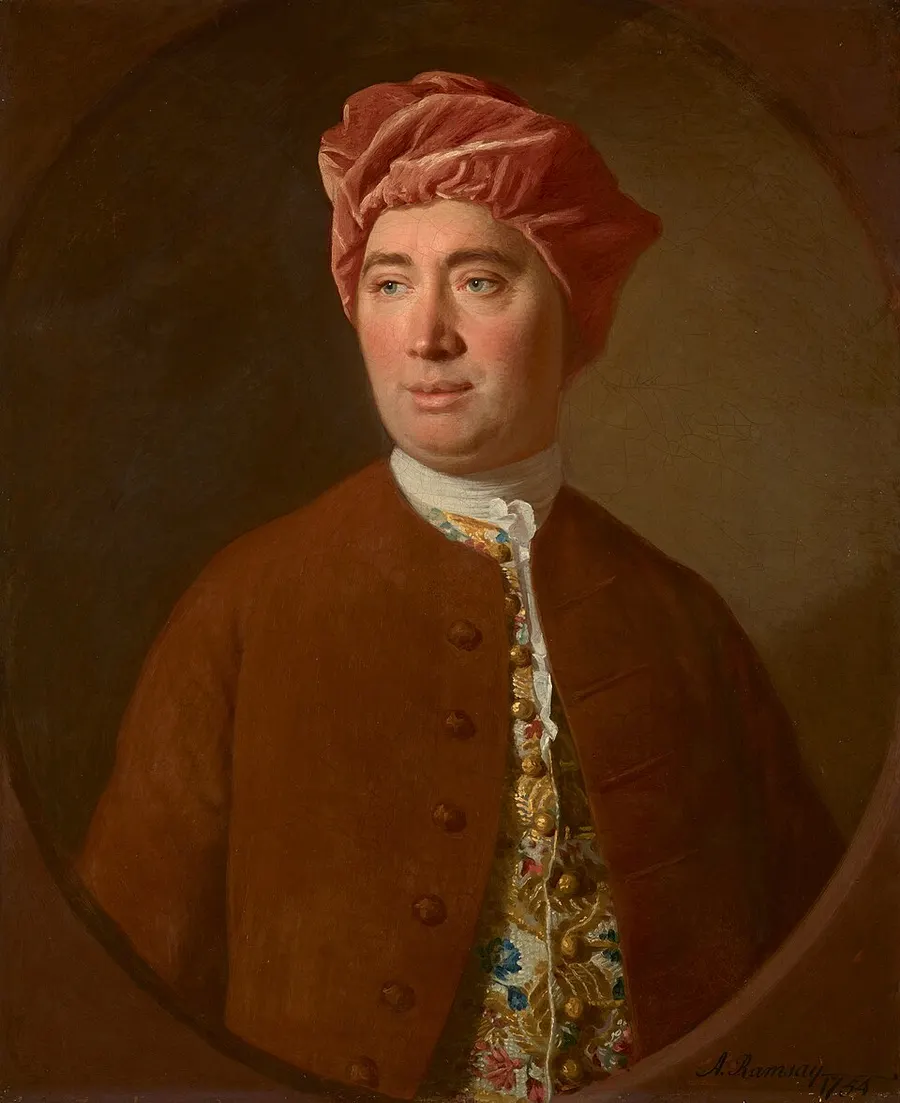
David Hume · Allan Ramsay, 1766
Hume argued that when we say "the sun warmed the stone," what we actually observe is only that the two events "sunshine" and "the stone becoming warm" repeatedly succeed each other in experience, and we never directly perceive any necessary, logically inviolable causal connection between them — so-called "causal necessity" is but a habitual psychological expectation the mind forms after repeatedly observing a constant conjunction, not an objective truth reason can strictly prove.
"Awoke Me From My Dogmatic Slumber"
In the Prolegomena to Any Future Metaphysics Kant admitted that it was precisely Hume’s skeptical doubt of the necessity of causation that "interrupted my dogmatic slumber," prompting him to reexamine the limits and possibility of rational cognition and at last build his whole system of critical philosophy centered on the question "how are synthetic a priori judgments possible" — Hume’s skepticism thereby indirectly giving rise to the most important founding work of German classical philosophy.
Below are how modern works borrow or reinterpret this name or story — not the original material. The two differ, so keep them apart.
The "problem of induction" (a term in philosophy of science)Still the classic starting point that cannot be got around in the philosophy of science when discussing "how a scientific theory can be reasonably justified."