← The Musée d’Orsay🌀 September 1889, Saint-Rémy🌐 中文
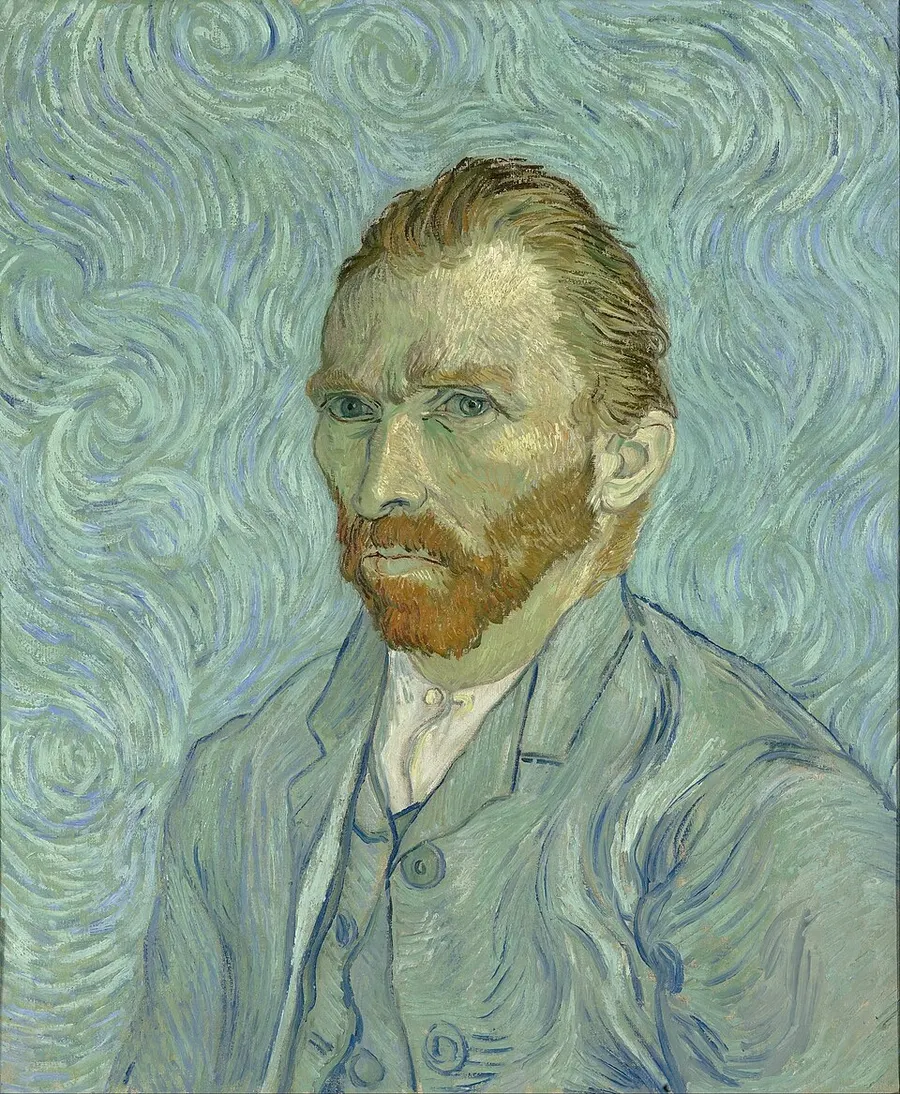
Van Gogh, Self-Portrait (1889)
Nine months after the ear, in the asylum, he painted this face from a mirror: the blue background still swirls, but the eyes hold steady like the storm’s center — unwanted in his lifetime, now the face of Orsay.
Where it livesThe Upper Impressionist Gallery · Level 5, Van Gogh galleries · The Van Gogh room — follow signage
- ✨ Origin
Origin · A Face at the Center of the Storm
In the Saint-Rémy asylum he was his own only reliable model — this canvas is conventionally counted among his last self-portraits.
Pin the timeline first: December 1888, Arles — the shared-house experiment with Gauguin collapses and Van Gogh cuts away part of his left ear; May 1889 — he commits himself voluntarily to the asylum of Saint-Paul-de-Mausole at Saint-Rémy. In early September of that year, just out of a weeks-long crisis, he writes to his brother Theo that he is at work on a self-portrait: people say — and I am willing to believe it — that it is hard to know yourself, but it is not easy to paint yourself either. The letter dates this canvas almost to the week. Scholarship conventionally counts it among his final self-portraits (whether any followed in the Auvers months is debated) — a face of thirty-six, with ten months of life remaining.
Read the canvas by its division of labor: background and coat share one system of pale-blue and grey-green whorls, coil upon coil, all but sweeping the figure away — the very language of the sky in The Starry Night, painted three months earlier in the same asylum. The face is another country: the strokes shorten and tighten, cheekbone and brow built like masonry, and above all the eyes — green, nailed in place. The painting is the live record of a standoff: chaos rotating at the perimeter, will encamped at the center. His own words to Theo confirm the reading: you will see, he wrote, that my face is much calmer than before, though the gaze may be more unsteady.
Two facts easily missed. First, the mirror: painting his reflection, the bandage-side appears on the right — in life it was the left ear; the reversed face is a reminder that every self-portrait is a conspiracy between painter and mirror. Second, the restraint: in the asylum his palette turned deliberately to grey-blues and earths — the tale that doctors rationed his colors circulates widely on thin evidence (recorded here as circulating), while his own letters give the credible version: he was teaching himself to say deeper things with plainer color.
Sources: Van Gogh's letters to Theo (September 1889) · Chronological studies of the Saint-Rémy period · Debate over the attribution of the "last self-portrait" (disputed, noted as such)
- 🧭 Journey
Journey · The Sister-in-Law’s Long March
From the last layerThe will encamped at the storm’s center in the canvas is exactly what Johanna carried on — he held the paintings together; she held him together.
Theo died within half a year of Vincent — and it was Theo’s widow Johanna who spent thirty years turning a houseful of unwanted canvases into world heritage.
The protagonist of this painting’s journey is not the painter but a woman art history long undervalued. In July 1890 Van Gogh died by his own hand at Auvers; within half a year Theo — who had bankrolled his brother’s entire career — collapsed and died. Left to Theo’s widow, Johanna Bonger, were an infant son and several hundred unsellable canvases; everyone around her advised disposal. The twenty-eight-year-old Dutchwoman did the opposite: she moved home, kept a boarding house with Van Goghs on its walls, taught herself the trade, systematically edited and published the nine-hundred-odd letters between Vincent and Theo — the letters through which the world learned to hear him — and mounted exhibition after exhibition from Amsterdam to Paris, building her brother-in-law’s name from zero by hand. Art history owes her a chair at the table; scholarship has only recently begun paying that debt.
This 1889 self-portrait descends through the Theo–Johanna line. It entered the French national collections in the earlier twentieth century by gift, hung with the Louvre’s modern pictures, and moved to Orsay in the great 1986 migration of the Impressionist and Post-Impressionist holdings — from asylum studio to the museum’s emblem, with Johanna’s thirty-year march in between.
The numbers state the absurdity of the curve best: by the standard account Van Gogh sold one confirmed painting in his lifetime — The Red Vineyard, for 400 francs (widely repeated; scattered other sales are debated, and both positions are noted here). In 1990 the Portrait of Dr Gachet fetched 82.5 million dollars, then the highest price ever paid for a picture. From 400 francs to 82.5 million in a century — not a curve of artistic value, but of how long the world takes to see. The lesson this site keeps repeating lands hardest on him: being seen was never the work’s own doing.
Sources: Biography of Johanna Bonger and the publication history of the letters · Records of the sale of The Red Vineyard (the commonly cited account, noted as such) · Records of the 1990 auction of the Portrait of Dr. Gachet
- 📍 Today
Today · Two Steps for the Whorls, One for the Eyes
From the last layerJohanna’s march turned a relic into an emblem — the gaze you can meet today was earned step by step across those thirty years.
Step back two meters to watch the background turn; lean in one step to watch the eyes hold — this painting is read with your feet.
The Van Gogh room is always full, but next to the Mona Lisa’s hall it counts as roomy — wait for a frontal spot; it’s worth it. Read by zooming: first retreat two meters and let the background whorls turn as a system — coat and ground nearly merge, the figure’s lower half dissolving into the storm; then one step in (mind the line) for the face alone: strokes short as chisel-cuts, and in the pupils two minute points of light, the quietest place on the canvas. In one step back and one step forward you have read the painting’s whole drama with your body: dissolution, and holding.
Then use the room for two comparisons. ① Starry Night over the Rhône or the neighboring Saint-Rémy canvases: the same whorls painting a sky read as romance — what do they read as beside a man’s own face? Carry the question back to the self-portrait. ② The Church at Auvers (June 1890, one month before the end): the same blue, the same writhing line, one of the last landscapes of his life — from the September self-portrait to the June church, nine months apart, you walk his final stretch between two frames.
Three onward threads. Art history: the Van Gogh figure page in our Art History universe holds the full life and web (Gauguin, Theo, those who shaped him and those he shaped); and don’t miss Olympia downstairs (own page) — Manet reviled alive and canonized dead, Van Gogh unseen alive and deified dead: two curves, one lesson. Architecture: on your way out, the great clock and vault (our Station page) — the whorls of 1889 and the steel of 1900 stand eleven years apart; modernity detonating on canvas and in engineering at once. And the human thread: if this painting reminds you of someone not yet seen — that is precisely why it hangs here.
Sources: Musée d'Orsay display notes · Chronology of the Saint-Rémy and Auvers periods