← The Louvre⚖️ c. 1754 BC🌐 中文
The Code of Hammurabi
The most complete early law code we have, carved on a black basalt stele over two meters tall — which was itself once carried off as war booty.
Where it livesRichelieu Wing · Level 0, Mesopotamia galleries · Near Eastern Antiquities — follow museum signage
- ✨ Origin
Origin · Two Hundred Eighty-Two Laws, Divinely Given
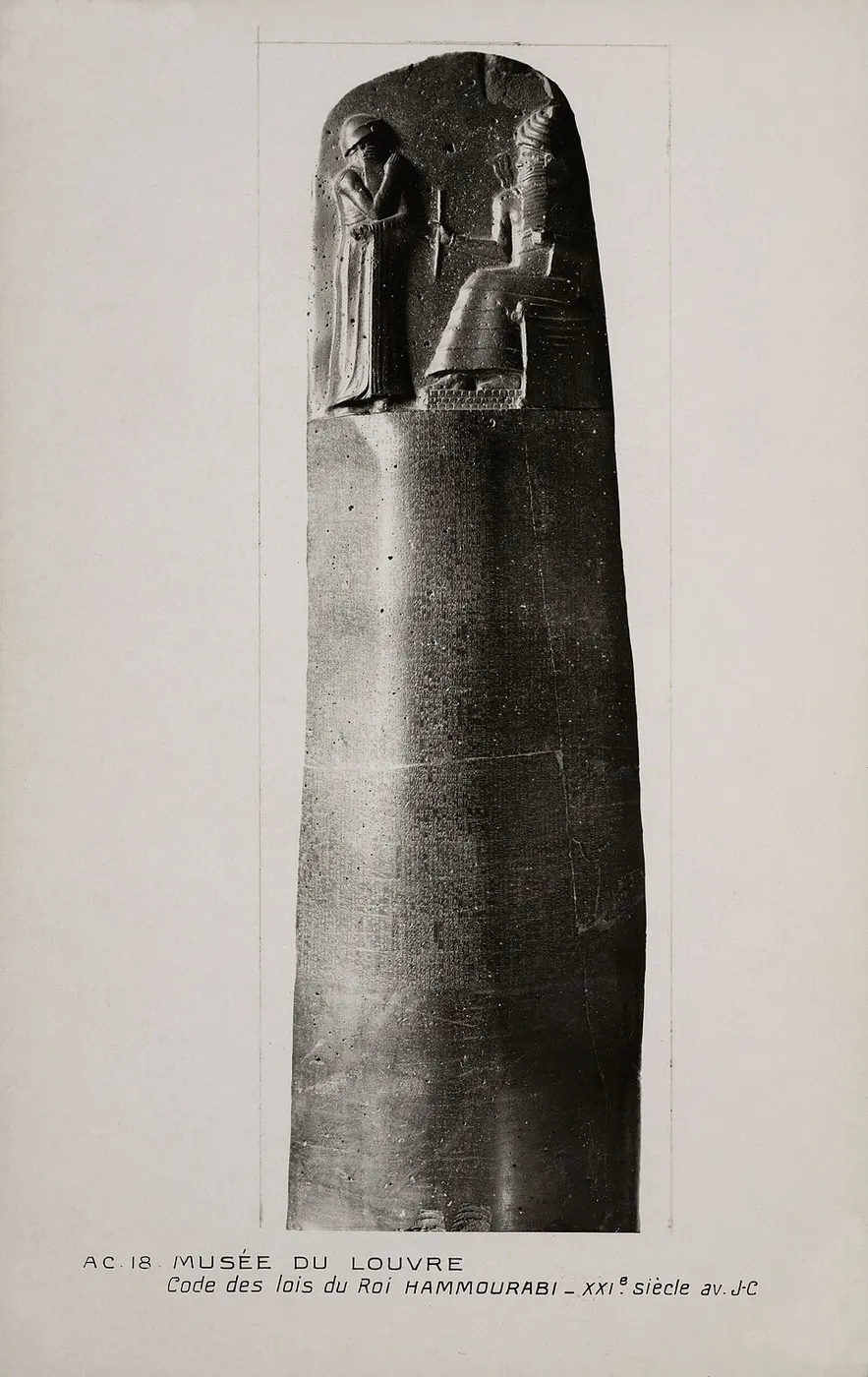
The relief at the crown shows the sun god Shamash handing Hammurabi the rod and ring — law’s authority from the gods, carved in stone for all to read.
Hammurabi reigned some forty-two years (c. 1792–1750 BC) — three patient decades of diplomacy and canal-digging, then a lightning final stretch that unified Mesopotamia and made Babylon the capital of the world. This 2.25-meter black basalt stele, erected late in his reign, is the empire’s closing statement. In the crown relief, Shamash — sun god and god of justice, flames rising from his shoulders — hands the standing king a ring and rod: surveyor’s tools, the measuring instruments of justice. The composition makes one claim: these laws are not the king’s whim but heaven’s commission.
Clear up the common misconception first: this is not humanity’s first law code. Ur-Nammu’s Sumerian code predates it by some three centuries. Its standing comes from completeness and maturity — prologue, roughly 282 rulings, epilogue — covering injury, tenancy, loan interest, dowries, adoption, medical malpractice and building collapse: a cross-section of Babylonian society. Every clause takes the same form: "šumma — if a man does X, then Y." That if-then casuistic structure is the ancestor of legal drafting to this day.
Read the penalties and you meet a society honest to the point of discomfort: three tiers — free men (awīlum), commoners (muškēnum), slaves (wardum) — and the same injury costs entirely different amounts depending on the victim’s tier. The famous "eye for an eye" applies only between equals; harming a social inferior is settled in silver. Public and predictable, yes; equal, no — the stone records the real order of its age, not an ideal one. And the epilogue states the stele’s purpose outright: let the wronged man come before it and "hear the words of the stone, and understand his case." For the first time, the law had a public address anyone could visit.
Connects to⚖️HammurabiPower & OrderThe lawgiver — where the written-law tradition begins in the Power universe⚖️HammurabiWorld CivilizationsThe same king, seen from the World Civilizations universeSources: The stele inscription (Akkadian cuneiform: prologue, laws, epilogue) · Louvre Department of Near Eastern Antiquities, catalogue notes
- 🧭 Journey
Journey · The Law Stone Becomes Plunder
From the last layerPrecisely because it embodied kingship and order, the conqueror had to take it — to seize the law stone was to declare the old order void.
Six centuries after its carving an Elamite king hauled it to Susa; three millennia later, French archaeologists dug it out there.
Around 1158 BC the Elamite king Shutruk-Nahhunte swept through Babylonia with a precise shopping list: not just treasure, but monuments. This stele — generally thought to have stood in Sippar, the sun god’s holy city — was carted off to the Elamite capital Susa (in today’s southwestern Iran) along with the Victory Stele of Naram-Sin and other sacred stones of Mesopotamia. The stone that spoke of justice left home as spoils: in the ancient Near East, to seize an enemy’s gods and monuments was to declare their order void. The king had several columns near the base ground smooth for a triumphal inscription of his own — which was never carved. Erasing another’s law is easy; writing your own legitimacy is hard.
It then lay three thousand years under the Susa acropolis. Between December 1901 and January 1902 the French mission under Jacques de Morgan unearthed it in three great pieces — working under the 1900 Franco-Persian convention that granted France ownership of its finds. That was the legal frame of the colonial age; Iran maintains a legitimate historical grievance, and this last leg of the stele’s journey belongs to the same story of power writing the rules. We record it plainly.
What followed in Paris was a scholarly miracle of speed: Father Jean-Vincent Scheil deciphered and translated the entire text within a year, publishing the French edition in 1902 — a stone from the eighteenth century BC speaking again twelve months after excavation. In the epilogue Hammurabi curses whoever effaces his name: may Shamash shatter his scepter. The Elamite eraser’s name is nearly forgotten; Hammurabi’s, thanks to that dig, rang around the world. The curse, it seems, worked.
Sources: Jacques de Morgan's excavation report from Susa (1901–02) · Father Jean-Vincent Scheil's 1902 translation · The 1900 Franco-Persian archaeological agreement (a colonial-era legal framework, noted as such)
- 📍 Today
Today · Crown, Base, and the If-Then
From the last layerThe plunder to Susa left that blank on the stone — the damage you see today is the journey’s own evidence.
Three things: the investiture relief, the ground-away columns, and the "if" that opens every law.
The Richelieu wing is the museum’s quietest, and you can circle the stele at arm’s length — an unimaginable luxury in front of the Mona Lisa. Start with the relief: the flames at Shamash’s shoulders mark him as the sun; the ring and rod he extends are land-surveying tools — in Mesopotamia the image of justice is measurement, not scales; Hammurabi’s hand raised to his lips is the standard gesture of audience before a god. Then crouch to the lower shaft: the conspicuously smooth blank is what the Elamite king ground away — the scar of its abduction, and the journey’s most physical evidence.
Then look at the writing: roughly four thousand lines of cuneiform in vertical bands, cut with near-typographic precision. You don’t need Akkadian — just know that every law opens with šumma, "if": if a surgeon’s operation kills a free man, his hand is cut off; if a builder’s house collapses and kills the owner, the builder dies; if it kills the owner’s son, the builder’s son dies. That last one should chill you — "equivalence" in that age could step over the culprit onto his child. Grasp those clauses and you have measured the distance between justice then and now — and felt the continuous line that runs between them.
Before leaving, glance around: the Mari statues and the human-headed Assyrian lamassu nearby come from the same river world. This stele is no isolated treasure but the spokesman of the civilization that first pressed itself into clay and stone — the Near East department has the museum’s thinnest crowds and its densest gold. Ten extra minutes here are never wasted.
Sources: Louvre display notes