← The Louvre🚩 1830🌐 中文
Liberty Leading the People
Nearly everyone assumes it depicts the Revolution of 1789 — it is the July Revolution of 1830, bought by the state a year later and then hidden for decades.
Where it livesDenon Wing · Level 1, French Romantic galleries · French large formats — follow museum signage
- ✨ Origin
Origin · Witness to Three Days of Barricades
In July 1830 three days of street fighting toppled Charles X; that autumn Delacroix began painting — "I may not have fought for my country, but at least I shall paint for her."
Nail down the date first, because nearly everyone gets it wrong: this is not the storming of the Bastille in 1789 but the "Three Glorious Days" of 27–29 July 1830, when the restored Bourbon king Charles X issued ordinances dissolving parliament and gagging the press, and Paris threw up barricades and threw him out within seventy-two hours. Delacroix, thirty-two, witnessed the fighting (he did not fight), wrote his brother the famous line that October, and finished the 2.6 × 3.25 m canvas in roughly three months, in time for the Salon of 1831.
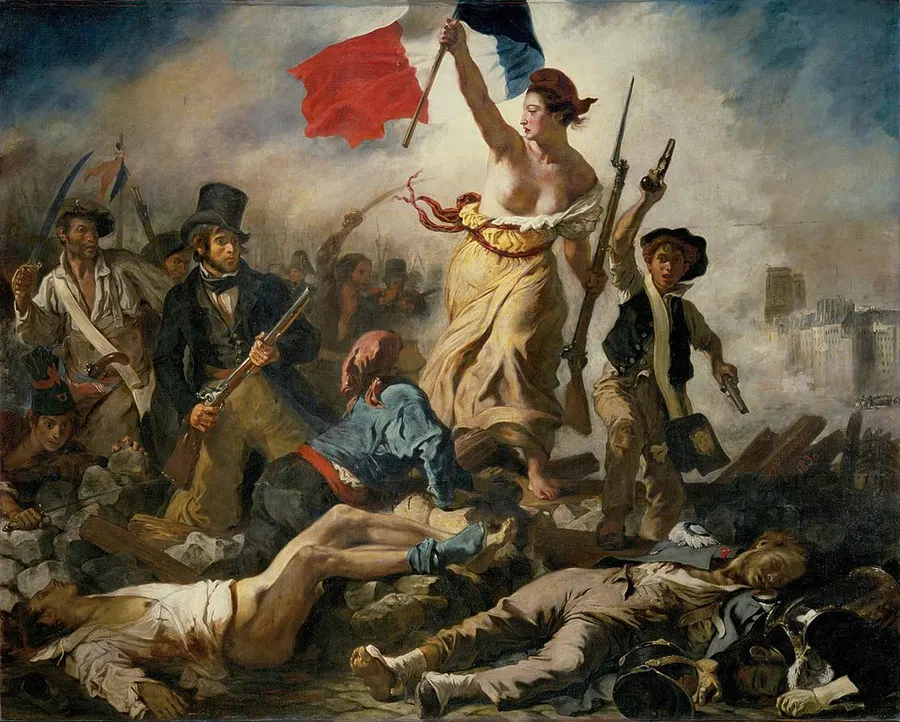
The picture’s central invention is a daring splice: Liberty herself is allegory — bare-breasted, profile like a classical relief, wearing the Phrygian cap (the liberty symbol descended from the felt cap of Rome’s freed slaves) — while the barricade she strides, the crowd around her and the corpses beneath are reportage. The boy brandishing two pistols at her right is often taken as the seed of Hugo’s Gavroche in Les Misérables three decades later (recorded here as "often taken"); the top-hatted young man with the hunting gun stands for the bourgeois citizen at the barricade — long rumored a self-portrait, now widely doubted. In the smoke at the right rise the towers of Notre-Dame flying the tricolor: the painting’s time-and-place stamp.
The two corpses in the foreground are the hardest part: on the left a stripped body, trousers gone — a detail drawn from documented atrocities of the street fighting; on the right a royal soldier. The ideal held highest, the price laid in the front row, and between them a crowd advancing over the dead — Delacroix put revolution’s full ledger on one canvas, neither prettified nor judged. Dropping a mythological figure into current events caused a stir at the 1831 Salon hardly quieter than the gunfire it painted.
Connects to🔥Eugène DelacroixArt HistoryThe painter — Romanticism turning this morning’s news into mythSources: Delacroix's letter to his brother (October 1830) · Records of the 1831 Salon · Louvre Department of Paintings, catalogue notes
- 🧭 Journey
Journey · Bought by the State, Hidden by the State
From the last layerIt made revolution too stirring — the regimes that owned it feared it most; buying it was a way of containing it.
The July Monarchy, born on the barricades, bought the barricade painting — then found it too dangerous and hid it for decades.
When the Salon closed in 1831 the new regime bought the painting for three thousand francs — the government of Louis-Philippe, the "Citizen King" enthroned by that very revolution. On paper, elegant PR: the new monarchy acquiring the picture of its own origin. But soon after it went up, Paris rose again in 1832 (the uprising of Les Misérables), and the government grasped the problem: a painting that makes barricades this stirring can always inspire the next one. It came down into storage, surfacing only in permissive intervals — brought out after the revolution of 1848, whisked away again once the June Days were crushed. The painting’s exhibition timetable is a cardiogram of nineteenth-century France’s love-fear of revolution. Only in 1874 did it enter the Louvre for good — forty-four years after it was painted, eleven after Delacroix’s death.
The twentieth century completed the flip from hazard to national emblem: the hundred-franc note of the 1980s carried it, stamps carried it, schoolbook covers carried it — the picture a government dared not hang became the Republic’s official image. In 2013, on loan to the Louvre-Lens, it was defaced with a marker by a visitor and cleaned the same day; in 2024 the Louvre gave it a full restoration, lifting eight layers of yellowed varnish — the tricolor snapped back to its original brilliance, and many discovered that the "brown old master" was painted in colors as fresh as a news photograph.
Its journey mirrors the Coronation exactly: one canvas commissioned by power and orphaned by power’s fall; the other painted unbidden, bought by power, then buried by it. The two now hang as neighbors in the same wing — provenance tells stories the paint cannot.
Sources: Records of the 1831 state acquisition (3,000 francs) · Louvre accession archives of 1874 · 2024 restoration report
- 📍 Today
Today · Recognize the Face You’ve Seen Before
From the last layerThe more the canvas was hidden, the deeper the figure sank into the Republic’s symbols — you can store a painting, not a personification.
You already see her everywhere: Marianne is France personified, from stamps and banknotes to town-hall busts.
After the 2024 restoration there has never been a better moment: stand back for the color first — the varnish-freed red and blue of the tricolor burn against the gunsmoke grays, the flag reading as the battlefield’s single light source; the composition is a pyramid, flag at the apex, corpses at the base — revolution’s structure in one glance.
Then approach and take four stations in order. ① Her profile and the Phrygian cap — this figure would be named Marianne and become the Republic’s official person: on the stamps, on the francs before the euro, in the bust that stands in every town hall in France. You have met her many times; this is the original. ② The boy with two pistols — revolution conscripts children too, and Delacroix does not look away. ③ The stripped corpse at lower left — idealism’s invoice, placed nearest the viewer. ④ The tiny tricolor on Notre-Dame’s tower in the smoke at right — the painting’s signature: time, place and allegiance in one fleck of red-white-blue.
Don’t leave yet; take two steps within the network. A few rooms ahead hangs Géricault’s Raft of the Medusa, the other summit of the same movement that painted current events as epic. In the other direction waits David’s Coronation — Neoclassical order against Romantic fire, power’s painting against the people’s. One corridor, one full duel of aesthetics and politics. That is what a museum lens is for: the Louvre is not a pile of exhibits but a web.
Sources: Louvre display notes · Documentation of the display after the 2024 restoration