← The Louvre👑 1806–1807🌐 中文
The Coronation of Napoleon
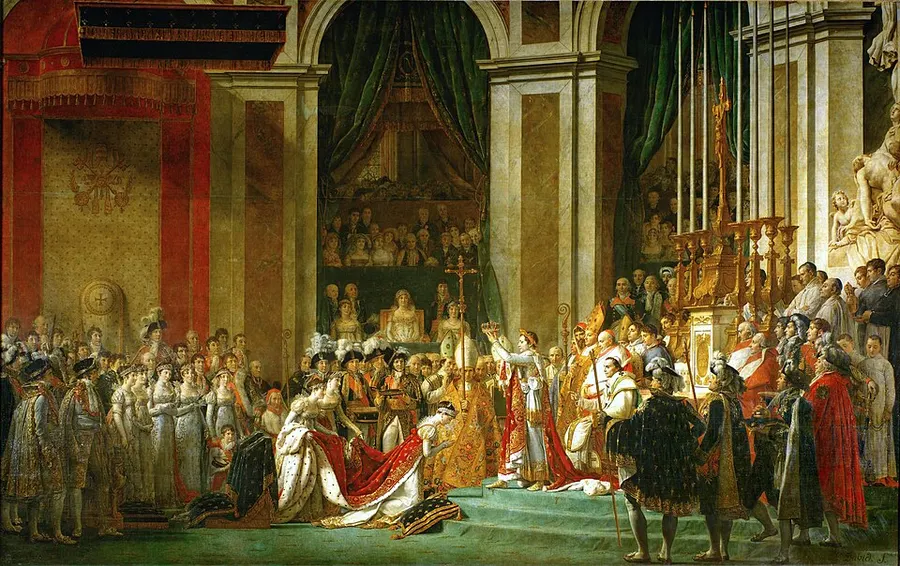
Nearly ten meters wide — and it does not show the pope crowning Napoleon: he has already crowned himself, and turns to crown his wife.
Where it livesDenon Wing · Level 1, French large-format galleries · The grand gallery near the Mona Lisa — follow museum signage
- ✨ Origin
Origin · A Meticulously Staged Enthronement
Notre-Dame, 2 December 1804: Napoleon summoned the pope to watch, then took the crown himself — and David was ordered to turn that instant into legitimacy itself.
First, grasp the audacity of the ceremony itself. Notre-Dame, 2 December 1804: a thirty-five-year-old general from minor Corsican nobility is to be crowned "Emperor of the French." He has brought Pope Pius VII from Rome — but where Charlemagne had bowed to receive his crown from a pope a thousand years earlier, Napoleon, at the climax, lifts the crown from the altar, turns, and places it on his own head; then he crowns the kneeling Joséphine. The pope watches, seated, throughout. All Europe read the gesture: my power comes not from the Church, not from blood, but from myself — though I need you all present to witness it.
The court painter Jacques-Louis David sat in the cathedral tribunes that day, sketchbook working. David’s own résumé was a history of the Revolution: painter of the Death of Marat, regicide who voted for Louis XVI’s execution — now in service to a new emperor. Commissioned to record the rite, he labored nearly three years (1805–07), had a scale model of the cathedral interior built, summoned the principals to pose one by one, and settled roughly a hundred and fifty identifiable portraits onto a canvas of 6.21 × 9.79 meters — which is why it doubles as documentary evidence: you can still pick out Talleyrand, Murat, Berthier.
But it is a photograph taken under orders. The chosen instant is Napoleon crowning Joséphine — translating the scandal of self-coronation into tenderness. The pope, by a widely repeated account, originally sat with hands on his knees until Napoleon remarked he had not brought him so far "to do nothing," whereupon David repainted the hand into a blessing (reported as anecdote). Madame Mère, enthroned in the center box, never attended — she was feuding with her son that day; the emperor required her presence in paint. Joséphine, forty-one, is relieved of her years; Napoleon quietly gains height. This is not a record. It is the ceremony held a second time, on canvas, in the emperor’s preferred cut.
Connects to🎖️NapoleonEuropean HistorySubject in the frame, client outside it — Europe universe👑NapoleonPower & OrderThe same man in the Power universe: a self-manufacturer of legitimacySources: Louvre Department of Paintings, catalogue notes · Archives of David's studio · The anecdote about the Pope's gesture given as "reportedly"
- 🧭 Journey
Journey · From Propaganda to Artifact
From the last layerA painting built for a regime shares the regime’s fate — the regime fell, the canvas became a relic, the painter an exile.
It stunned the 1808 Salon; when the empire fell the canvas passed to the state — and the painter died in exile in Brussels.
The painting went public at the Salon of 1808 and stunned Paris. Napoleon studied it at length and delivered the famous verdict: "This is not a painting — one walks in this picture." David received the Legion of Honour. For the next years it served as the centerpiece of the empire’s image machine — its first identity was, without qualification, political propaganda.
When the empire collapsed in 1815 the picture’s fate turned with its master’s. A regicide who had voted for the king’s death, David was banished by the restored Bourbons and died in Brussels, never permitted burial in France; in exile he repainted a nearly full-size replica from memory and sketches (now at Versailles — easiest tell: in the replica, Pauline Bonaparte’s gown is pink). The original passed to the state and shuttled for decades between storage and display — a colossal celebration of a usurper’s coronation had no comfortable wall under the restored monarchy — before settling permanently in the Louvre late in the nineteenth century.
The flip of identity is the real story of this journey: born as propaganda, displayed today as an artifact. And precisely because we know what was altered — the absent mother installed, the papal hand raised, the wrinkles erased — it has become primary evidence for how power writes its own account. A lie, once labeled, becomes a truth about lying. Which is this site’s recurring method: lay out the versions, and the painting testifies on its own.
Sources: Records of the 1808 Salon · Comparative material on the Versailles replica · Archives of David's exile
- 📍 Today
Today · Find What Shouldn’t Be There
From the last layerOnce you know the ceremony was directed, every alteration becomes the show — a labeled lie carries more information than a plain truth.
A treasure list: the self-crowned emperor, the repainted hand, the absent mother — and the painter hidden in his own picture.
First retreat to the far end of the gallery and read the composition. Light falls like a stage spot on Napoleon and Joséphine while pope and clergy sink into shadow — who is protagonist and who is scenery, the lighting has already said. Note what is on Napoleon’s head: a golden laurel wreath, the sign of Caesar and Roman legitimacy, not a Christian king’s crown — he chose Caesar, not Charlemagne, as his ancestor.
Then move close and work the list: ① Madame Mère enthroned dead center — absent that day; ② Pius VII’s right hand raised in blessing — by the famous account, originally resting on his knee; ③ among the red robes a step behind the emperor, the master opportunist Talleyrand; ④ in the tribune above, David painted himself and his family in — the one with the sketchbook is the painter, reserving a seat at the history he was manufacturing. And a detail outsiders miss: the two princesses bearing Joséphine’s train are Napoleon’s sisters, who nearly boycotted the ceremony over the indignity of carrying their sister-in-law’s train — in paint, they comply serenely.
Finish with an experiment: the Mona Lisa hangs a few steps away. In one suite of rooms, the museum’s most famous small picture and one of its most famous large ones — here, power hiring its preferred history; there, a painter keeping one human face for himself until death. Look at the hundred and fifty faces of the coronation, then go back to the one face. You will understand why, five centuries on, the queue is for her.
Sources: Louvre display notes · Studies identifying the figures in the painting