Those Who Drew the Lines on the Map · Founders & Monarchs
The Norman ConquestThe Kingdom of EnglandFeudalism
Who they are
William (c. 1028–1087) was Duke of Normandy in France who in 1066 led an army across the English Channel, defeated King Harold II of England at the Battle of Hastings, and was crowned King of England — the "Norman Conquest." It was the last successful foreign conquest in English history; thereafter Norman nobles replaced the old Anglo-Saxon aristocracy, French long served as the language of the English court and law, and it deeply shaped the many French-derived words of modern English. The Domesday Book he ordered compiled is among the earliest and most systematic nationwide surveys of land and property in medieval Europe.
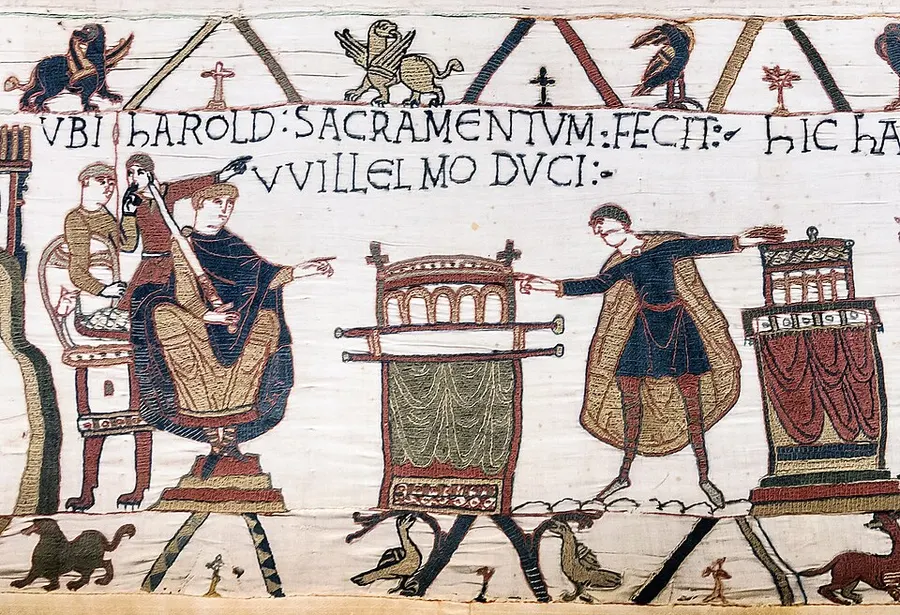
The Bayeux Tapestry: Harold’s oath to William · 11th century
On October 14, 1066, William’s army fought Harold II’s near Hastings. Tradition says Harold was killed by an arrow in the eye during the battle (the truth of this episode is still discussed by historians, based mainly on the imagery of the Bayeux Tapestry), the English line then broke, and William took the English throne.
The Domesday Book
To count the resources and tax base of his newly conquered lands, William ordered a detailed property survey across the whole realm in 1086, recording the ownership of every plot, animal, and person; for the thoroughness of its scrutiny, against which the people could not argue, it was called the "Domesday Book" — one of the most important firsthand sources for the social and economic history of medieval England.
Version differences
Whether Harold II really died of "an arrow in the eye" rests mainly on the imagery of the Bayeux Tapestry, but the tapestry’s pictorial details admit several readings, and modern scholarship keeps some reserve on this specific cause of death.
Below are how modern works borrow or reinterpret this name or story — not the original material. The two differ, so keep them apart.
French words in modern EnglishAfter the Norman Conquest French was long the language of the English court and law, and a great many modern English words to do with government, law, and food (such as government, justice, beef) trace to French loanwords of this period.