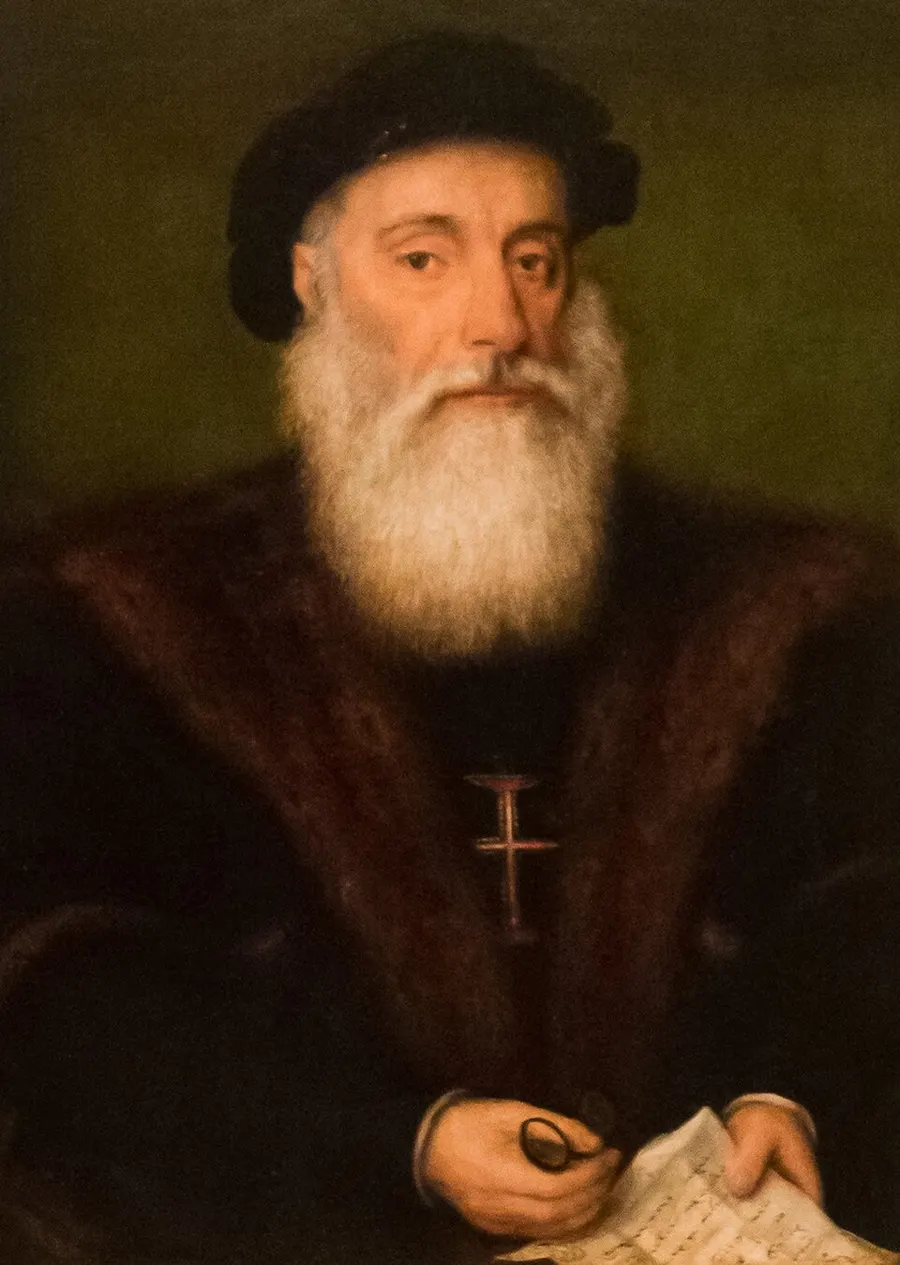
Navigator Who First Opened the Sea Route to India Around the Cape of Good Hope
One Story Remembered for Life · Small Roles, Famous Names
The Age of ExplorationThe Route to IndiaThe Portuguese Maritime Empire
Who they are
Vasco da Gama (c. 1460–1524) was a Portuguese navigator who from 1497 to 1499 led a fleet around the Cape of Good Hope at Africa’s southern tip and successfully opened a new route reaching India entirely by sea, breaking the earlier monopoly whereby Europe’s trade in Asian spices had to pass through Arab and Venetian middlemen. The opening of this route let Portugal, over the century that followed, build a vast maritime trading empire spanning Africa, India, and Southeast Asia, and marked Europe’s Age of Exploration entering a new phase centered on directly opening sea routes for the spice trade.
Primary sourcesDa Gama’s voyage logPortuguese royal navigation archives
Key stories
Around the Cape of Good Hope
Portrait said to be Vasco da Gama · MNAA, Lisbon
Da Gama’s fleet sailed south along the west coast of Africa, rounded the waters of the Cape of Good Hope, long thought fearsomely dangerous, and worked its way north up the east coast of Africa, guided by Arab pilots familiar with the monsoon patterns of the Indian Ocean, at last crossing the Indian Ocean to the port of Calicut on India’s southwest coast — completing the first European sea voyage direct to India.
The Breaking of the Spice-Trade Monopoly
The route to India that da Gama opened let Portuguese ships bypass the overland spice-trade network long passed hand to hand by Arab and Venetian merchants, loading pepper, cinnamon, and other spices directly in India for return to Europe, shattering at a stroke the spice-trade monopoly long held by the trading city-states of the eastern Mediterranean and lifting Lisbon into a rising trade hub of Europe.
Below are how modern works borrow or reinterpret this name or story — not the original material. The two differ, so keep them apart.
The Vasco da Gama BridgeThe Vasco da Gama Bridge in Lisbon, Portugal, is one of the longest bridges in Europe, named for him in commemoration of this Age of Exploration history.