Navigator Whose Fleet Completed the First Circumnavigation
One Story Remembered for Life · Small Roles, Famous Names
The Age of ExplorationCircumnavigationThe Route to the Spice Islands
Who they are
Ferdinand Magellan (c. 1480–1521) was a Portuguese navigator who, funded by the Spanish crown, led a fleet west across the Atlantic and around the strait at the southern tip of South America (later named the "Strait of Magellan") into the Pacific, seeking to open a new route to the Spice Islands. He himself died in a local tribal conflict in the Philippine islands, never living to see the voyage’s completion, but his surviving crew sailed on westward and at last returned to Spain in 1522, completing the first recorded circumnavigation in human history and proving by actual voyage that the earth is a sphere — a knowledge that until then had rested largely at the level of theory.
Primary sourcesAntonio Pigafetta’s voyage log (a surviving member of the fleet)
Key stories
The Discovery of the Strait of Magellan
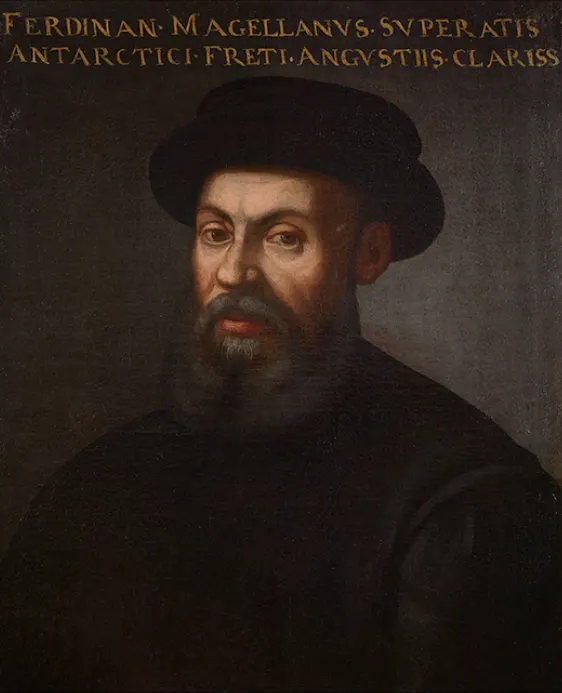
Ferdinand Magellan · anonymous, 16th century
As the fleet worked south along the coast of South America seeking a waterway to the Pacific, it searched for months through great hardship before at last finding a narrow, winding strait of treacherous currents, crossed it successfully into a relatively calm ocean that Magellan named the "Pacific," and the strait itself was later named the "Strait of Magellan" for him.
Death on Mactan Island
In 1521 Magellan became entangled in a conflict on Mactan Island in the Philippines between the local chief Lapulapu and another tribe, and, leading a small party rashly onto the island to fight, was outnumbered and killed on the spot. The fleet was thereafter commanded on by the crew, and at last, with only one ship and eighteen men left, returned to Spain in 1522, completing this nearly three-year circumnavigation.
Below are how modern works borrow or reinterpret this name or story — not the original material. The two differ, so keep them apart.
The Magellanic CloudsThe two dwarf galaxies visible in the Southern Hemisphere night sky, the "Large Magellanic Cloud" and "Small Magellanic Cloud," are named for him, commemorating his fleet’s recorded observations of the southern sky on the voyage.