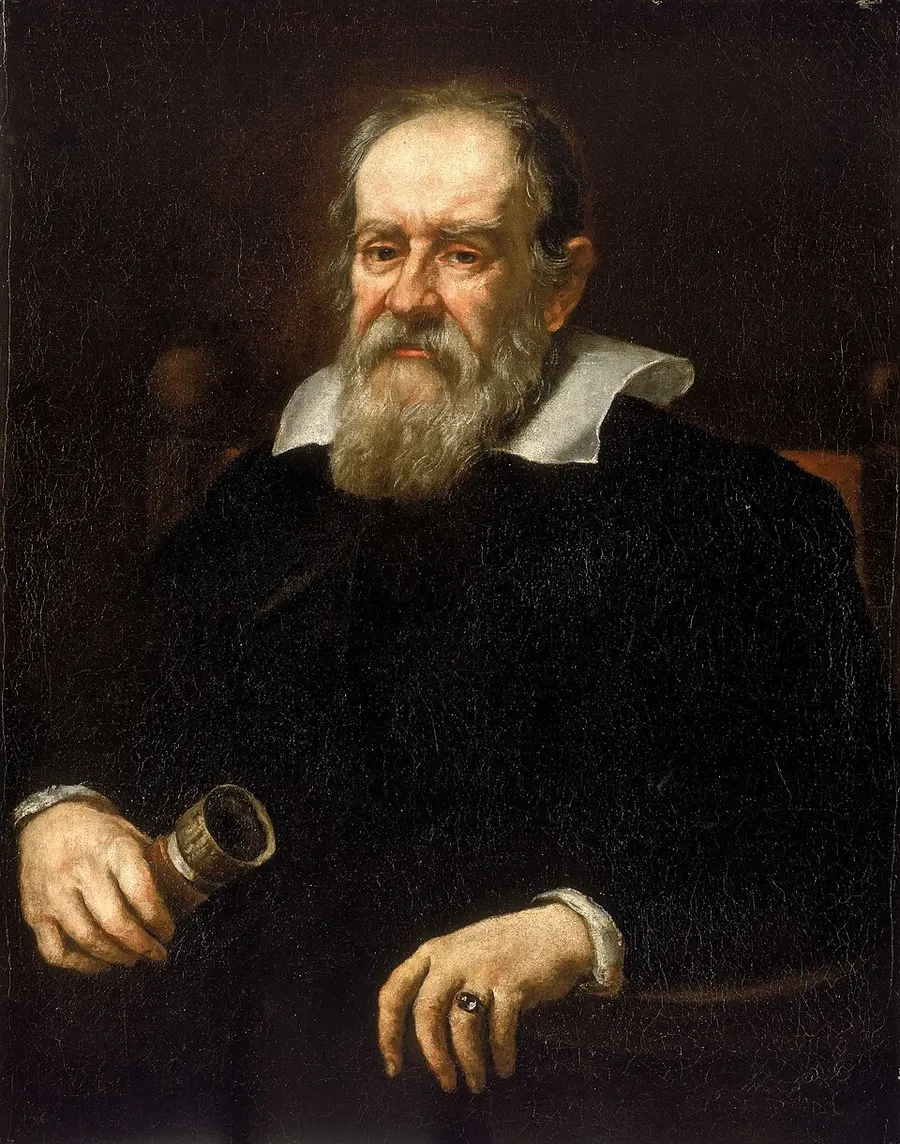
Italian Astronomer and Physicist, "Father of Modern Science"
Those Who Changed How Humanity Thinks · Masters & Thinkers
AstronomyHeliocentrismThe Scientific Revolution
Who they are
Galileo Galilei (1564–1642) was an Italian astronomer and physicist who improved the telescope and with it observed Jupiter’s moons, the craters on the Moon, and other previously unknown phenomena, strongly supporting the heliocentrism proposed by Copernicus. This stance conflicted with the geocentrism then officially supported by the Roman Catholic Church, and in 1633 he was tried by the Inquisition and forced to publicly recant heliocentrism, spending the rest of his life under house arrest (he is said to have muttered "and yet it moves" after his forced recantation, though historians broadly hold this a later embellishment). His laws of inertia and free fall in mechanics also paved the way for Newton’s later system of classical mechanics.
Primary sourcesGalileo, Dialogue Concerning the Two Chief World SystemsRecords of the Roman Inquisition trial
Key stories
A New Sky Through the Telescope
Galileo Galilei · Justus Sustermans, 1636
Galileo improved on the Dutch-invented telescope and turned it on the night sky, finding four moons orbiting Jupiter, the Moon’s surface covered with craters and mountains, and Venus showing a full cycle of phases — observations plainly at odds with the traditional geocentric picture of "all things orbiting a perfect Earth," and direct observational evidence for Copernican heliocentrism such as had never existed before.
The Trial by the Inquisition
In 1633 Galileo was summoned and tried by the Roman Inquisition for insisting on heliocentrism, and, facing harsh charges, the nearly seventy-year-old was forced to kneel and publicly swear to abandon the doctrine, then kept under house arrest until his death. This trial is one of the most famous historical cases of conflict between science and religious authority; the Catholic Church did not formally rehabilitate the case until 1992.
Version differences
The line "and yet it moves," often ascribed to Galileo’s muttering after his recantation, is broadly held by scholars to be a later literary embellishment appearing only after the eighteenth century, with no reliable contemporary source.
Below are how modern works borrow or reinterpret this name or story — not the original material. The two differ, so keep them apart.
The Vatican’s 1992 exonerationIn 1992 the Catholic Church formally acknowledged that the trial of Galileo had been in error, and this exoneration, nearly 360 years late, has itself become a landmark event in the history of the relationship between science and religion.