🏰HistoryEuropean History
🏠 Home🌐 中文
European HistoryEUROPA
🪐

Kepler

Original nameJohannes Kepler

German Astronomer, Proposer of the Three Laws of Planetary Motion

Those Who Changed How Humanity Thinks · Masters & Thinkers
The Laws of Planetary MotionAstronomyOptics

Who they are

Johannes Kepler (1571–1630) was a German astronomer who, working through the vast body of precise astronomical observations left by his late mentor Tycho Brahe, discovered that planetary orbits are in fact ellipses rather than the perfect circles previously assumed, and from this proposed the "three laws of planetary motion," making Copernican heliocentrism more precise and providing the key mathematical foundation for Newton’s later law of universal gravitation. He was also an important contributor to the optical theory of the telescope, and through a life of religious persecution, family misfortune, and financial want, he never ceased his search for the mathematical harmony of the cosmos.

Primary sourcesKepler, New AstronomyThe archive of Tycho Brahe’s observational data

Key stories

The Obsession From Circle to Ellipse
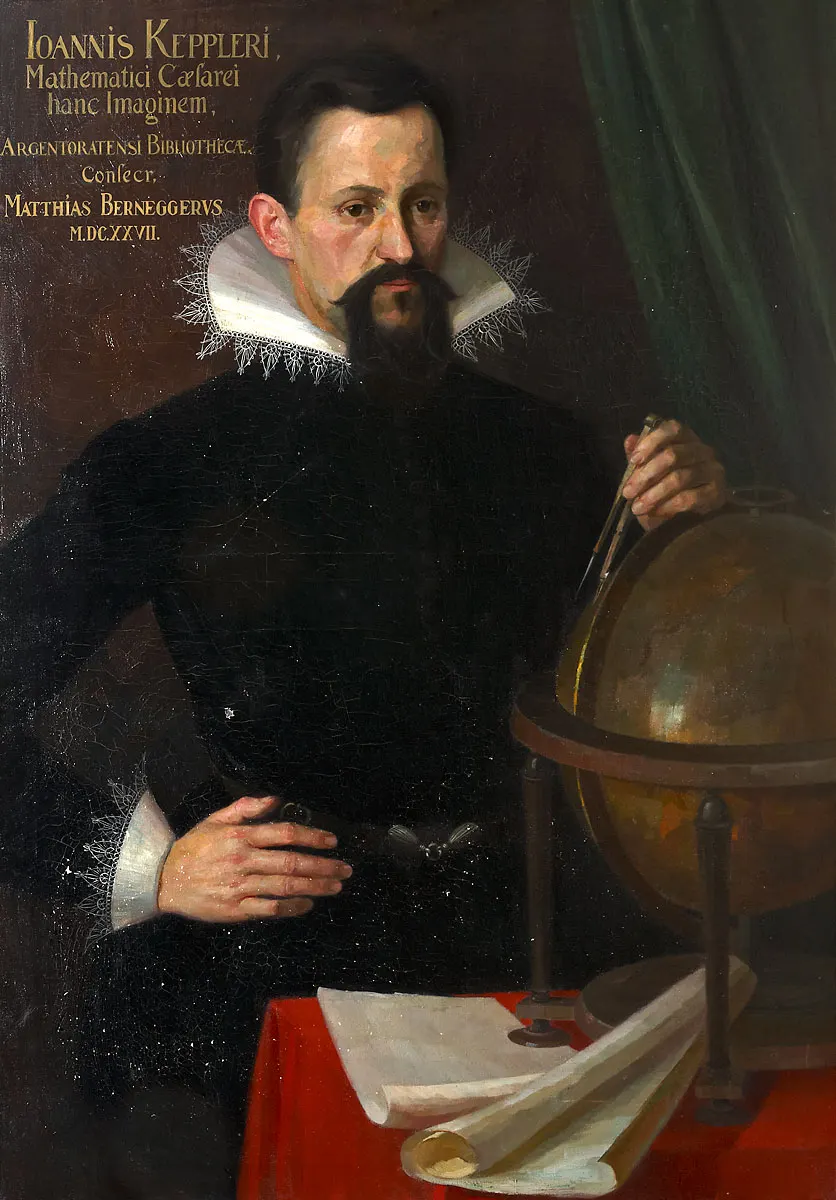
Johannes Kepler
Johannes Kepler · portrait, 1610

Kepler at first firmly believed planetary orbits must be "perfect" circles, but found that the observational data for Mars could never fit a circular model; after nearly a decade of repeated calculation, he boldly gave up the "obsession with circles" and proposed that planetary orbits are in fact ellipses — a discovery that broke astronomy’s near-religious devotion to the "perfect circle" since ancient Greece.

His Mother’s Witchcraft Trial

Late in life Kepler had to spend much energy defending his aged mother, accused of witchcraft and facing execution; he personally wrote the legal defense over several years and at last saved her from the ultimate penalty — an experience that reflects, from the side, the age’s fierce clash between scientific reason and the superstition of witchcraft in European society.

Relationships

Echoes today

Below are how modern works borrow or reinterpret this name or story — not the original material. The two differ, so keep them apart.

The Kepler space telescopeThe space telescope NASA launched in 2009 specifically to search for exoplanets was named for him, carrying on his scientific spirit of exploring "other worlds."

Appears in

Curiosity mailCurious about world civilization? Leave your email — we’ll tell you when there’s something worth a look.

Free · unsubscribe anytime · Privacy